Church of St Gregory, Sudbury: A Medieval Parish Church
Site at a Glance
- Popularity
- Medium
- Country
- United Kingdom
- Primary era
- Medieval
- Eras represented
- Medieval, Early Modern, Modern
- Civilizations
- British, English
- Site type
- Religious
- Remains
- Church
On this page15 sections
History
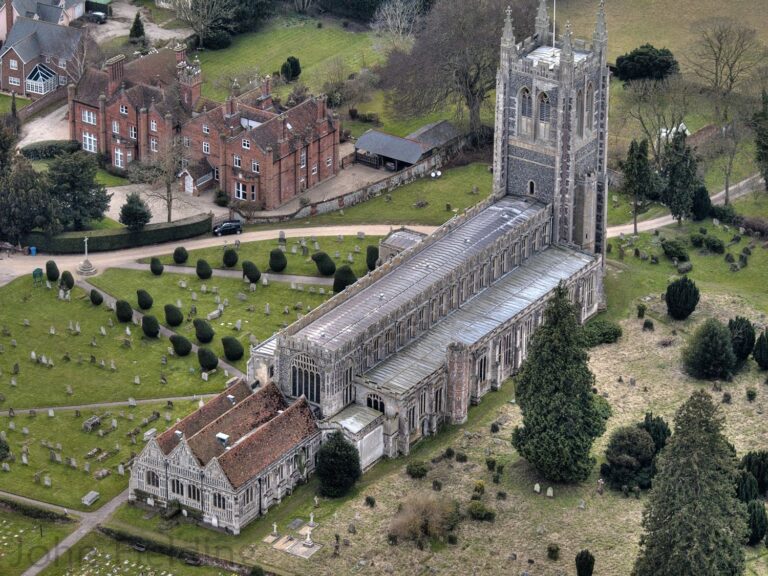
The Church of St Gregory, Sudbury, is an active Church of England parish in the United Kingdom, dedicated to Gregory the Great, pope from 590 to 604. Its origins predate 970, and most of the present building dates from the 14th and 15th centuries. It took shape in Perpendicular Gothic, a late medieval English style marked by strong vertical lines and large windows. The church belongs to the Diocese of St Edmundsbury and Ipswich and the Archdeaconry of Sudbury.
Early church and medieval building
Wills made in 970 and 993 name the church. Its existence in 797 is considered probable because Ælfhun, Bishop of Dunwich, died while visiting Sudbury. The Domesday Book, William the Conqueror’s survey of English land and resources, records the church in 1086 as holding 50 acres of land and 36 acres of meadow, according to the men of the Hundred.
The aisles are thought to have been rebuilt under Archbishop Simon Sudbury around 1370. An inscription once set in a window stated that he had built the chapel at the east end of the north aisle in 1365.
Simon Sudbury and the college
In 1374, Simon Sudbury and his brother John of Chertsy founded a college beside the church. It housed six secular canons, clergy who did not belong to a religious order, serving St Gregory’s and St Peter’s. St Peter’s was a chapel of ease, intended for worshippers who could not conveniently reach their main parish church. The college occupied three acres next to St Gregory’s churchyard, on a site believed to have been the home of the brothers’ father, Nigel Theobald.
Simon Sudbury was beheaded by rebels in 1381 during the Peasants’ Revolt, an English uprising in which opposition to taxation was a major issue. His association with the poll tax was a reason for his death. His mummified head was brought to St Gregory’s.
By 1526, the college was still operating but was in poor repair. Its canons often quarrelled, and its warden, then over 80, was frequently away. The last warden, Richard Eden, surrendered the college to the Crown in 1538. In 1544, the king granted its estate to Sir Thomas Paston for £1,280; Paston apparently did not live there. After passing through several hands, the estate was acquired by the Borough of Sudbury for use as a workhouse. The remaining medieval buildings were demolished in 1836 to make way for a more suitable building.
Religious change and civil war
Before the English Reformation, the church contained an image of the Virgin Mary known as Our Lady of Sudbury. In 1502, Elizabeth of York, queen consort to Henry VII, gave it a cash offering. An image of Saint Christopher was destroyed in 1531; the Christopher Inn in Gainsborough Street commemorates it.
In 1643, during the First English Civil War, fought between Parliamentarian and Royalist forces from 1642 to 1646, William Dowsing and other Parliamentarians destroyed medieval stained glass. Their record describes breaking ten large glass angels, eighty in all.
Restoration and continuing use
Deterioration of the building led to the church’s closure in 1860. Architect William Butterfield oversaw restoration work completed in 1862, regarded as unusually sympathetic for its time. The church became a Grade I listed building in 1952. In 2011, a CT scan of Simon Sudbury’s head at West Suffolk Hospital enabled forensic expert Adrienne Barker to create a facial reconstruction at the University of Dundee, completed that September.
Remains
Building layout and style
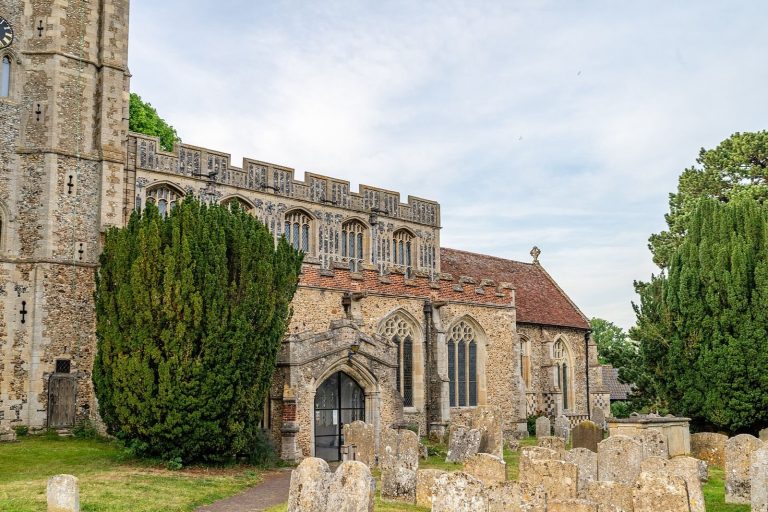
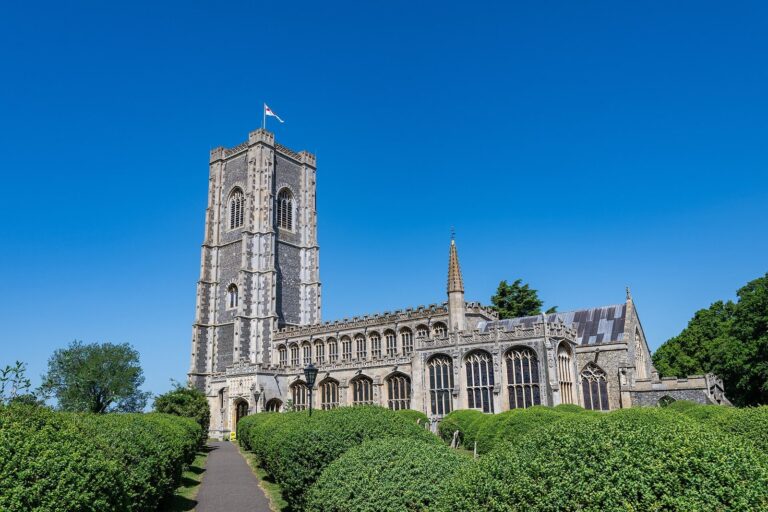
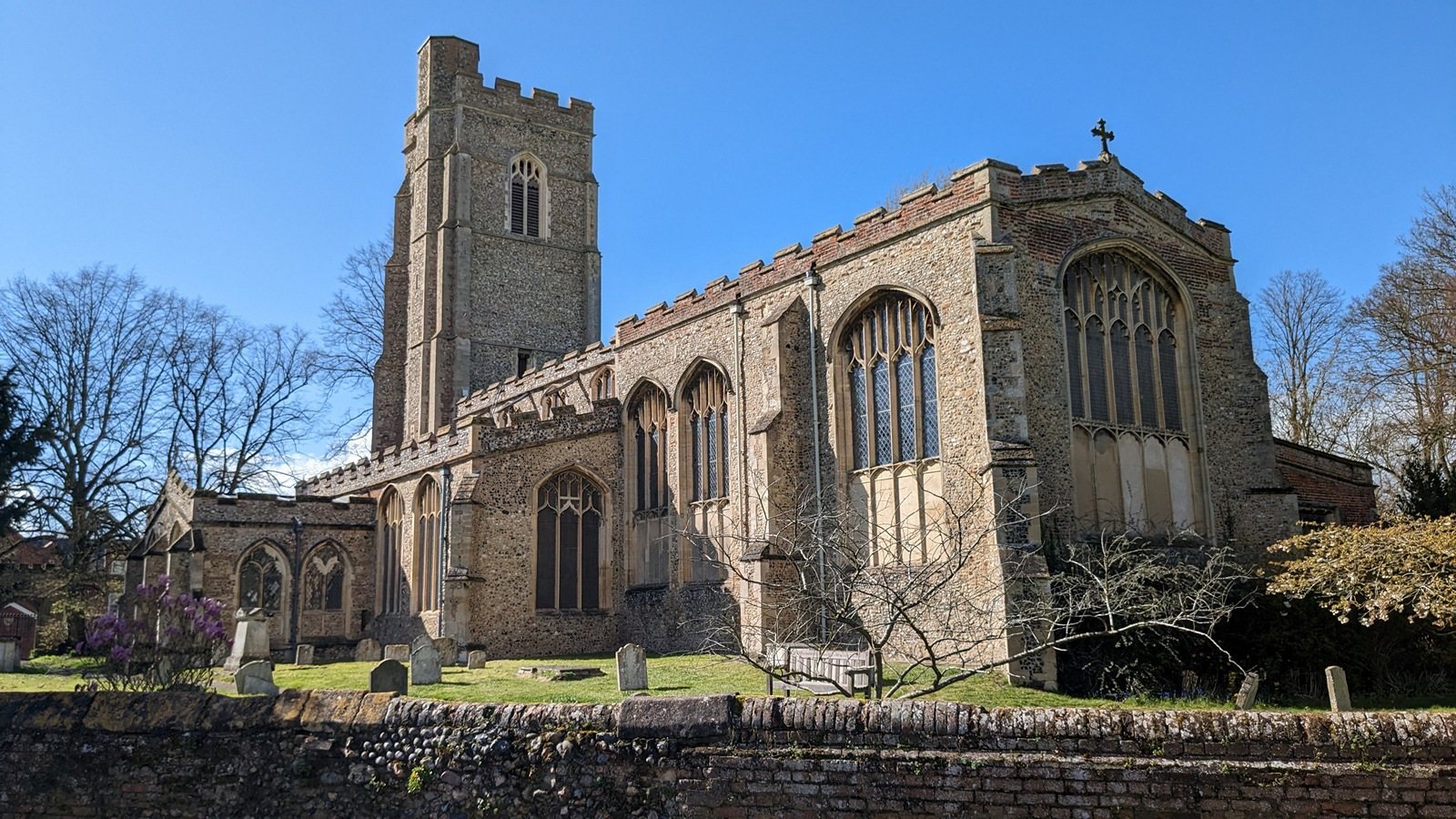
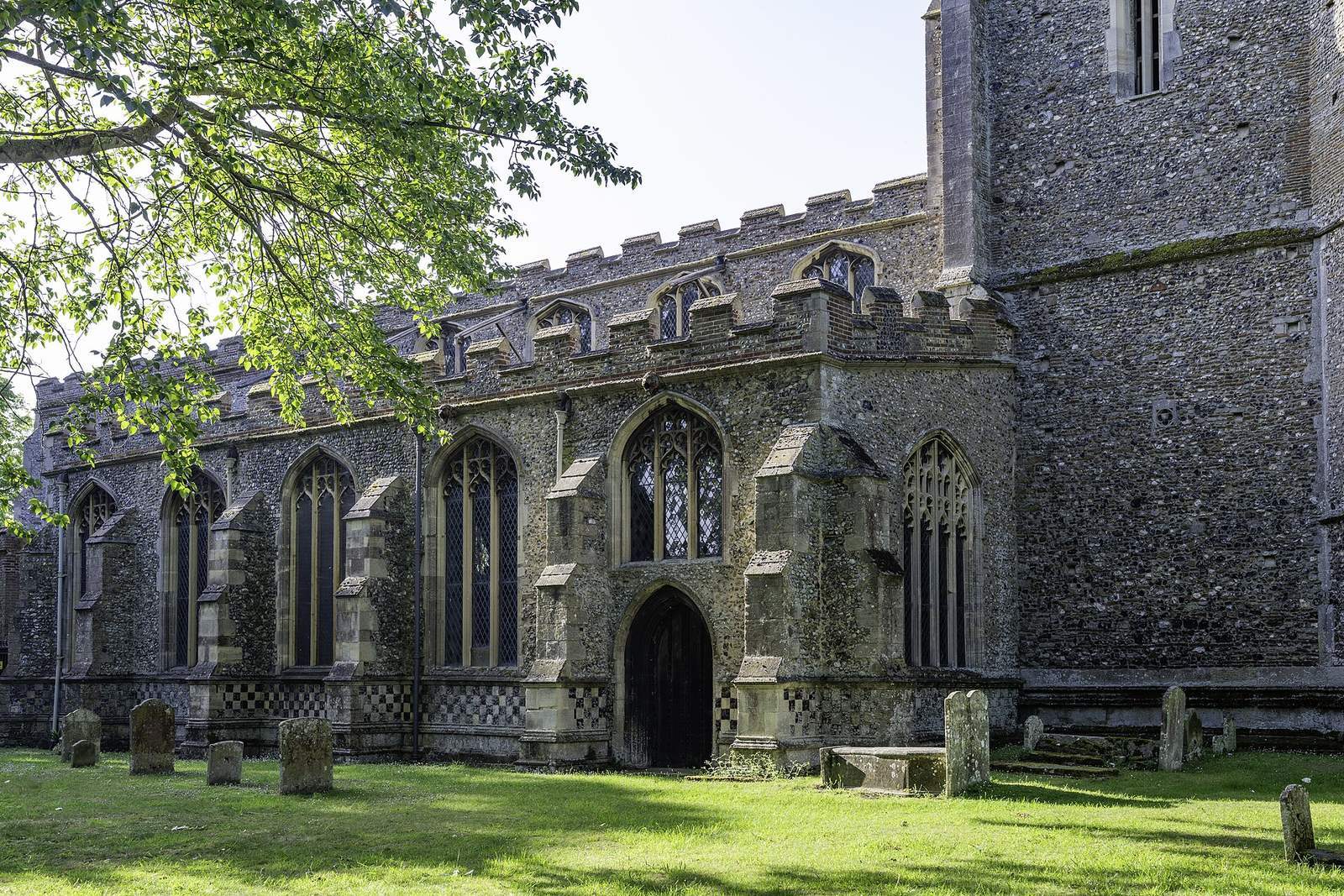
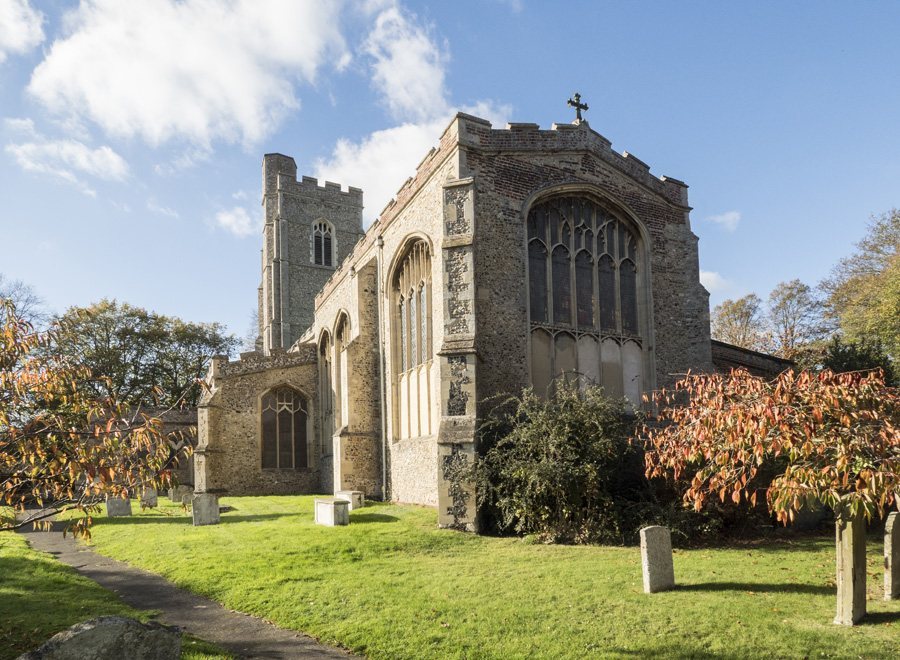
The flint-faced church has a west-end bell tower with a stair turret on its southeast side. The nave has a clerestory, a high wall section with windows above the main roofline, and a 14th-century arcade of four bays; the south-side capitals are simpler and may be earlier. The large chancel has tall Perpendicular windows. A substantial porch on the south side has a chapel attached to its east, while an early 16th-century brick vestry stands at the east end. The chapel at the east end of the north aisle, once dedicated to All Souls, now houses the pipe organ.
Interior fittings and memorials
Font cover
The church’s 15th-century font cover rises 12 feet (3.7 metres), making it exceptionally tall and elaborate. Architectural historian Nikolaus Pevsner described it as one of the finest medieval font covers in the country. In the 19th century, its lowest section was adapted to slide upwards, allowing the font to be used without lifting the entire cover.
Choir stalls and screen panels
The choir stalls have carved heads on their armrests and small ledges, called misericords, beneath the folding seats. Two panels from the former rood screen, a partition between the nave and chancel, are built into the stall backs and were painted over during the Victorian restoration. A third panel, left unrestored and displayed at the west end, shows the legend of John Schorne conjuring the Devil into a boot.
Simon Sudbury’s head
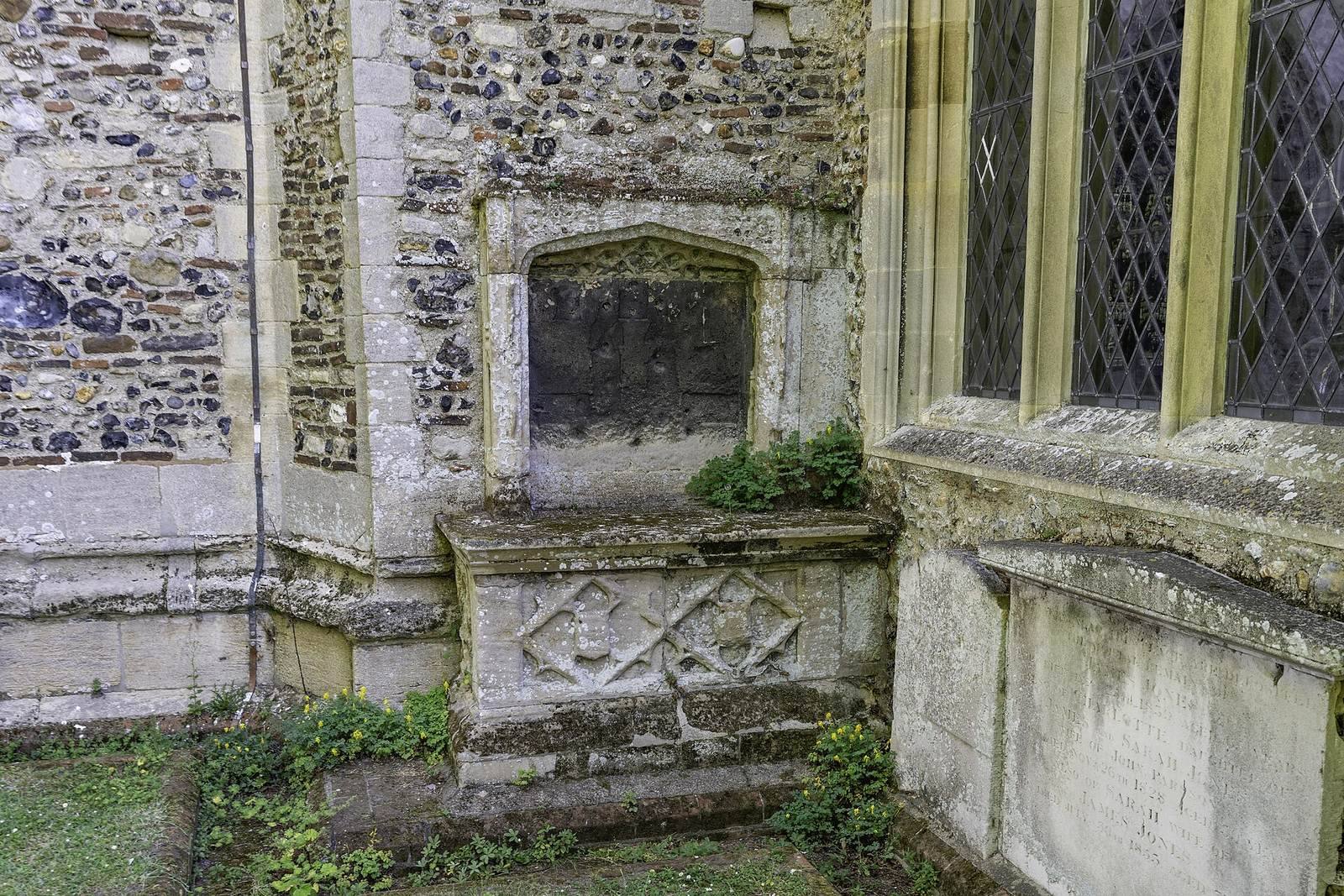
Simon Sudbury’s mummified head is kept in a niche in the vestry wall. A copy of his facial reconstruction is on permanent display in the church.
Medieval tombs and inscription
One stone slab is believed to mark the tomb of Nigel and Sara Theobald, Simon Sudbury’s parents. Another is thought to mark the burial place of Thomas Jane, Bishop of Norwich, who was buried at St Gregory’s in 1500. A slab in the south aisle bears an inscription in Anglo-Norman French, a medieval form of French used in England. In translation, it says: “Here lies Seive de St. Quintin, formerly the wife of Robert de St. Quintin, who died in the year of Grace 1300 on the day of St. Gregory. Pray for her soul.”
Thomas Carter’s tomb
The chest tomb of Thomas Carter, who died in 1706, carries a Latin inscription addressed to a traveller. It says that on the day Carter died, “a Sudbury camel passed through the eye of a needle,” urges the wealthy to “go do likewise,” and concludes, “Farewell.”
Organ and bells
Bishop and Son, a London firm, built and installed the present pipe organ in 1879. Earlier instruments from St Peter’s were brought to St Gregory’s: a John Snetzler organ dating to about 1750 was installed in 1841, and a replacement made by Samuel Parsons was sold to the church in 1866 for £100. The present instrument has been cleaned and its bellows restored by Bishop’s; its clarinet stop is no longer used. The original ring of six bells gained two higher-pitched treble bells in 1785, cast from an old bell from Sudbury Priory. The lowest-pitched bell was recast by Pack and Chapman at the Whitechapel Bell Foundry in 1774, and Thomas Mears recast the others there in 1821.
College gateway
The college’s heavily restored gateway survives on the west side of the churchyard, the remaining visible fabric of the institution that once stood beside St Gregory’s.