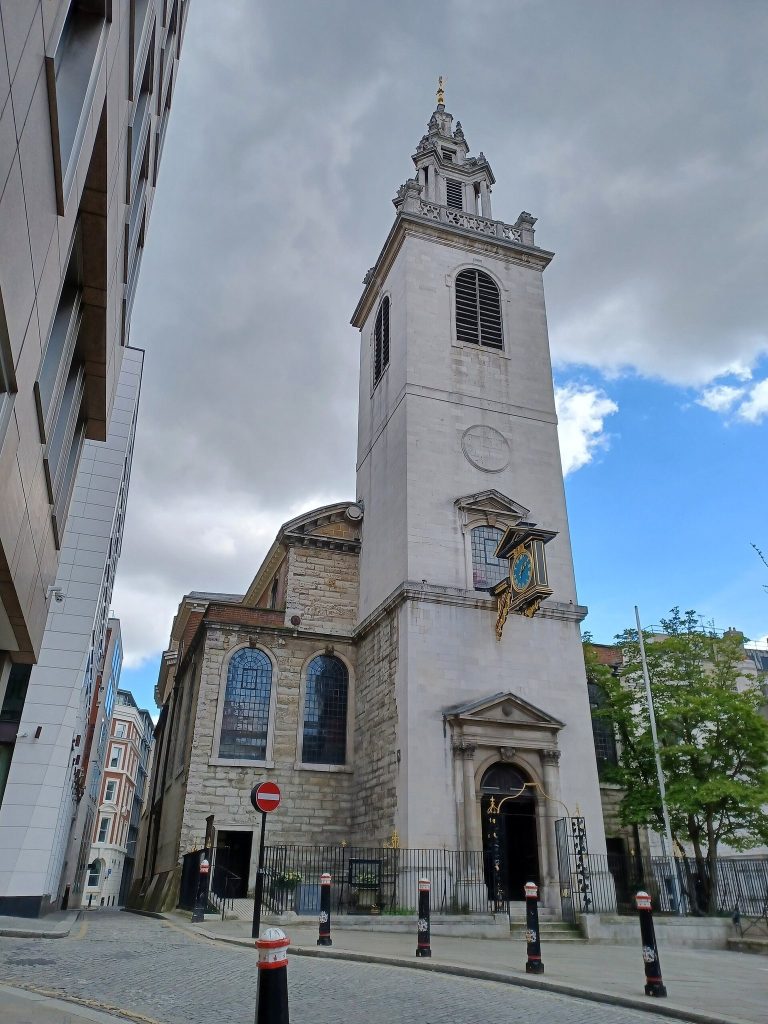
St Peter upon Cornhill: A Wren Church on London’s Roman Basilica Site
Site at a Glance
- Rating
- 4.8
- Popularity
- Very Low
- Country
- United Kingdom
- Primary era
- Early Modern
- External website
- Open
- Eras represented
- Medieval, Early Modern
- Civilizations
- English
- Site type
- Religious
- Remains
- Church
On this page10 sections
History
St Peter upon Cornhill is an Anglican Church of England church in London, United Kingdom, rebuilt in the English Baroque style between 1677 and 1684 after the Great Fire of 1666. Dedicated to Saint Peter, it stands in the City of London and belongs to the Diocese of London. Its origins may reach back to the Roman period or the early Christian community in London, although its foundation date is uncertain.
Early Christian traditions
Medieval tradition attributed the church’s foundation to Lucius, a legendary early British king whose reported conversion belongs to medieval Christian tradition rather than securely documented Roman-period history. John Stow and earlier writers said that Lucius founded St Peter’s after his conversion in AD 179, dedicated it to Saint Peter, and established an archiepiscopal see there. The tradition further held that the church remained an archiepiscopal seat until the arrival of the Saxons in the fifth century, when London was abandoned and Canterbury became the base of the Gregorian mission to the Kingdom of Kent during the sixth century.
The original tablet associated with this tradition was destroyed in the Great Fire. A replacement brass plate was later installed and remains in the vestry. In 1417, the Mayor of London decided during a dispute that St Peter’s was the first church founded in London. Since St Paul’s Cathedral was founded in 604, the decision shows that fifteenth-century Londoners regarded St Peter’s as a pre-sixth-century foundation.
London’s Christian community is securely attested by AD 314, when Bishop Restitutus attended the Council of Arles, an important early Christian council held in Gaul. A large aisled building excavated near Tower Hill in 1993 has been proposed as another possible church, but its identity remains uncertain, and its date of AD 350 to 400 is later than the traditional foundation attributed to St Peter’s.
Medieval church and institutions
The first definite documentary reference to the medieval church dates from around 1038. In his will, Ælfric II, Bishop of Elmham, left a messuage, or urban property, to “St Peter in London.” Henry II mentioned the church again in a charter of 1156.
By 1226, St Peter’s had three chaplains. They were described as co-conspirators in the murder of Amise, a deacon of the church who was stabbed by the vicar of St Paul’s. The earliest recorded appointment in the list of vicars was John de Cabanicig in 1263, after a prolonged vacancy during which patronage was claimed by Pope Urban IV.
In 1447, Parliament under Henry VI ordered St Peter’s to host one of London’s four parochial schools. The church also maintained a library and scriptorium, a workspace for copying manuscripts, which remained in use until about 1548. Sir John Crosby left money in his 1475 will for repairs to the library, which contained a 1290 manuscript copy of Saint Jerome’s Vulgate, his Latin translation and revision of the Bible. A horsemill was given to the church in 1444, and its bells were recorded in 1552, when an Aldgate bell foundry was commissioned to cast a new bell.
Rebuilding and later associations
The medieval church was badly damaged in the Great Fire of London in 1666. The parish initially attempted to repair it, but the building was rebuilt between 1677 and 1684 to designs by Christopher Wren, the architect responsible for rebuilding numerous London churches after the fire. The eastern end of the medieval site was surrendered for the widening of Gracechurch Street, making the new church approximately 10 feet, or 3 metres, shorter than its predecessor.
St Peter’s was formerly Roman Catholic and became part of the Church of England in 1538. In 1954, at the suggestion of rector Douglas Owen, who had served as a regimental chaplain, it became the regimental church of the Royal Tank Regiment, a British Army armoured regiment. Since 2007, that role has been held by St Mary Aldermary. St Peter’s was designated a Grade I listed building on 4 January 1950 and is now a satellite church of the parish of St Helen’s Bishopsgate. It is used for Sunday services, mid-week Bible studies, staff training, and youth activities.
The churchyard was mentioned by Charles Dickens in Our Mutual Friend. The Players of St Peter, a theatre group formed at the church in 1946, performed there until 1987 before moving to St Clement Eastcheap, where its members continued to perform medieval mystery plays.
Remains
Roman setting and foundations
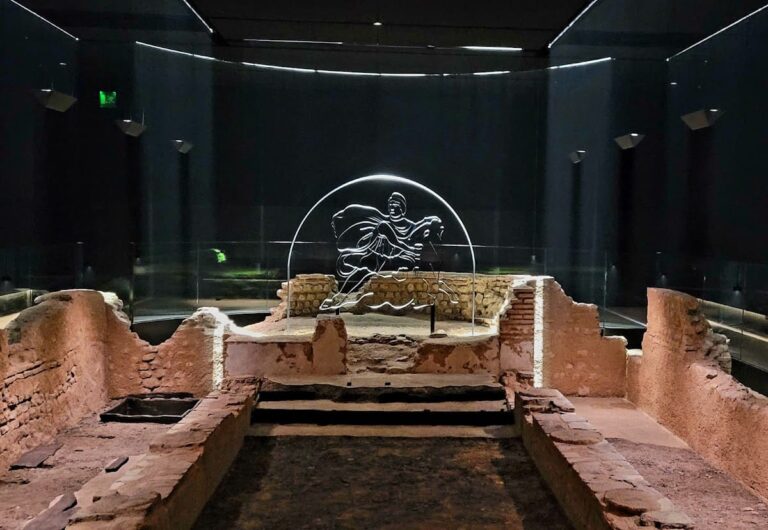
St Peter upon Cornhill stands on the highest point of the City of London, directly above the foundations of London’s Roman basilica, a large civic, legal, and administrative building constructed around AD 90 to 120. Most of the associated forum lay to the south. The church’s alignment follows the basilica closely, differing by about two degrees.
The eastern end of the church and its high altar occupy an area where some Roman basilicas contained an aedes, a shrine or temple room. Nineteenth-century excavations beneath Gracechurch Street, immediately beside the church’s eastern end, uncovered an adjoining room with yellow wall panels bordered in black and a tessellated floor, a pavement made from small pieces of stone, tile, or similar material. The room may have been more formally appointed than ordinary rooms and may have served as an antechamber to a shrine room.
The understructure of the church may have used the dry, solid fabric of the second-century basilica wall as support, although this remains a possibility. The Roman basilica was probably largely demolished around AD 300. Its building materials were removed, possibly for other construction projects, and the ground was levelled before being covered by a thick layer of dark soil.
Wren’s church
Exterior
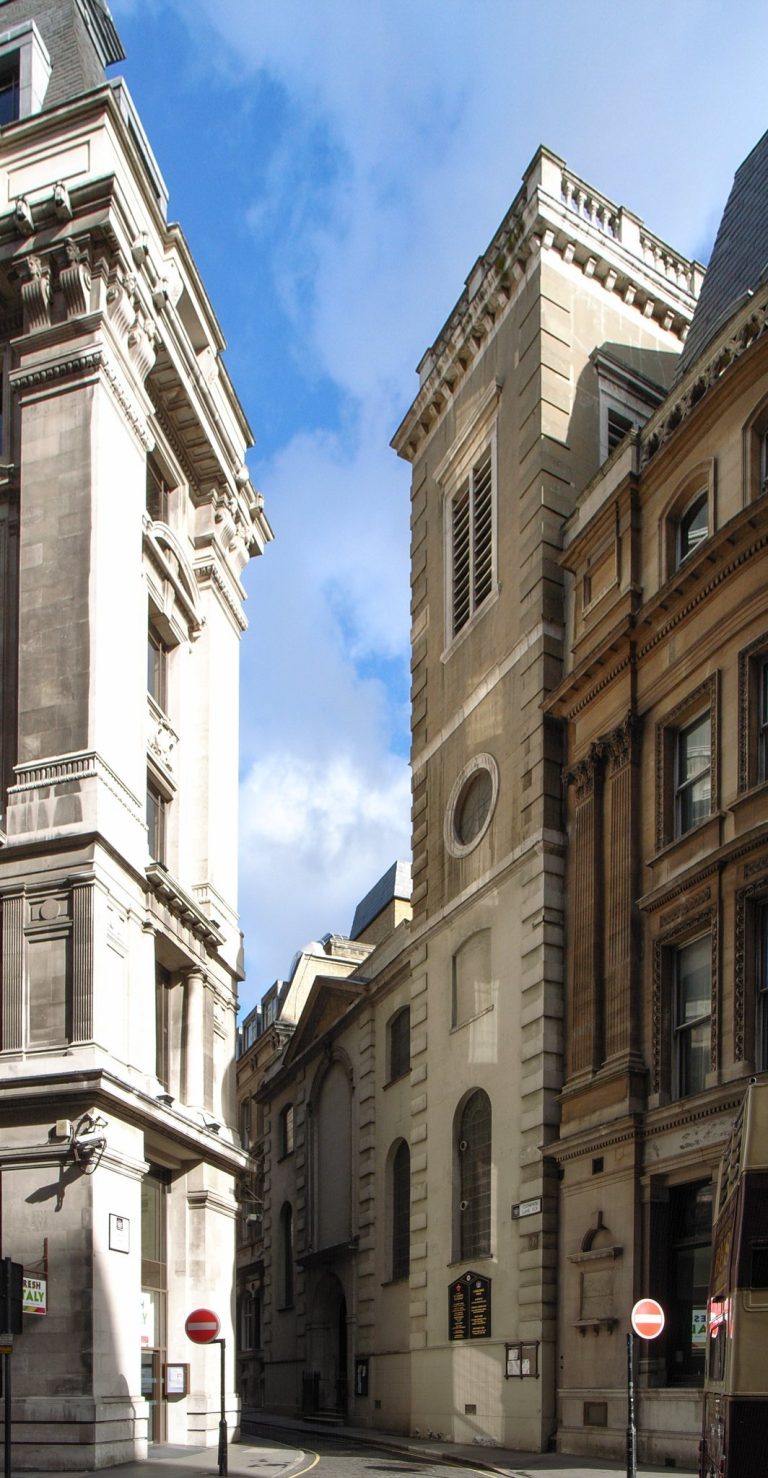
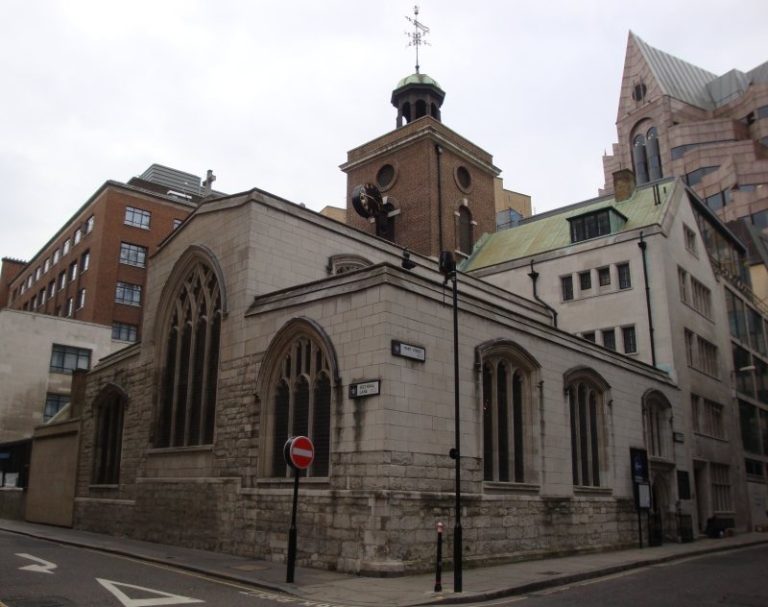
The present church is an English Baroque building of stone, brick, stucco, and lead. Its eastern frontage, facing Gracechurch Street, is a grand stone-faced composition with five arched windows between Ionic pilasters, which are shallow rectangular supports with classical capitals. These stand above a high stylobate, or raised supporting base, and carry an entablature. Above it is a blank attic storey and a gable containing one arched window flanked by two round windows.
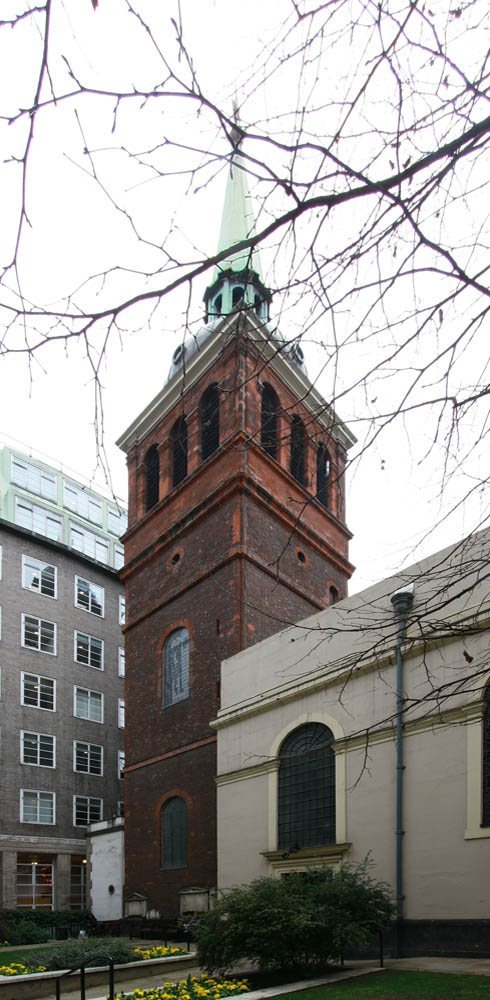
The north and south elevations are stuccoed and considerably simpler. Shallow nineteenth-century shops survive along the Cornhill side, positioned between the church and the pavement. The brick tower has a lead-covered cupola topped by a small spire, and its weather vane is shaped like Saint Peter’s key.
Interior
The interior is aisled, with square arcade piers resting on medieval pier foundations. The nave has a barrel vault, while the aisles have transverse barrel vaults. A screen separates the nave from the chancel, an unusual feature among Wren’s churches that was installed at the insistence of William Beveridge, the rector during the rebuilding.
The church contains a gallery organ associated with Elizabeth Mounsey, who became its organist in June 1834 and held the position for 48 years before resigning in 1882. Displayed there is an autographed souvenir quotation from a J. S. Bach passacaglia, given by Felix Mendelssohn to the fourteen-year-old Mounsey on 30 September 1840 after his impromptu performance on the organ.
Churchyard and memorial features
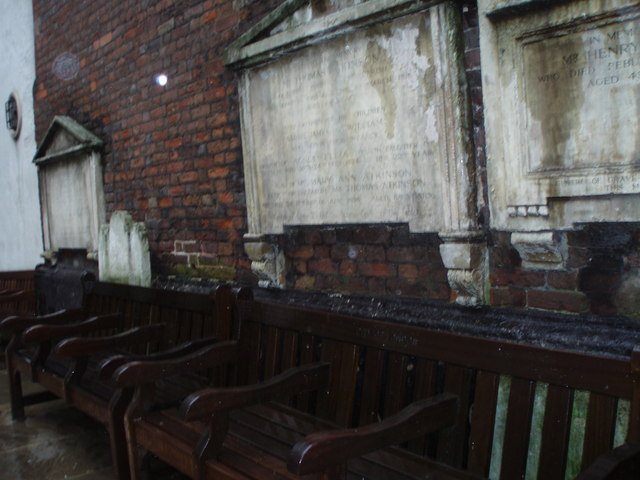
The grounds include a churchyard with seats and a small garden. A memorial stained-glass window associated with the Royal Tank Regiment is also part of the church’s surviving features.