Latakia Tetraporticus: A Roman Triumphal Arch in Syria

Site at a Glance
- Rating
- 4.6
- Popularity
- Very Low
- Country
- Syria
- Primary era
- Classical
- Eras represented
- Classical
- Civilizations
- Roman
- Site type
- Civic
- Remains
- Arch
On this page6 sections
History
Latakia Tetraporticus is a Roman triumphal arch in Latakia, Syria, traditionally associated with Emperor Septimius Severus and dated to the late second century AD. A tetrapylon, also called a tetraporticus, is a monumental structure organized around four passageways or openings, often serving as a landmark or ceremonial gateway.
Severan foundation
Latakia supported Septimius Severus during the struggle for the Roman throne. His rival occupied and damaged the city, but Severus later defeated him. According to the traditional account, the emperor rewarded Latakia by ordering the construction of the arch. It consequently became known as a triumphal arch and a symbol of the city.
Septimius Severus ruled the Roman Empire from AD 193 to 211. The monument is also known locally as the “Hanging Church” and the “Square Arch.” A local explanation links these names with the occupation of the surrounding settlement by the Crusaders and its later liberation by Saladin, the Muslim ruler and military leader who founded the Ayyubid dynasty and led campaigns that recovered much of the eastern Mediterranean from Crusader control.
Burial, reuse, and restoration
At a later period, the arch became buried and was used for an extended time as a mosque. Walls were built across its openings, while residential buildings gradually encroached upon the monument and impaired its appearance.
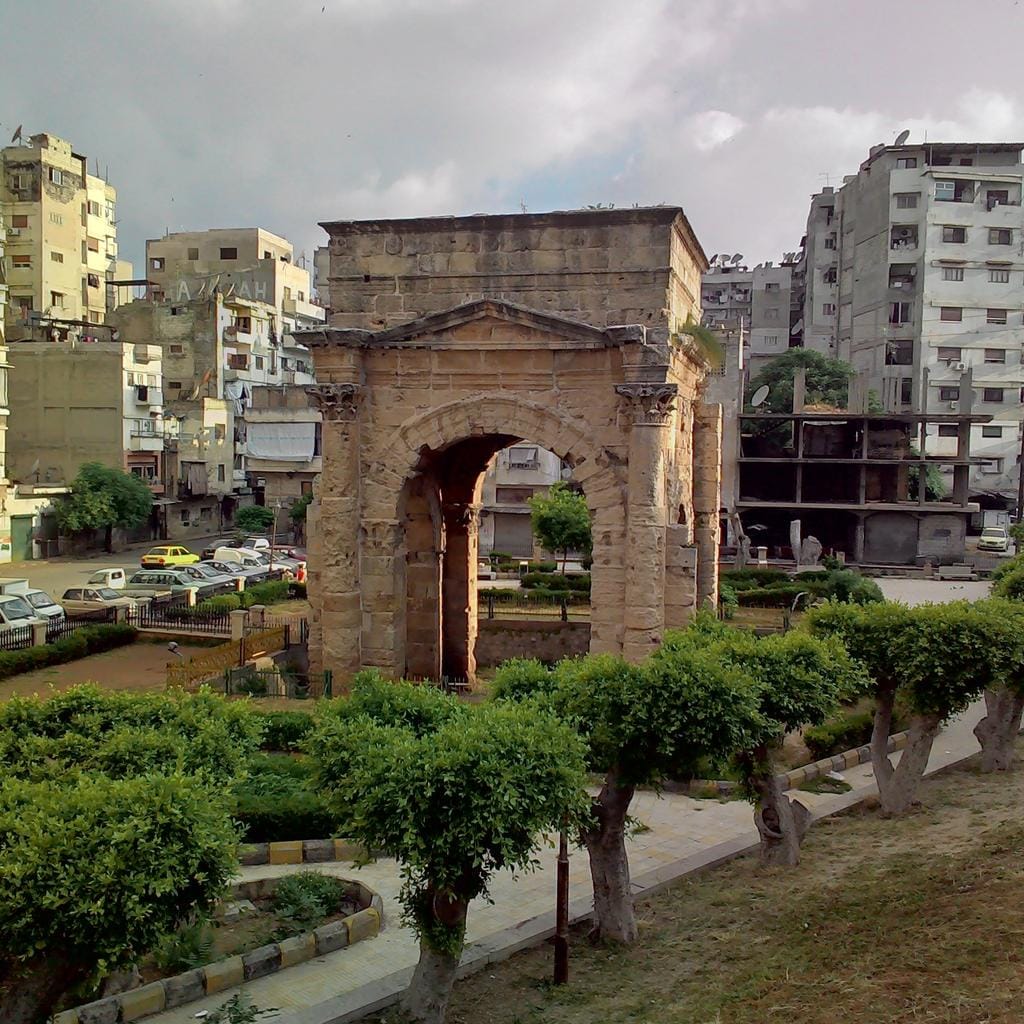
During improvements to the Saliba neighborhood, the state demolished adjacent buildings, removed the walls that blocked the openings, and carried out limited repairs. These interventions revealed the monument’s earlier architectural character and restored its original appearance more clearly. It now stands in a small public garden, approximately 2 meters below the surrounding ground level.
Remains
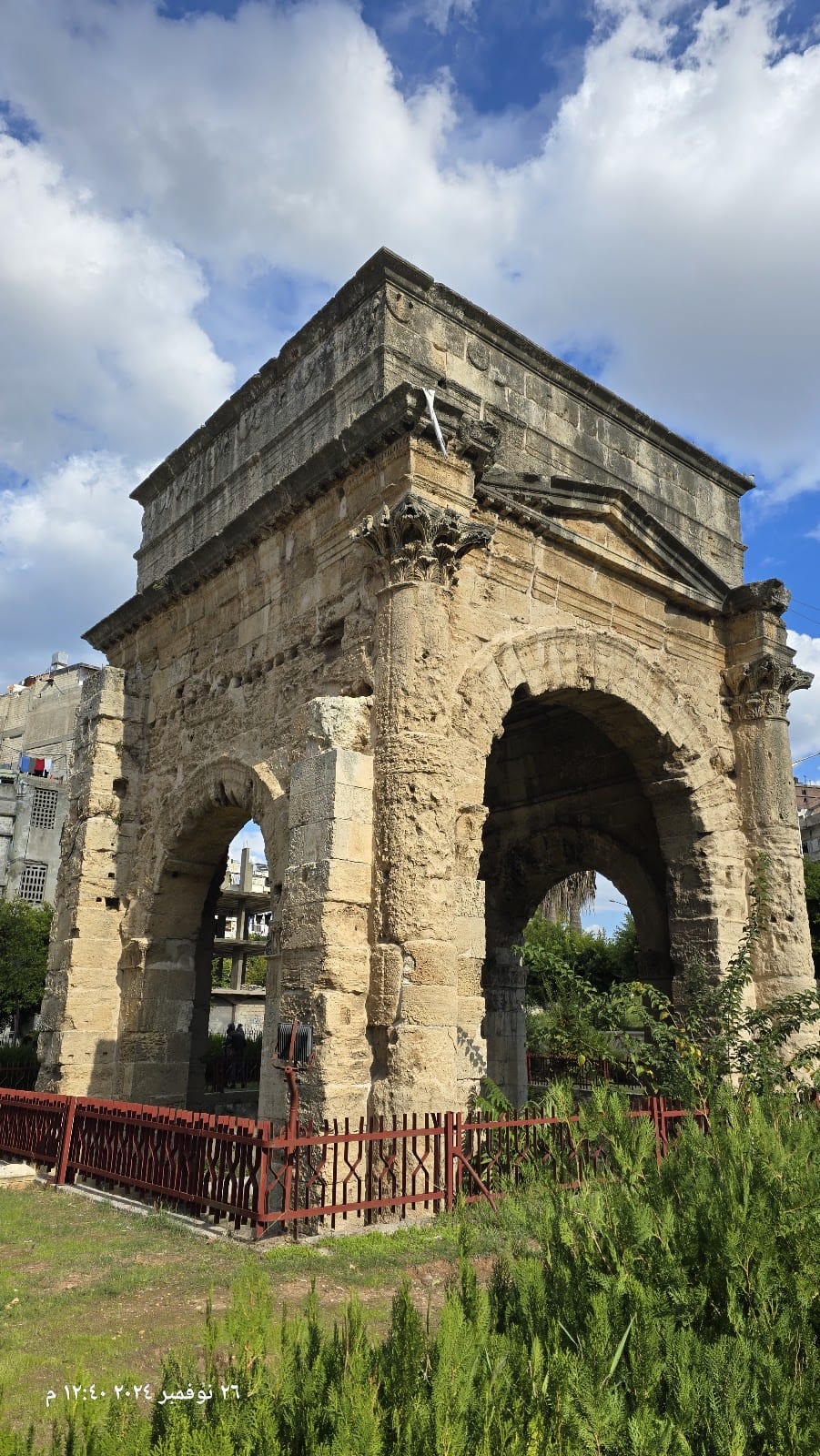
The monument is a cubic sandstone tetrapylon on a square plan measuring approximately 12 meters on each side. Four openings pass through the structure, while a hemispherical dome rises above its square mass. The openings vary in width from one side to another, and each is formed by a carefully built stone arch supported at its lower ends by columns.
Columns and carved decoration
The columns carry Corinthian capitals, which are column tops decorated with elaborate vegetal ornament, especially acanthus leaves. Above them are entablatures, the horizontal architectural bands supported by columns, decorated with friezes and cornices. The inner and outer faces bear carved and low-relief images of victory symbols and Roman military equipment, including swords, shields, helmets, and spears.
Setting and condition
Latakia Tetraporticus stands in the Saliba neighborhood on Port Said Street, in the southern or southeastern part of modern Latakia. It would have marked the eastern end of the Roman city, and classical Roman columns remain in the surrounding streets. Its sturdy cubic form helped it survive earthquakes that damaged other parts of the ancient city. The sandstone columns and walls show weathering and erosion attributed to Latakia’s humid climate.