Landguard Fort: A Coastal Defense at the Mouth of the River Orwell




Site at a Glance
- Rating
- 4.6
- Popularity
- Medium
- Country
- United Kingdom
- Primary era
- Early Modern
- External website
- Open
- Eras represented
- Early Modern, Modern
- Civilizations
- British, English
- Site type
- Military
- Remains
- Fort
On this page11 sections
History
Landguard Fort is a coastal military fortification in the United Kingdom, standing at the mouth of the River Orwell outside Felixstowe. Its earliest defenses were established in 1540 to guard the river mouth and the approaches to Harwich Harbour. Originally known as Langer Fort, it developed through successive periods of expansion into a complex of fortifications that served from the Tudor period through the Second World War.
Tudor and Stuart defenses
The first fortifications consisted of earthworks and a blockhouse. In 1621, King James I, the Stuart king of England from 1603 to 1625, ordered the construction of a square fort with bulwarks at each corner. This seventeenth-century defense formed one of the principal historical phases incorporated into the later complex.
Landguard Fort was tested in 1667, when a Dutch force of about 2,000 men landed on Felixstowe beach and advanced towards it. The attackers were led by Michiel de Ruyter, a leading Dutch admiral of the seventeenth century. Nathaniel Darell, an English military officer, directed the defense, supported by 400 musketeers from the Duke of York and Albany’s Maritime Regiment, described as the first Royal Marines, along with 100 artillerymen and 54 cannons. The attack was repulsed.
Eighteenth-century reconstruction
A new battery was built in 1717. In 1745, construction began on a completely new fort on adjoining ground, following a pentagonal plan with projecting bastions. Further batteries were added during the 1750s and 1780s. Around 1755, Philip Thicknesse, the fort’s lieutenant governor, commissioned two landscape paintings for the Governor’s Quarters from Thomas Gainsborough, an English painter then living in Ipswich. Damp conditions at the fort later destroyed the paintings, although an engraving of one survives.
During the eighteenth and nineteenth centuries, the fort was treated administratively as part of Essex. Births and deaths within the garrison were consequently recorded as taking place at “Landguard Fort, Essex.”
Napoleonic and nineteenth-century changes
During the Napoleonic Wars, the fort’s strength and readiness for combat repeatedly concerned the Army. General Lord Cornwallis, commander-in-chief of the Eastern District, visited in 1801. After 1804, the fort was extended and strengthened, while supplies and ammunition were moved to Harwich for safety.
One incident during this period revealed the problems created by poor discipline within the garrison. Soldiers drank gin taken from a captured smugglers’ boat, and four died, probably from alcohol poisoning. The fort’s defenses also continued to change physically, with later work reshaping the interior barracks and river-facing batteries.
Second World War operations
During the Second World War, Landguard Fort and nearby installations became headquarters for the coast artillery defending Harwich Harbour. The complex also served as the headquarters and plotting room for heavy anti-aircraft defenses in the Harwich-Ipswich area, as the Naval Port War Signal Station controlling shipping movements in and out of Harwich Harbour, the Stour, and the Orwell, and as a remote-control station for defensive minefields at the harbour entrance. The anti-aircraft headquarters moved to Martello Tower Q in Felixstowe in 1941.
The fort was also one of the launch sites for Operation Outward, a British project that sent unmanned hydrogen balloons over Germany carrying incendiary devices or trailing steel wires intended to damage power lines. Many thousands of balloons were launched from Landguard between 1942 and 1944.
Observers at the fort recorded and plotted air raids, German minelaying operations, shipwrecks, and air crashes. In 1944, probably after a false alarm, the Landguard guns fired on suspected German midget-submarine raiders at the harbour entrance. Later that year, Allied landing ships were loaded at the former Royal Air Force piers to the north.
Preservation and historic status
The Army left Landguard Fort in 1957. The structure has since been consolidated and is managed by English Heritage as a public historic site. It is a Grade I listed building, a designation for buildings of exceptional architectural or historic interest in England, recorded here from 1986. It is also a scheduled monument, a legally protected archaeological or historic site, with that designation recorded from 1962. The fort is classified as part of the East Anglian Device Forts, coastal defenses developed under the Tudor monarchy, and the Palmerston Forts, nineteenth-century British defensive works associated with Lord Palmerston.
Remains
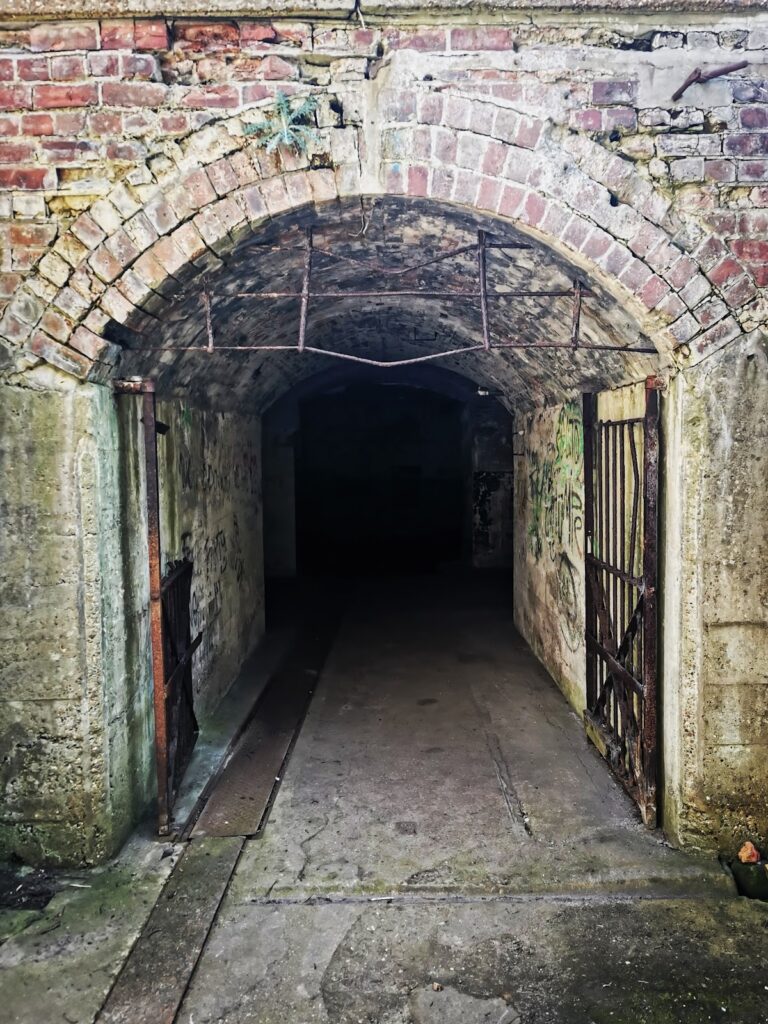
Landguard Fort survives as an intact military battery whose fabric brings together a seventeenth-century square fortification, an eighteenth-century pentagonal bastioned fort, later batteries, and extensive nineteenth- and twentieth-century defenses. Its construction includes brick passageways, reinforced defensive walls, protected gun positions, bombproof structures, gun ports, enclosed batteries, and concrete emplacements. The complex retains both the broad defensive arrangement and many interior spaces associated with its long military use.
The pentagonal fort and entrance defenses
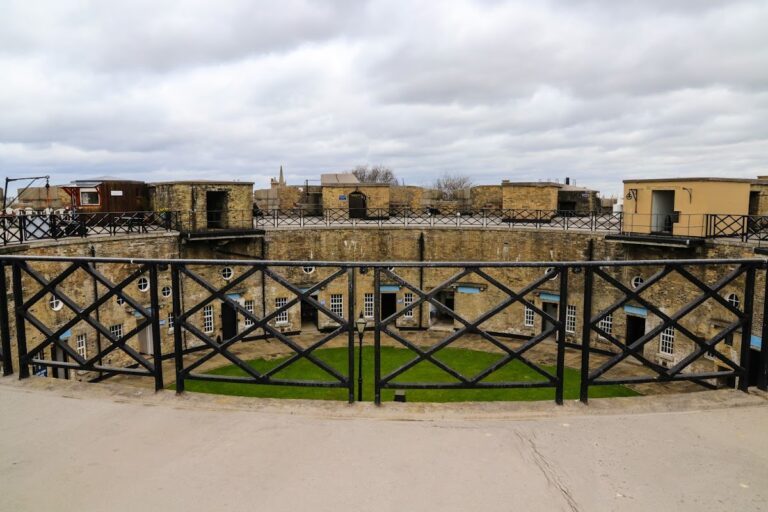
The 1745 fort follows a pentagonal bastioned plan. Its principal arrangement includes a curtain wall, an inner ditch or moat, an inner courtyard, entrance works, and the Holland, Harwich, and Chapel Bastions. A bastion is a projecting fortification designed to provide flanking fire along the face of a defensive wall. Together, these elements form the central defensive framework of the later fort.
The entrance complex contains a main entrance, an entrance block, a guardroom, a passage over the entrance, an inner entrance to the courtyard, a sally port, and an entrance tunnel. A double pulley raised the inner gate. The moat is crossed by a caponier, a covered passage projecting into or across a moat, whose end has an unusual quarter-sphere bombproof nose. A mock ravelin block was built to house a submarine-mining contingent. A ravelin is an outwork placed beyond a moat to protect an approach to the main fort.
Nineteenth-century fortifications
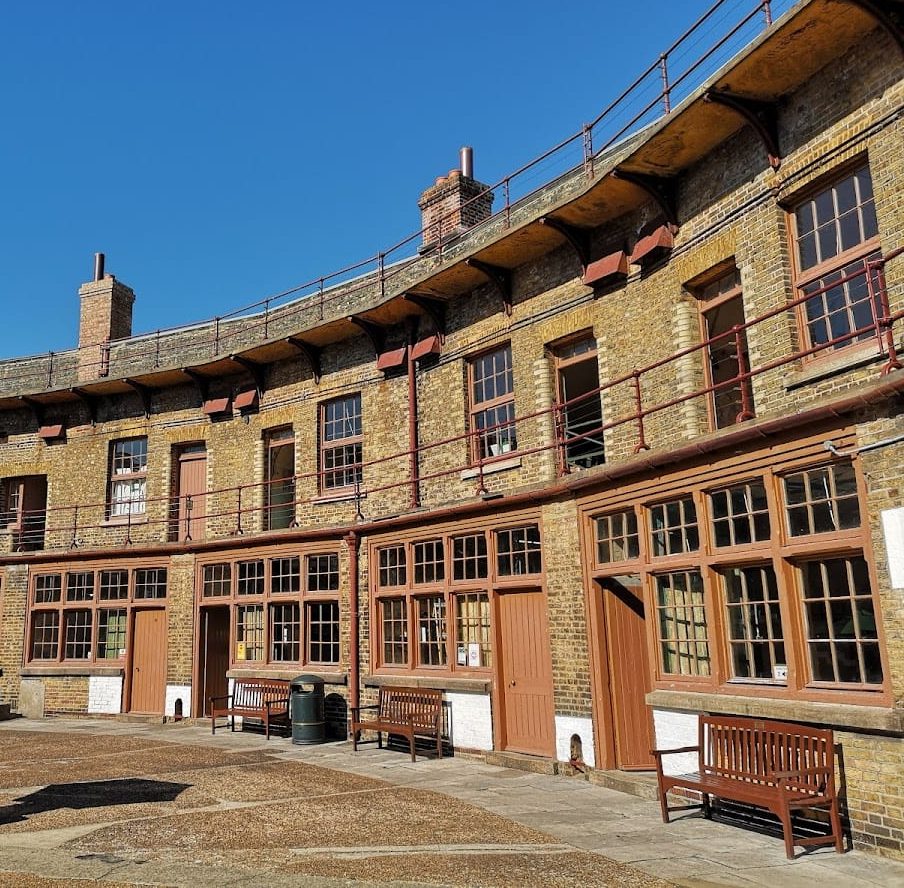
Nineteenth-century alterations rebuilt the interior barracks in a keep-like form and reconstructed the river frontage as a new casemated battery. A casemated battery is a gun battery housed in protected, vaulted, or fortified chambers. Several formerly open bastions were enclosed, changing the appearance and defensive character of the earlier fort while retaining its main fortification plan.
Batteries and gun positions
The surviving batteries include the Left Battery, Right Battery, and Darell’s Battery. They contain gun emplacements, gun ports, defensive positions, and control or observation posts. A position for a movable gun overlooked Felixstowe Docks. The Left Battery also contains a 10-inch gun pit that was converted into an anti-aircraft operations room for Harwich in 1939.
Second World War coast-artillery defenses on the Landguard Peninsula included four 6-inch guns and two twin six-pounder guns installed in concrete emplacements. These emplacements remain. Their survival preserves the physical evidence of the fort’s later role in defending the harbour and its approaches.
Communications, stores, and garrison spaces
The fort retains military communications and control spaces associated with its twentieth-century functions. These include anti-aircraft and seaward-defense plotting rooms, a control tower with ranging aids, a radar room, a radio and Morse-code room, a telephone exchange, and a teleprinter room.
Other surviving spaces include barrack rooms and offices, an armoury, a gunpowder magazine, cartridge and shell lifts, a fire station, a guardroom, a prison cell, a schoolroom, a washroom, a shower room, a cobbler’s shop, a display room, and a tearoom. The gunpowder magazine contains cartridge-storage containers and a cartridge lift. The fort also retains a ramp associated with submarine mines and other features connected with submarine mining. An eighteenth-century clock and three fire buckets survive within the complex.