Harwich Redoubt: A Napoleonic Coastal Fort in the United Kingdom


Site at a Glance
- Rating
- 4.6
- Popularity
- Low
- Country
- United Kingdom
- Primary era
- Modern
- External website
- Open
- Eras represented
- Modern
- Civilizations
- British
- Site type
- Military
- Remains
- Fort
On this page9 sections
History
Harwich Redoubt is a circular British fort in the United Kingdom, built between 1808 and 1810 to defend the port of Harwich against the threat of Napoleonic invasion. The Napoleonic Wars were a series of European conflicts fought from 1803 to 1815, chiefly between Napoleonic France and shifting coalitions of opposing states. The redoubt formed part of a coastal defence plan proposed in 1805, which envisaged 55 Martello Towers along the East Anglian coast, although only 29 were constructed.
Construction and early armament
Major Alexander Bryce of the Royal Engineers supervised construction. The Royal Engineers were the British military corps responsible for designing and building fortifications and other defensive works. Harwich Redoubt cost an estimated £32,000 and followed a design similar to those used at Dymchurch Redoubt and Eastbourne Redoubt. Its plan allowed for ten guns rather than eleven, and it was originally armed with ten 24-pounder cannon.
Modernisation and changing defence
The fort was repeatedly adapted as artillery developed and military assessments changed. Work in 1861 and 1862 prepared it for 68-pounder cannon and strengthened the gun positions with granite facing. In 1872, three emplacements were modified for 12-ton rifled muzzle-loading guns. These were large weapons loaded through the muzzle, with rifled barrels that improved range and accuracy. In 1903, three emplacements were equipped with 12-pounder quick-firing guns, designed to fire more rapidly than older heavy artillery.
Harwich Redoubt never fired a shot in anger. Its strategic importance probably declined late in the nineteenth century after the more powerful Beacon Hill Battery was built to the south. During the 1920s, the Town Council acquired the surrounding land, which had previously been kept clear as a field of fire. The land was later used for allotments, while the fort itself fell into disrepair.
Twentieth-century use and restoration
The redoubt briefly returned to military service during the Second World War, when it became an anti-aircraft site and a detention centre for British troops awaiting trial. After the war, British Civil Defence used the fort. This organisation was responsible for civilian emergency protection and preparations for air attack and other wartime dangers. Its disbandment brought the redoubt’s military service to an end.
After Harwich Redoubt was listed as an Ancient Monument, restoration began in July 1969 and has continued since then. The Harwich Society now operates the site as a museum. The redoubt is described as the largest Ancient Monument in the United Kingdom being restored by a voluntary group.
Remains
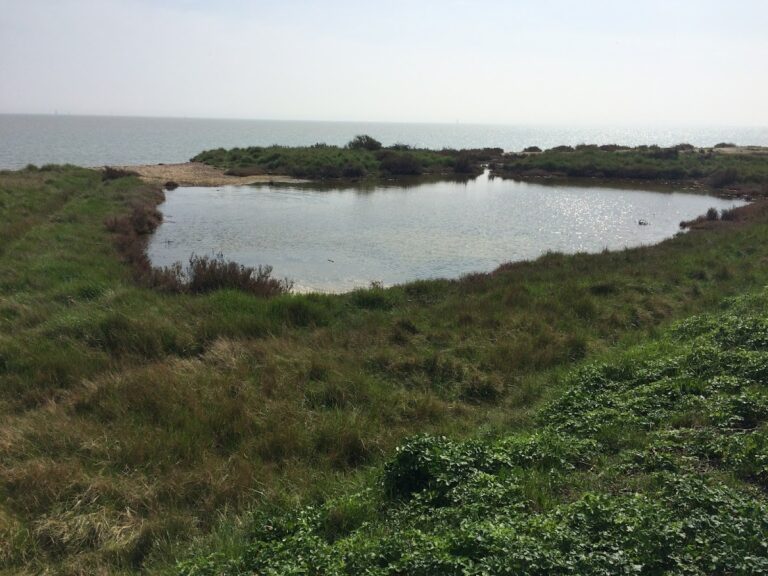
Harwich Redoubt is built mainly of brick with stone details and measures approximately 61 metres across. It stands on a hilltop just outside Harwich, overlooking the estuaries of the River Stour and River Orwell at the entrance to the harbour. This elevated position provided an unrestricted field of fire, while the guns could also create interlocking fire with those of Landguard Fort on the opposite shore.
Central buildings and artillery positions
Parade ground and casemates
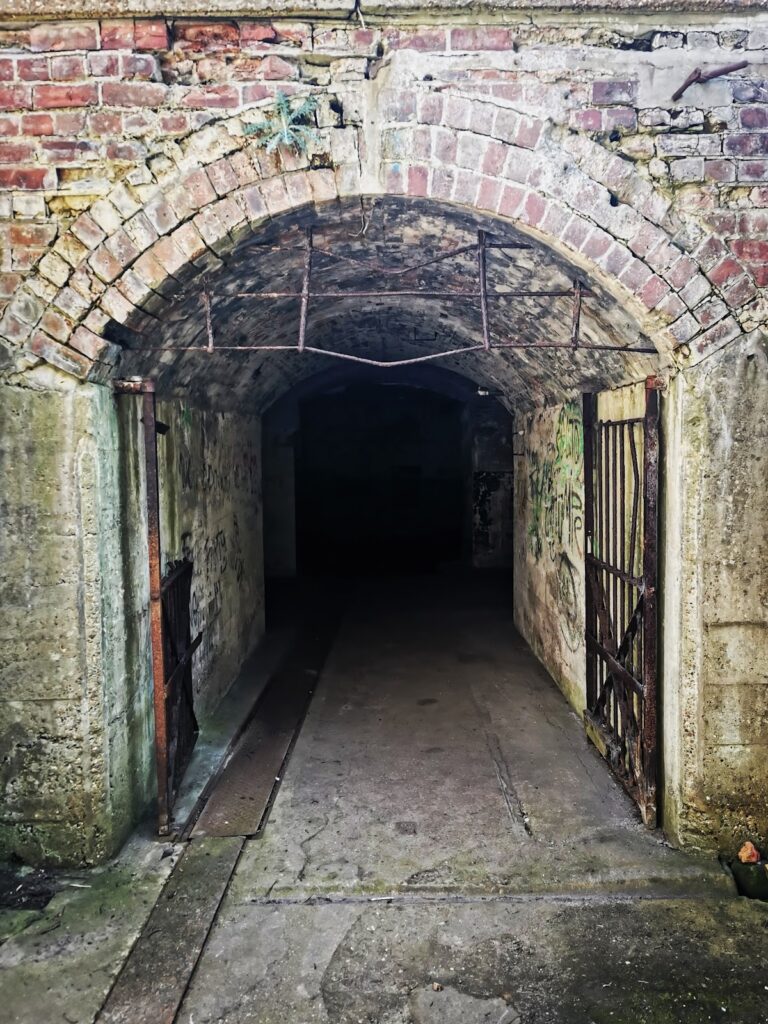
A central parade ground, approximately 26 metres across, is enclosed on the ground floor by 18 casemates. A casemate is a vaulted chamber within a fort, used for protected accommodation, storage, artillery, or other functions. The chambers radiate from the centre and housed barracks, stores, washing facilities, latrines, and a cookhouse. Two were used as the magazine and shell store. Ammunition hoists carried shells and other supplies from the lower level up to the gun positions.
Terreplein and guns
The gun positions occupy a terreplein, a raised artillery platform formed by the roof over the casemates. Ten embrasures, or openings for cannon, are set into the platform. Original guns, including the 9-inch, 12-ton rifled muzzle-loading gun recovered from the dry ditch, are displayed in the museum with other guns and numerous replica firearms. Rooms around the lower level of the parade ground have been arranged as reconstructions of their possible historical appearance, while others serve as exhibition spaces.
Dry ditch and surviving evidence
A dry ditch approximately 16 metres wide and 7 metres deep surrounds the fort. Slightly below the parapet of the gun platform, a brick counterscarp wall protects the scarp wall from enemy fire. The counterscarp and scarp are respectively the outer and inner faces of a defensive ditch.
During restoration, the 9-inch rifled muzzle-loading gun was found buried in the ditch. It had been pushed there after becoming obsolete because its large size and solid construction made it impractical to break up for scrap. Graffiti left by British soldiers during the Second World War remains visible in some of the rooms, providing physical evidence of the redoubt’s later military use.
Nearby sites