Landesburg Lechenich: A Medieval Territorial Castle and Administrative Center
Site at a Glance
- Popularity
- Medium
- Country
- Germany
- Primary era
- Medieval
- Eras represented
- Medieval
- Civilizations
- Electorate of Cologne, Holy Roman Empire
- Site type
- Military
- Remains
- Castle
On this page16 sections
History
Landesburg Lechenich is a medieval castle in Lechenich, Germany, begun by the archbishops of Cologne in 1306 as a territorial stronghold, residence, and center of government. A castle belonging to a territorial ruler, it later served the archbishops and electors of Cologne as both a fortified seat and the administrative and judicial center of the district.
The earlier castle and archiepiscopal control
A predecessor of the present castle was first recorded in 1138 as a lordly estate. In 1185, Archbishop Philipp of Heinsberg took over the Lechenich bailiwick, an office carrying delegated rights and responsibilities, from the Counts of Hengebach, who had held it as a fief. He placed local administration and justice in the hands of archiepiscopal officials, making the castle the district’s governing center.
During the thirteenth-century territorial struggles among the archbishops of Cologne, the Dukes of Brabant, and the Counts of Jülich, the earlier castle endured several sieges without being captured. In Archbishop Konrad of Hochstaden’s conflict with Cologne, it was used to hold patricians from the city whom he had brought there. In 1289, the castle was pledged to the Count of Berg as security, and he held it until 1292. In 1301, during King Albrecht I’s dispute with Archbishop Wigbold of Holte over tolls on the Rhine, Count Gerhard of Jülich and his allies destroyed the old castle and town defenses then under construction, acting on the king’s orders.
Construction and life as an electoral residence
With King Albrecht’s permission, Archbishop Heinrich II of Virneburg began a replacement castle within the town in 1306. Its residential tower was built between 1306 and 1317. Archbishops Walram of Jülich and Wilhelm of Gennep later enlarged the complex and strengthened its defenses. From the fourteenth century, the castle was a residence for the archbishops and electors of Cologne. Electors were princes entitled to take part in choosing the king of the Holy Roman Empire.
The castle combined a private residence with the work of government. Archbishops Walram and Wilhelm, along with their successors, stayed there. In the residence hall, the rulers received homage, appointed officials, granted fiefs, arbitrated disputes, and hosted diplomatic guests. Representatives of the Maas-Rhine Land Peace alliance, a regional pact intended to maintain peace among its members, met at Lechenich repeatedly from 1351 to 1381.
The castle also housed the district administration and court. Until the mid-sixteenth century, the district administrator lived in the outer ward’s administrative house. His duties included defending the ruler’s rights and overseeing the castle, town, district, and roads, as well as administering justice. A financial officer managed income and expenditure, arranged building upkeep, and paid the staff. The permanent garrison numbered sixteen, including officials, a gatekeeper, guards, and servants; the administrator also kept six to eight mounted retainers.
Four times each year, the administrator held a court that residents were obliged to attend. The customary rights and duties were read aloud, and complaints were heard. At longer hearings, the administrator, a fines officer, the local reeve, and lay judges imposed penalties for breaking laws or the elector’s orders. From 1325, the reeve and lay judges had their own court seal and held hearings in the great hall of the administrative or financial officer’s house. They issued legal documents, decided cases, and could imprison people for serious offenses. Their authority also extended to high justice, the right to try grave crimes and impose death sentences. They used this power in witch trials between 1626 and 1632. An executioner came from Cologne to carry out sentences at a site outside town near the former Roman road.
The castle’s agricultural estate supplied some food for the archbishop’s kitchen. From the sixteenth century, the land was leased, while income from fattened oxen and sheep’s wool helped support the household. The electors also received important visitors. King Sigismund stayed in 1414 while travelling to his coronation in Aachen and on his return to Bonn. King Frederick III visited on June 13, 1442, on his way from Bonn to his coronation in Aachen, and Emperor Charles V came in 1543 while travelling to Düren.
Decline, military occupation, and fire
After the archbishops and electors made Bonn their permanent residence, they came to Lechenich only occasionally. Their visits included hunting on the wooded Ville ridge and overnight stops on journeys to the Diocese of Liège, where they also held ecclesiastical and territorial authority. No overnight stays are recorded after 1657.
From April 17 to May 26, 1642, mercenary troops commanded by the French general Guébriant besieged Lechenich. They did not take the castle, although the town suffered extensive damage. In 1673, during the wars of Louis XIV, imperial troops under Montecuccoli occupied the town and castle without a fight. They remained until 1679, after which French troops were again quartered in the castle. On April 21, 1689, as they withdrew before advancing Brandenburg forces allied with the Emperor, the French set the castle on fire.
The fire ended the castle’s military importance and left it uninhabitable. Roofs over the main castle and tower received only makeshift repairs, and rooms, including the former residence hall, were used to store grain. During the eighteenth century the complex deteriorated further. The prison tower, the church’s correction house for clergy, and the chapel in the south wing were the only parts to survive. Fires in Lechenich in 1702 and 1722 led to repairs to the financial officer’s house; after the later fire, the outer ward, including that house, a barn, and stables, had to be rebuilt.
Private ownership and restoration
During the Napoleonic confiscation of church property, the castle and its grounds were taken as electoral property and auctioned in 1805. Andreas Borlatti, the son of the last senior financial officer, bought them. After his death in 1859, the estate passed to his granddaughter Maria Anna Borlatti and her husband, Cassius Rospatt. They sold the castle and farmland in 1869 to Heinrich Fischenich and Josefine Menzen. Fischenich sold the castle in 1894 to Georg von Bleichröder, who established a stud farm on land that also included a farm and property along the Trier-Cologne Roman road.
Hans Reinhard Schmidt-Elmendorff and his wife Gerda owned the castle from 1932 to 1967. Their sons inherited it after their deaths. Twentieth-century restoration campaigns, supported by a regional public association, helped secure the surviving ruins.
Remains
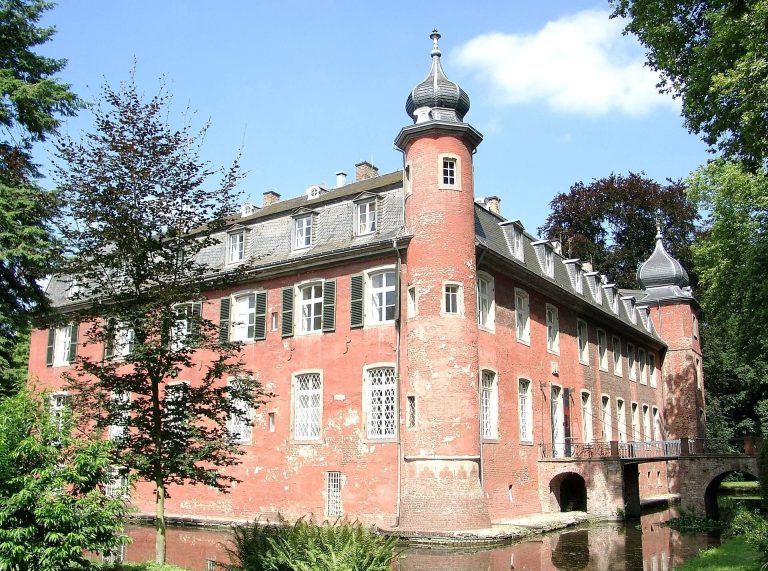
The surviving complex occupies the northeast corner of Lechenich’s old town, with parkland curving around it in a semicircle. The later castle stood within the fortified town and had an outer ward as well as a main castle. Brick forms its principal fabric, with trachyte, a volcanic building stone, used for corners and window surrounds.
The earlier castle site
The predecessor stood southwest of the present old town on a raised earthwork, with a residential tower. Broad, water-filled ditches supplied by the Rotbach, now called the Mühlenbach, surrounded the stronghold. Further ditches protected its outer ward, and an earth bank formed another defensive line. A faint trace of the old moat remains visible. The ditches were still open in 1810.
The main castle
The tower
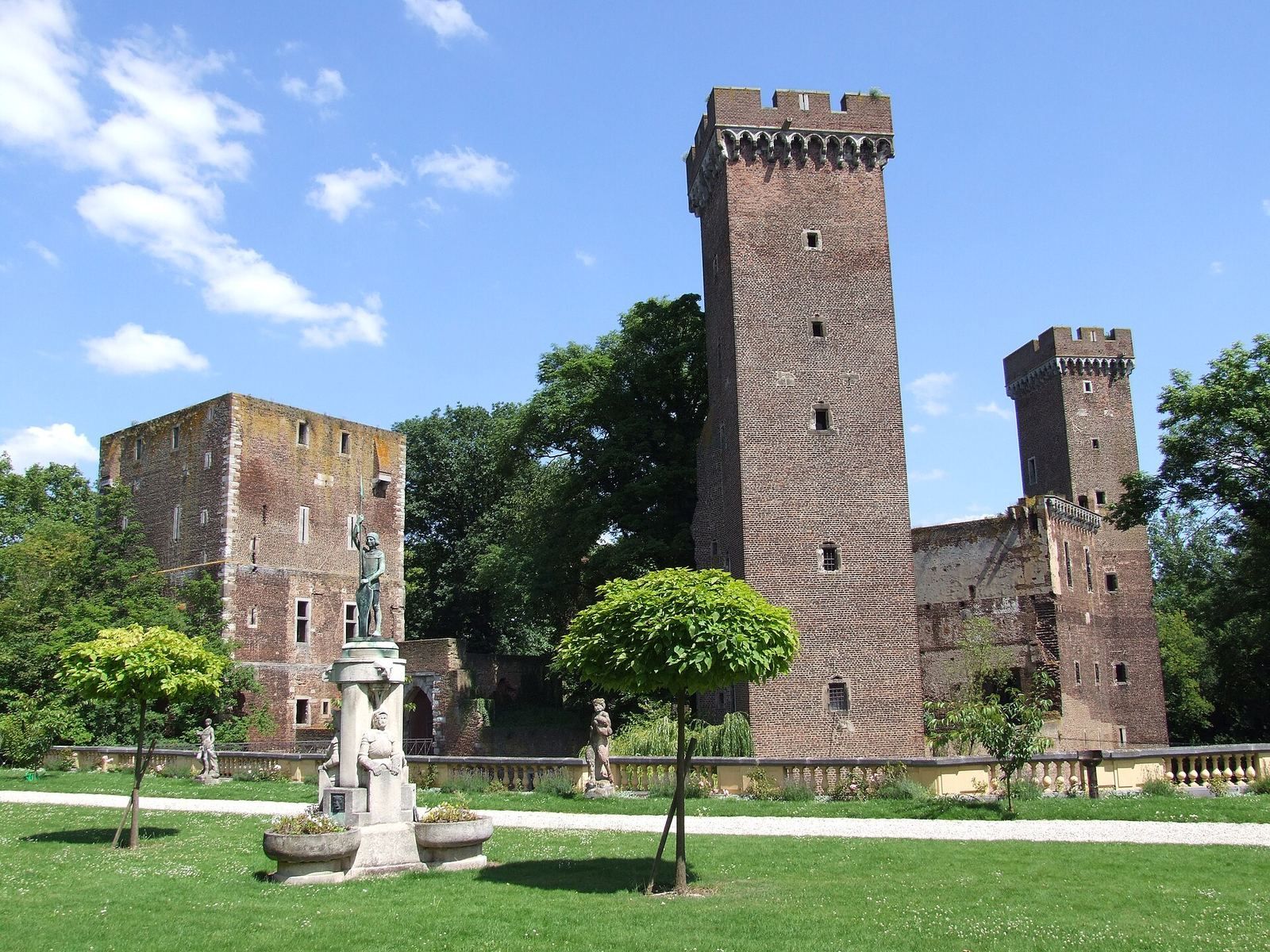
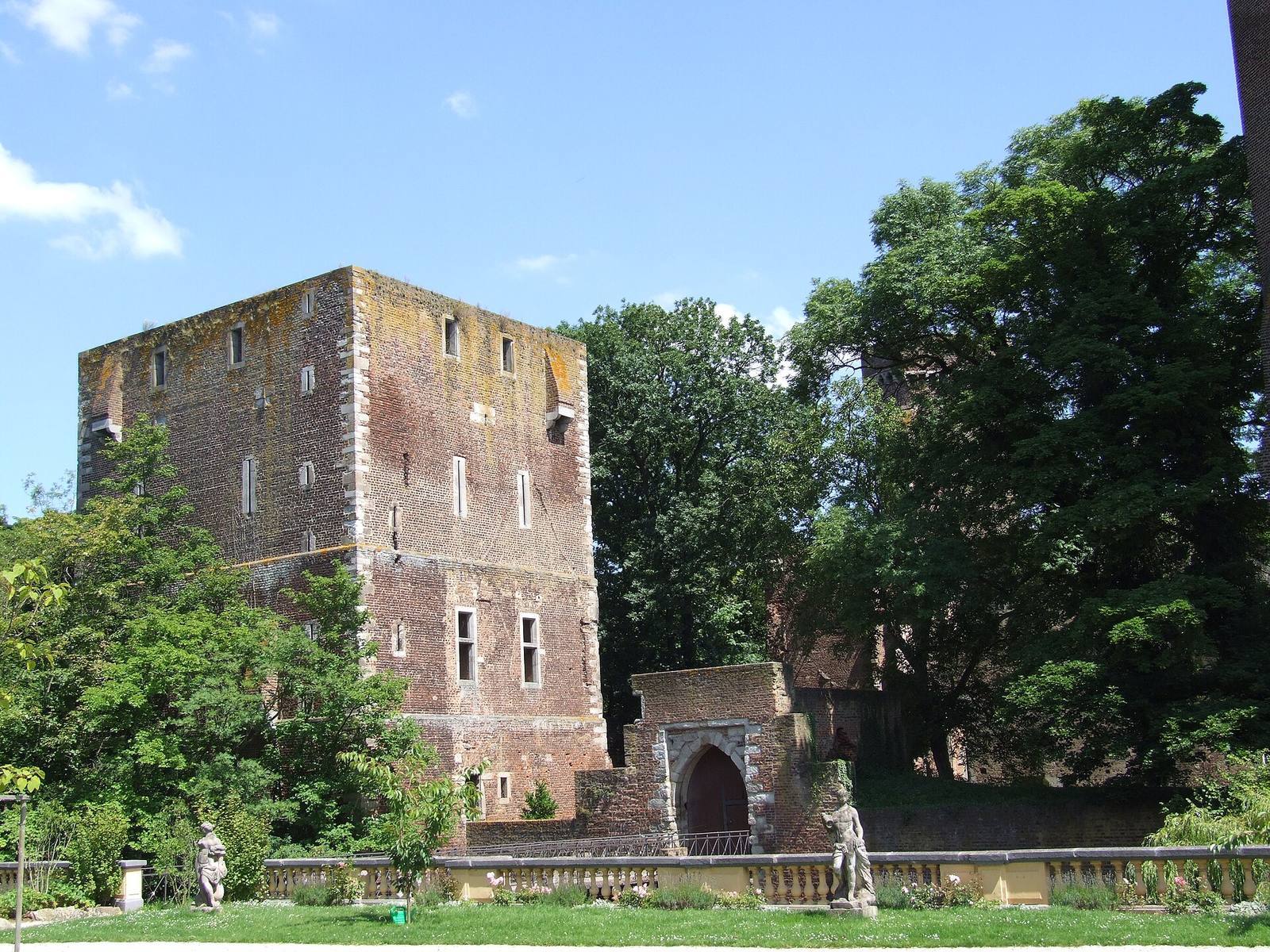
The five-storey main fortified tower measures 15 by 13 metres at its base. Its walls are 2.5 metres thick at the bottom and become 20 centimetres thinner at each higher storey.
The great hall and residential block
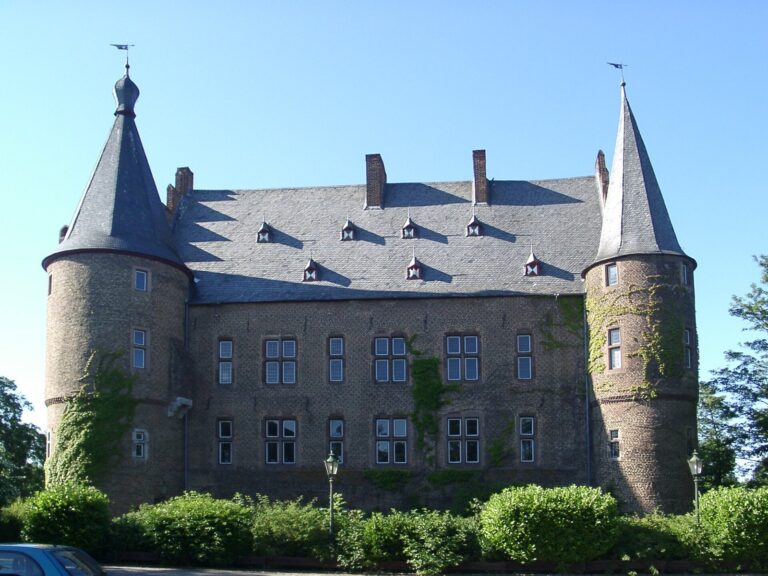
The principal hall and residential building runs along the full eastern side of the complex, measuring 33 by 12 metres. A seven-storey tower stands at each end of it.
Defenses and outer ward
Water defenses
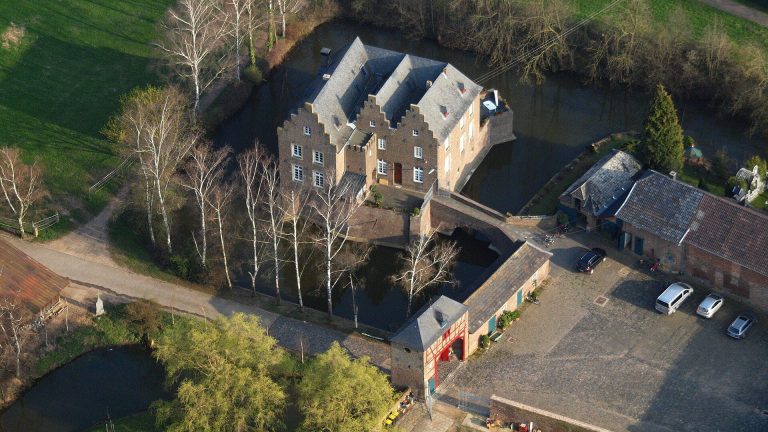
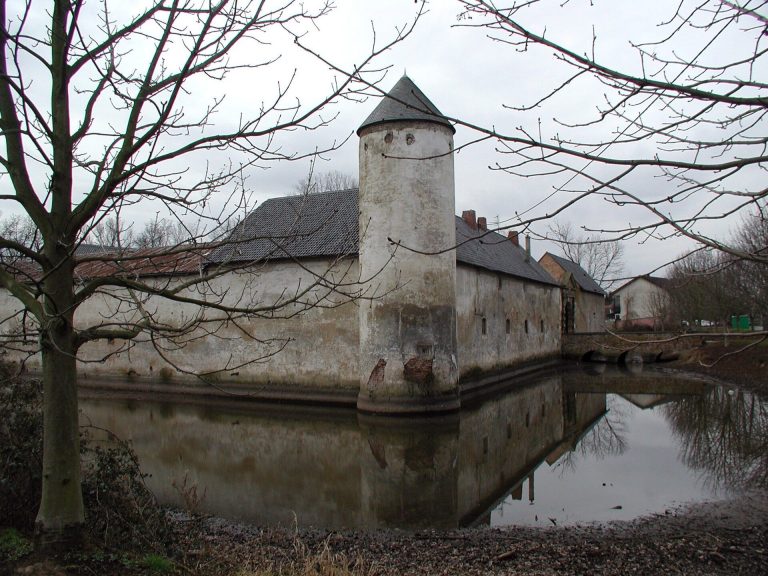
Two broad, water-filled ditches defended the later castle. The outer ditch enclosed the entire grounds, while the inner ditch surrounded the main castle. The town’s own walls and ditches provided a further defensive barrier.
Service and administrative buildings
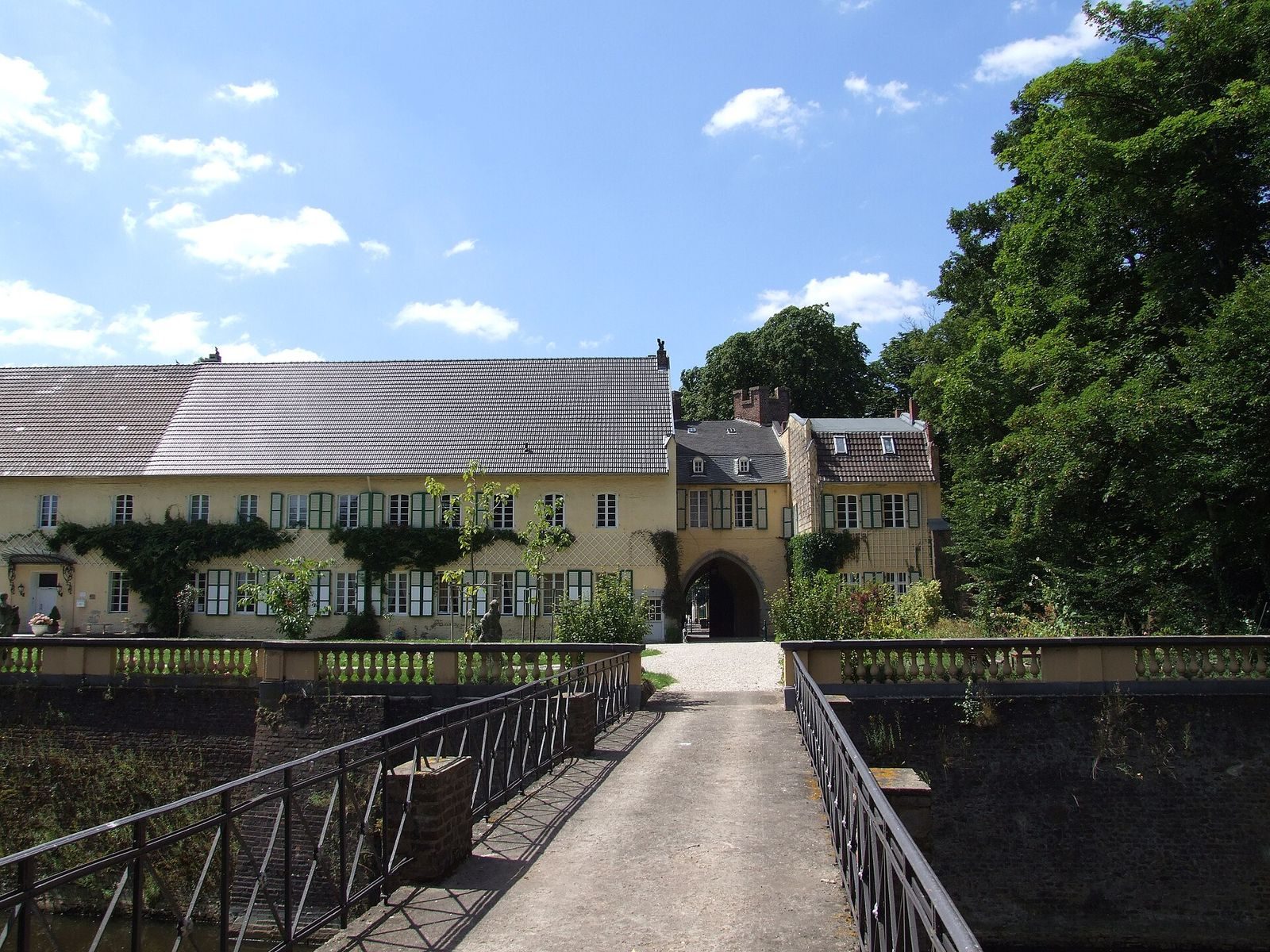
The outer ward contained the castle’s service and farm buildings. Its former administrative house, also known as the financial steward’s house, has been converted into a private residence. Some adjoining buildings are rented out.
Reused stone and altered grounds
Reused grave markers
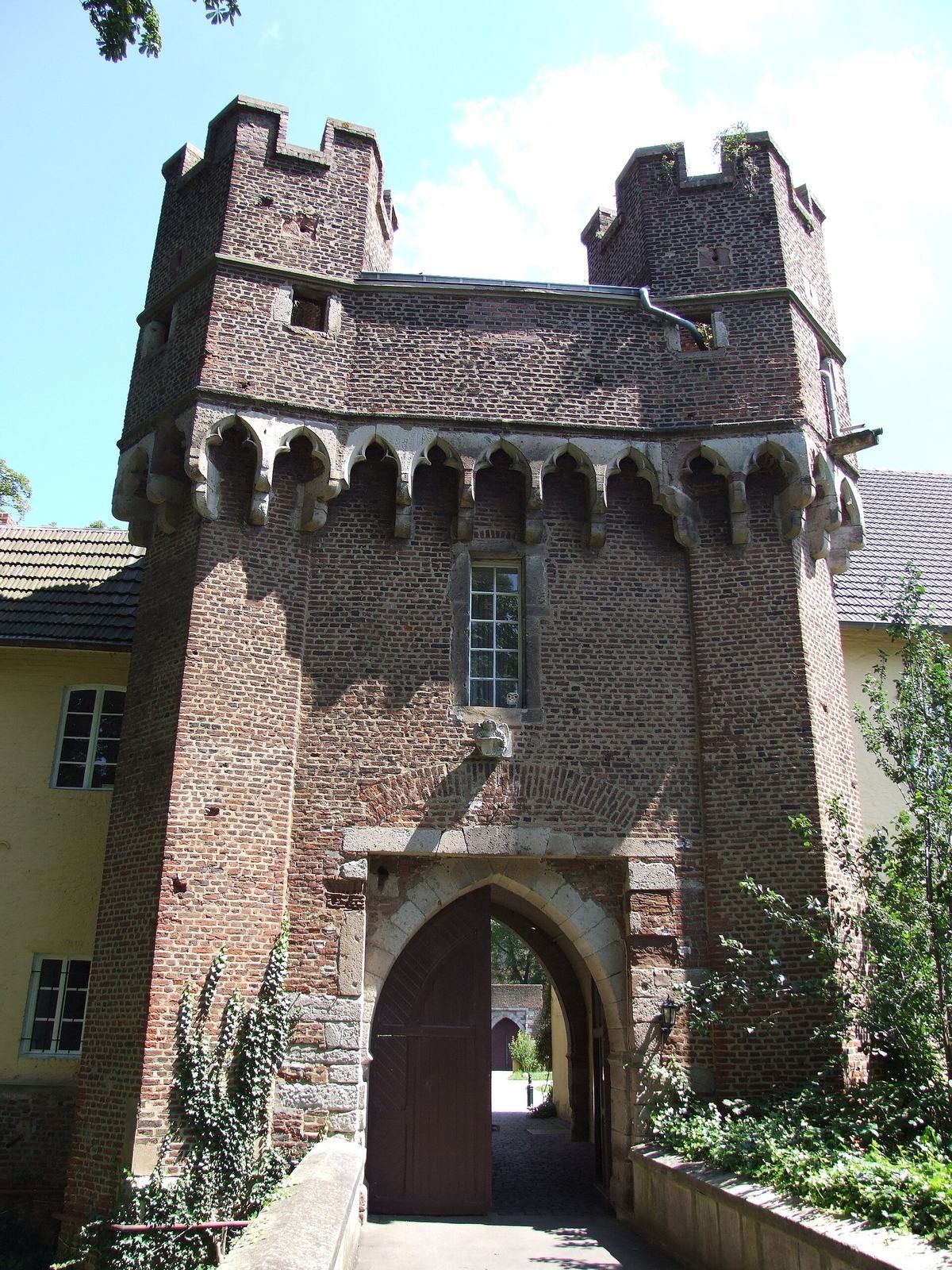
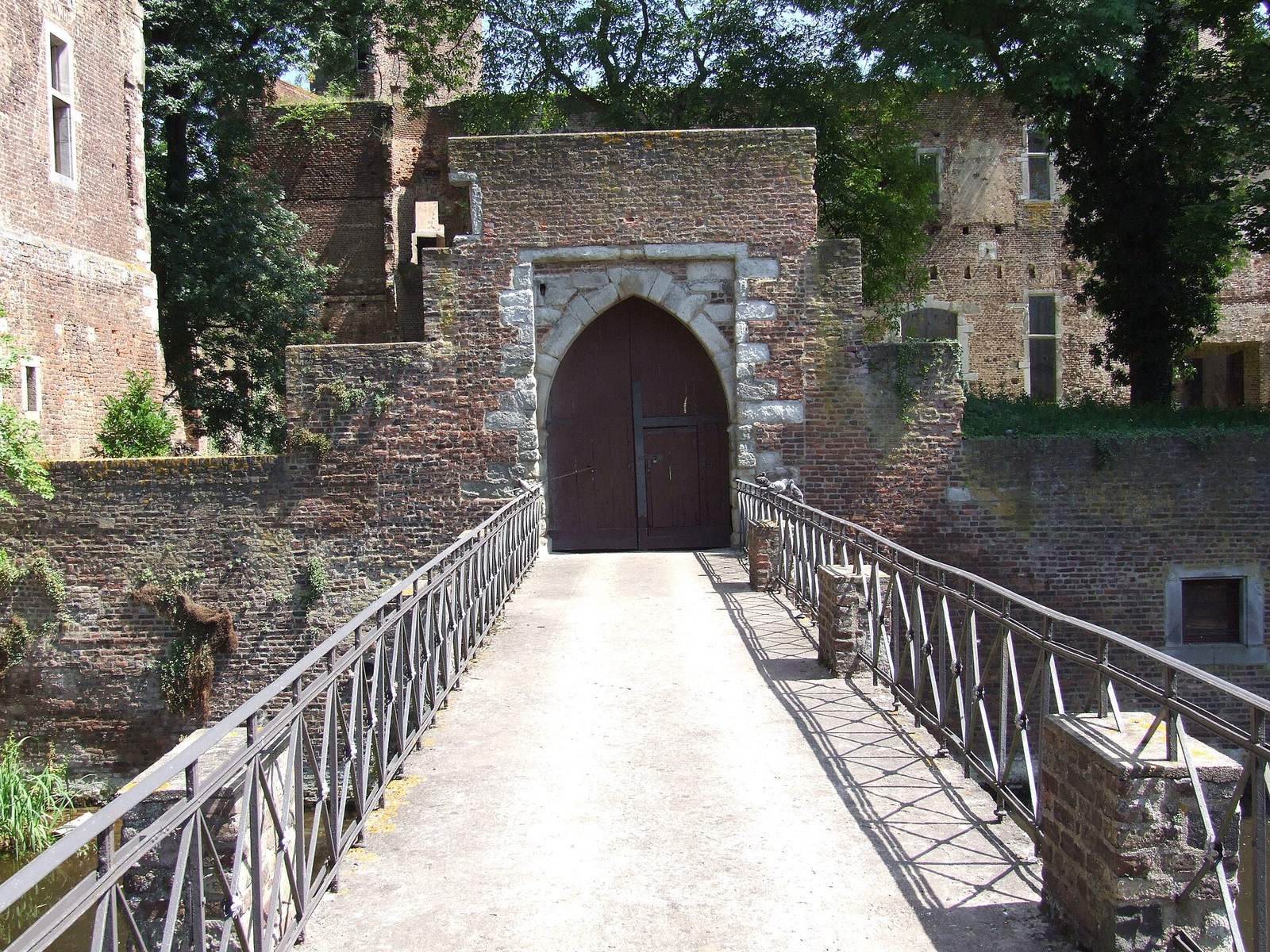
After the persecution of Jews in 1349, gravestones from a disused Jewish cemetery in Cologne were cut down and reused as building material in both the outer and main wards. A well-preserved stone belonging to Mar Jacob is set into the outer-ward gate.
The south wing and former gardens
The castle chapel stood in the south wing. The remaining parts of that wing, including the chapel, were demolished after the 1805 sale. Paintings made by A. Reuter in 1795 and 1797 preserve a partial record of the buildings before their removal. Houses and garages now occupy land that formerly served as the castle’s gardens.