Landa Church: A Medieval Parish Church in Frillesås, Sweden
Site at a Glance
- Popularity
- Very Low
- Country
- Sweden
- Primary era
- Early Modern
- Eras represented
- Medieval, Early Modern, Modern
- Civilizations
- Danish, Swedish
- Site type
- Religious
- Remains
- Church
On this page9 sections
History
Landa Church is a medieval parish church in Frillesås, Sweden, built around 1200. It is probably the earliest church in Landa to survive, and its present character reflects changes made in the late eighteenth and early nineteenth centuries. The church belongs to Landa Parish in the Diocese of Gothenburg.
Medieval origins
The church’s form suggests that monks from Ås Abbey helped build it. Ås Abbey was a medieval Cistercian monastery in Halland. Knowledge of Landa Church’s beginnings was lost when a fire destroyed records at Ölmevalla rectory during the seventeenth century.
Alterations and the leaning tower
In 1788, workers demolished the medieval chancel and lengthened the church eastward. A west tower followed soon afterward, and the bell was moved into it from a separate bell stand. These changes gave the church much of its late eighteenth- and early nineteenth-century character.
At a bishop’s visitation in 1836, the tower was reported to have settled by about three Swedish ells, nearly two metres. The observation linked its heavy stone construction with the clay beneath the church.
Restoration and later discoveries
A major restoration in 1915 added a sacristy on the north side of the chancel. Medieval wall paintings were uncovered in 2001.
Remains
Plan and exterior
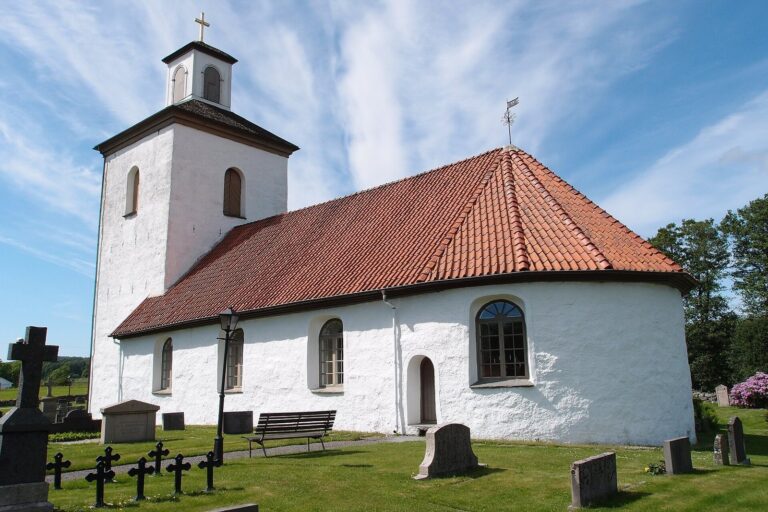
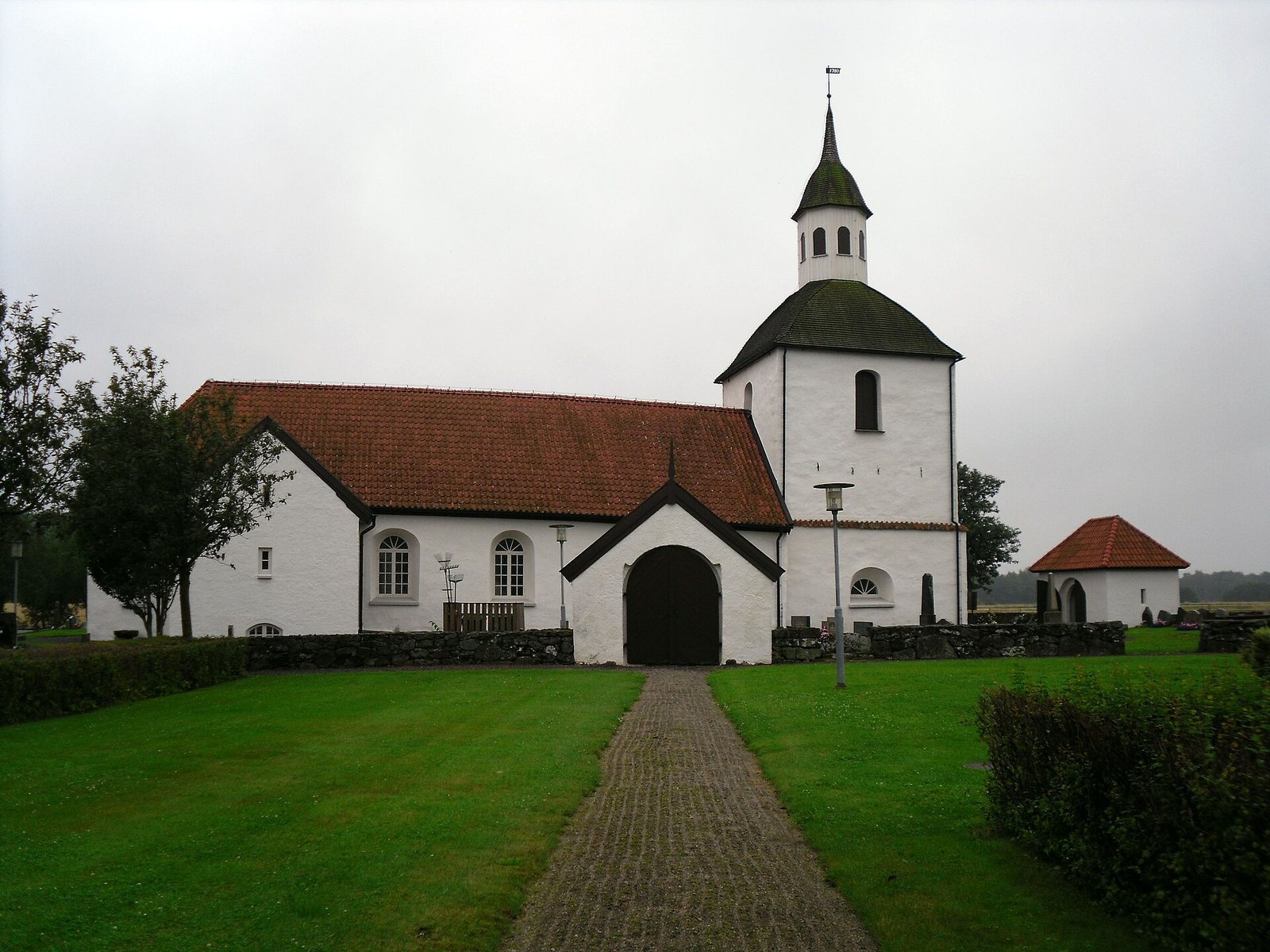
The church stands in a valley between wooded, rocky slopes. Its plan consists of a rectangular nave, the main body of the church, and a three-sided chancel around the altar. A sacristy projects from the chancel’s north side, while the west tower provides an entrance through its ground floor. Another entrance opens directly into the chancel from the southeast. The churchyard is enclosed by a wall with three white-plastered lychgates, or covered gateways. Built of stone and finished with white plaster inside and out, the church has large, round-arched openings. Substantial medieval masonry survives in the nave’s western part. The tower has a curved roof and a slender lantern, a small raised structure at its top, in a Gustavian style associated with eighteenth-century Swedish design. It leans on the clay soil beneath its heavy stonework.
Vault and paintings
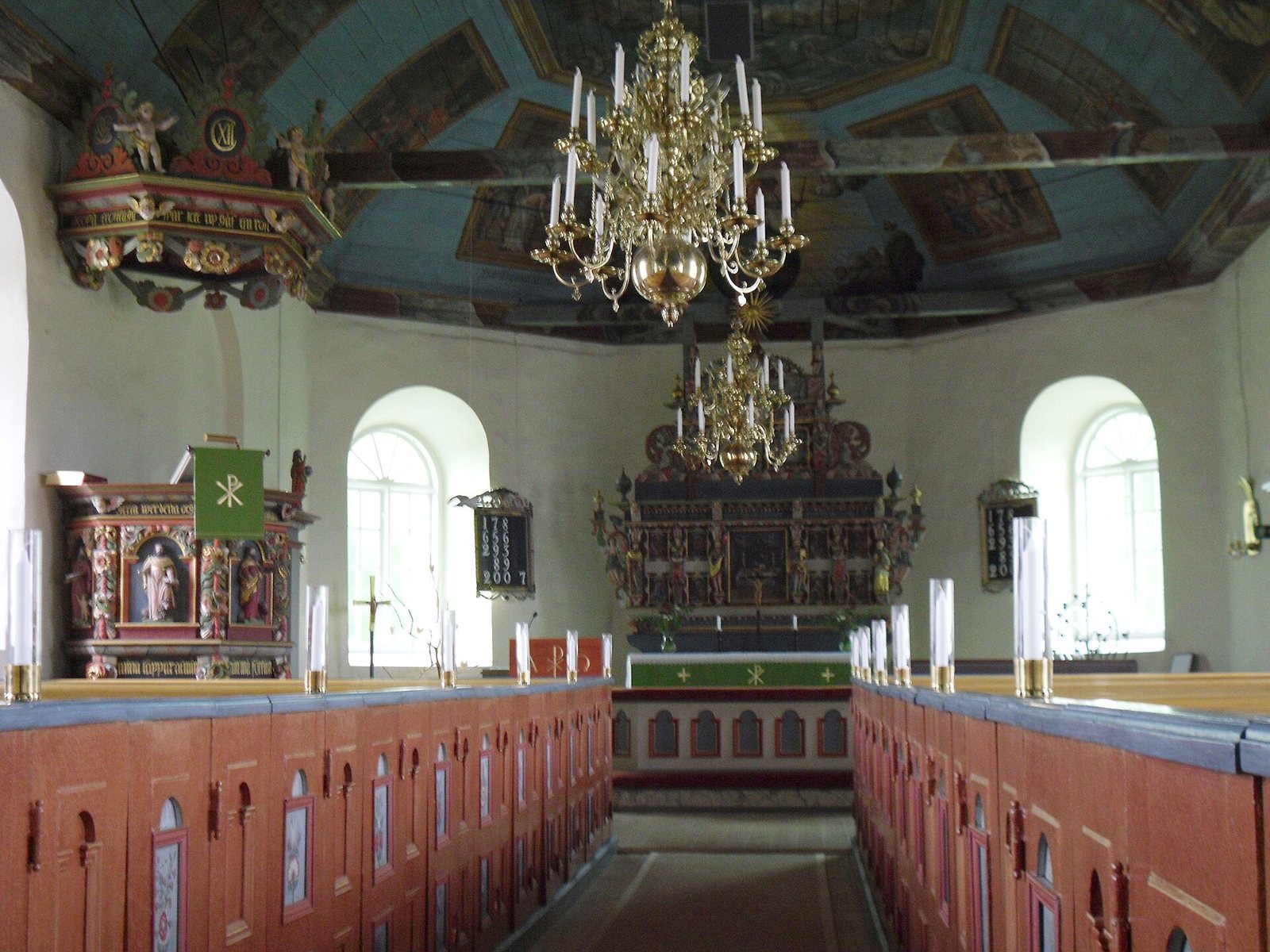
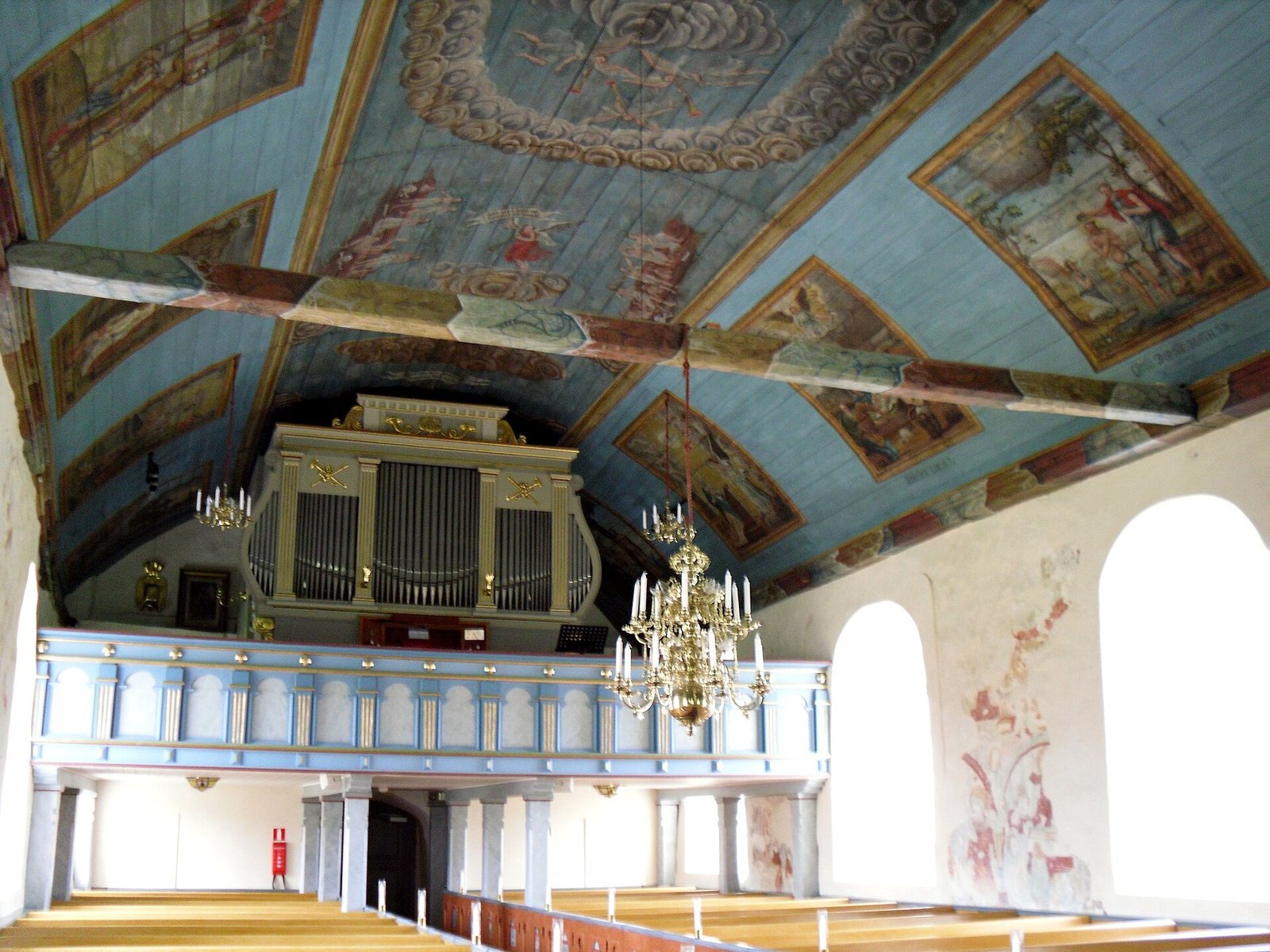
A wooden plank barrel vault, a continuous curved ceiling, dates to 1804. Exposed crossbeams and a pronounced cornice frame figurative paintings by Peter Hallberg and Varberg decorative painter Jacob Magnus Hultgren. The two artists also painted the pulpit and altar retable. The ceiling paintings have remained uncovered; during the 1915 restoration, a glaze-like treatment along the ceiling’s sides was changed to solid grey-green. The church also has wall paintings dating from the late fifteenth century to around 1520.
Altar and pulpit
The altar slab has a cavity for relics. Behind the altar stands a seventeenth-century retable, the decorated structure above or behind an altar, attributed to Marcus Jäger the Elder. Its stepped arrangement rises from a base through three recessed levels: two lower square panels show an Easter lamb and a crown of thorns, above them a triangle is flanked by angels with trumpets, and a gilded sun crowns the composition. The divine name JHWH, commonly rendered in English as Yahweh or Jehovah, appears at the top and in the ceiling decoration. The pulpit, made in 1699 by sculptor Master Hans Hultman, carries figures of the four Evangelists, the traditional authors associated with the Gospels. Their customary symbols appear with them: Matthew with an angel, Mark with a lion, Luke with an ox, and John with an eagle. Three Swedish kings, Gustaf V, Karl XII, and Gustav IV Adolf, are represented by royal initials on its canopy. A seventeenth-century pew stands in the chancel.
Organ
The church acquired a pipe organ in 1920. A. Magnusson Orgelbyggeri AB reconfigured it in 1959 with partly mechanical controls and eleven stops, which control sets of pipes, across two hand-operated keyboards and a foot-operated keyboard. Tostared Church Organ Factory rebuilt it in 1981 behind its existing facade. During the 1990s, the organ’s sound was adjusted to be stronger, including changes to the Principal and Octave stops in its main division.