Lamspringe Abbey: A Benedictine Monastery in Germany
Site at a Glance
- Popularity
- Medium
- Country
- Germany
- Primary era
- Early Modern
- Eras represented
- Medieval, Early Modern, Modern
- Civilizations
- German, Holy Roman Empire
- Site type
- Religious
- Remains
- Monastery
On this page17 sections
History
Lamspringe Abbey is a former religious house in Lamspringe, Germany, conventionally founded around 850 as a community of women. First recorded in 872, it grew into one of the wealthiest religious houses in the Diocese of Hildesheim before becoming a home for English Benedictine monks in exile. Its later history includes destruction during sixteenth-century conflicts, a change of religious life under the Reformation, and dissolution in 1803.
Foundation and medieval expansion
The abbey is first mentioned in 872, when Bishop Altfried of Hildesheim transferred tithes, a share of income or produce, to the women’s religious house. A foundation tradition written down in the sixteenth century names the Saxon noble Ricdag and his wife Imhildis as its founders. It places the house beside the Lamme spring and identifies their daughter Ricburga as its first abbess. The same tradition says that Altfried, described as Ricdag’s nephew, helped the founders obtain relics of the martyr Adrian from Pope Sergius II during a pilgrimage to Rome.
Shortly before 1130, the community adopted a reformed form of Benedictine religious life. Support from the bishops of Hildesheim and gifts from other patrons helped it accumulate extensive property. Duke Henry the Lion made a substantial donation in 1169, and Bishop Adelog confirmed the abbey’s holdings in 1178. Later gifts included land at Elze from Konrad of Westerhof in 1190 and property from Count Wedekind of Poppenburg in 1230. By 1259 the abbey held most of the nearby settlements and had gained rights of local protection and jurisdiction.
In the twelfth century, its holdings included about 300 hides, a traditional measure of agricultural land, along with farmland and woodland, ten mills, tithes in 17 places, and rights at four churches. Its estates extended from Seesen toward Brunswick and the Schaumburg region, with much of the property east of Lamspringe and in the Ambergau. The convent had about 180 canonesses, women belonging to a religious community, during the twelfth and thirteenth centuries. Its nuns copied and decorated manuscripts in a scriptorium, a room or workshop for preparing books, and built up a substantial library. The settlement of Lamspringe also grew around the need for agricultural and other workers. The abbey remained the diocese’s richest religious house until the fourteenth century.
The abbey’s property policy also included Iseshusen, near Rhüden. The settlement may have been an estate or an outfarm belonging to the abbey. It existed from approximately the twelfth to the fourteenth century, after which it became deserted.
Financial strain and sixteenth-century conflicts
During Bishop Gerhard’s rule, feuding and the loss of tithes and other income slowed the growth of both the abbey and the town. In 1405, King Rupert granted the abbey exemption from royal taxes, tolls, and military service after it petitioned him. Aristocratic gifts did not, however, end its financial difficulties.
The Hildesheim Diocesan Feud, a territorial conflict between the Prince-Bishopric of Hildesheim and Brunswick-Wolfenbüttel, brought direct destruction. Lamspringe and the abbey were burned in 1521 and again in 1522. Under the 1523 settlement at Quedlinburg, the town came under the Welf dynasty’s rule, then held by Henry the Younger. In 1552, during the Schmalkaldic War, a conflict between the Holy Roman Emperor and Protestant princes, mercenaries led by Vollrad von Mansfeld attacked the town and abused Catholic nuns.
Reformation and Catholic restoration
Duke Julius introduced the Reformation in his territory from 1568. The Catholic convent was turned into a Protestant women’s foundation with 19 residents, a change intended to keep the property operating as an economic enterprise. In 1572, Julius ordered valuable artworks, manuscripts, and books moved to Wolfenbüttel. Some valuables were melted down or put to other uses. Twenty-two of the most valuable manuscripts remain in the Herzog August Library, including 16 that date from before the thirteenth century.
The 1643 settlement returned Lamspringe to the Catholic bishopric of Hildesheim. Seeking to establish Catholic centers in his Protestant territories, the bishop arranged for the neglected buildings to pass to English Benedictine monks living in exile because of restrictions on Catholic religious life in England. Although the monks had been granted the premises in 1630, they took possession in the early 1640s. Eight monks formed the first community. Lamspringe became the English Benedictine Congregation’s only abbey in exile in Germany, and its renewed religious and economic life brought a new period of prosperity.
Eight English abbots governed the abbey between 1643 and 1803, and 172 monks took their vows there between 1644 and 1802. An English Catholic school for boys opened in the late seventeenth century, when Catholicism faced severe restrictions in England. It taught pupils aged eight to 17, usually between ten and 45 at a time, in theology, philosophy, and canon law; graduates went on to priestly ordination. In the eighteenth century, Lamspringe was a center for training Catholic clergy for England and the British Isles. The school and its pupils later moved to Ampleforth, where the school formed the basis of Ampleforth College. The first German joined the abbey in 1751.
In 1683, the English monk and later abbot Maurus Corker arranged for Oliver Plunkett’s remains to be brought to Lamspringe. Plunkett, an Irish Catholic archbishop, had been executed in England in 1681 and was venerated as a martyr. The abbey also held the head of Thomas of Hereford, a medieval bishop venerated as a saint. The community’s work extended beyond religious life: near the end of the eighteenth century it established a glassworks east of Lamspringe, in what is now Glashütte. Marketing problems soon forced it to close. Johann Friedrich Stender restarted the business in 1792, and the Stender glassworks continued until 1914.
Dissolution and later use
Prussia dissolved the abbey on 3 January 1803, after occupying Hildesheim in 1802. The state confiscated the abbey’s assets, which belonged to the Benedictine order rather than to the resident monks, and granted the 21 monks lifetime pensions. Seven left the order, with some remaining in Lamspringe, while 14 returned to England. The monastic community re-formed at Broadway in Worcestershire between 1828 and 1841, then dispersed among other houses without ever being formally dissolved. Its last surviving members joined Fort Augustus Abbey when it was founded in 1876.
The church was made available to Lamspringe’s Catholic community after the dissolution. The town formed part of the Kingdom of Westphalia, a Napoleonic-era kingdom in central Germany, from 1807 to 1813, and came under the Kingdom of Hanover in 1814. In 1818, the abbey buildings and lands were assigned to the Hanover Monastic Chamber, the state institution responsible for former monastic properties in Lower Saxony. The church serves the Catholic parish of the Assumption in the Diocese of Hildesheim, and an annual pilgrimage honors Oliver Plunkett.
About 1,100 books from the abbey library initially remained with monks who still lived at Lamspringe. An attempt to transfer the remaining books to England in 1821 failed, and they were sent to Hildesheim. Today, 161 books from the collection survive in libraries in Hildesheim and England. The St Albans Psalter, a richly illustrated book of Psalms brought to Lamspringe by the English monks, is now held at the Basilica of St Godehard in Hildesheim.
Remains
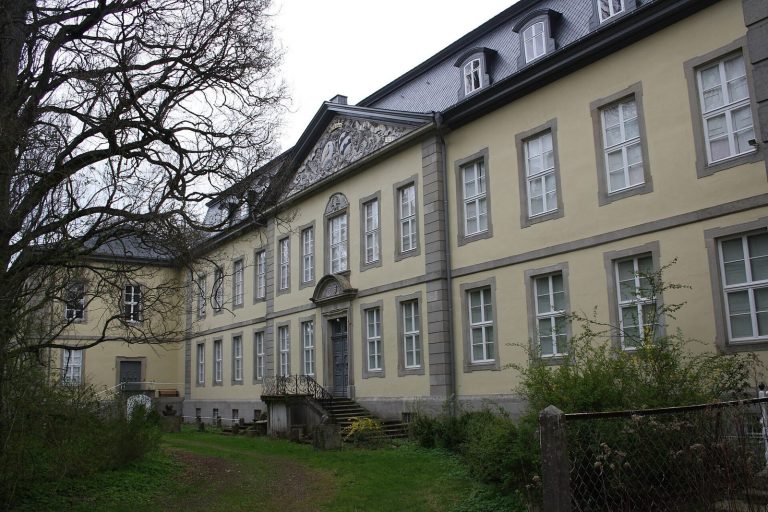
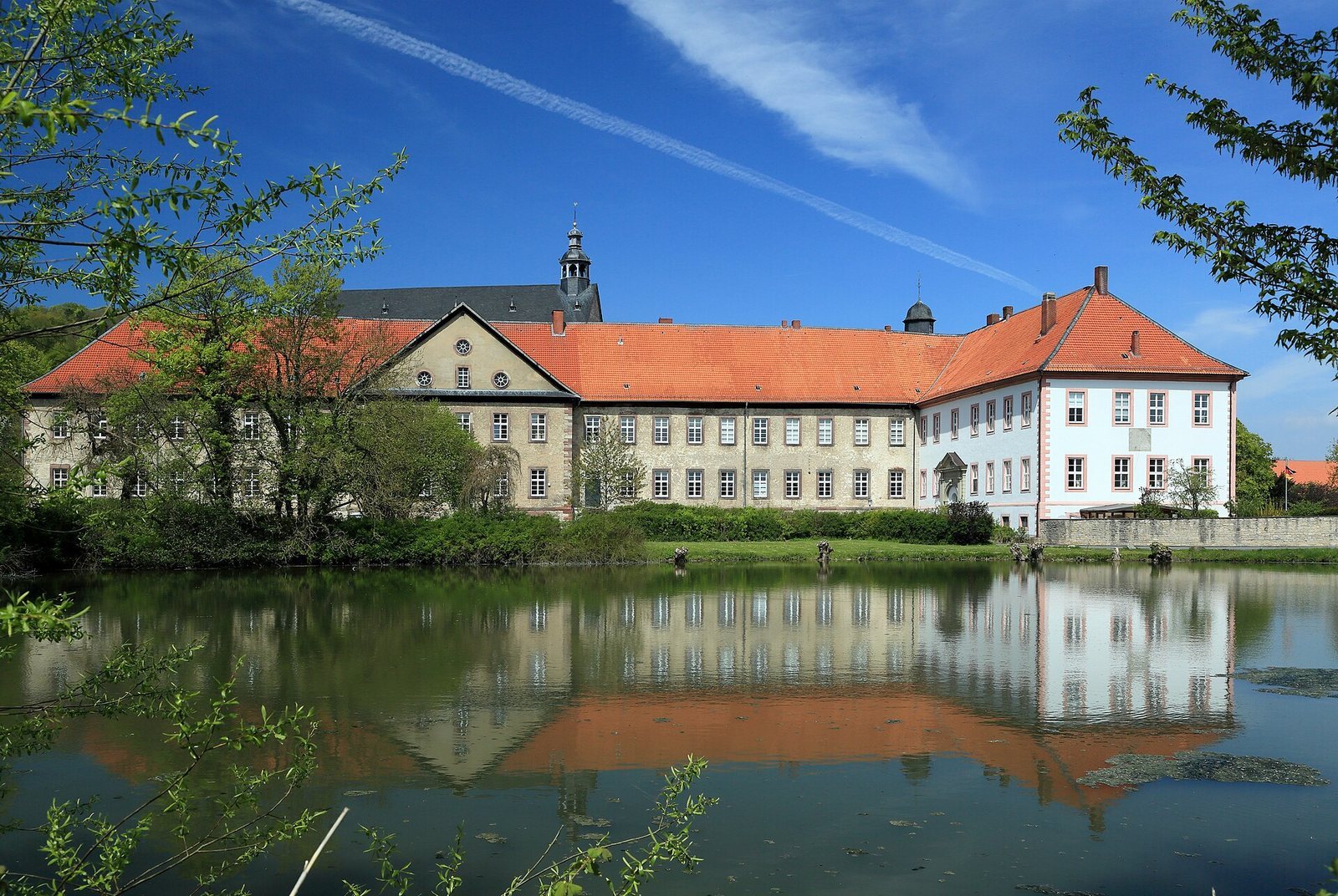
The surviving complex brings together a large church, two Baroque wings set at right angles, and grounds that include farm buildings and the former abbey garden. The principal buildings use stone, with rubble stone in the church and quarried stone in the abbey wings. The church and the wings reflect the rebuilding and expansion of the religious house after its return to Catholic life.
Abbey church
Structure
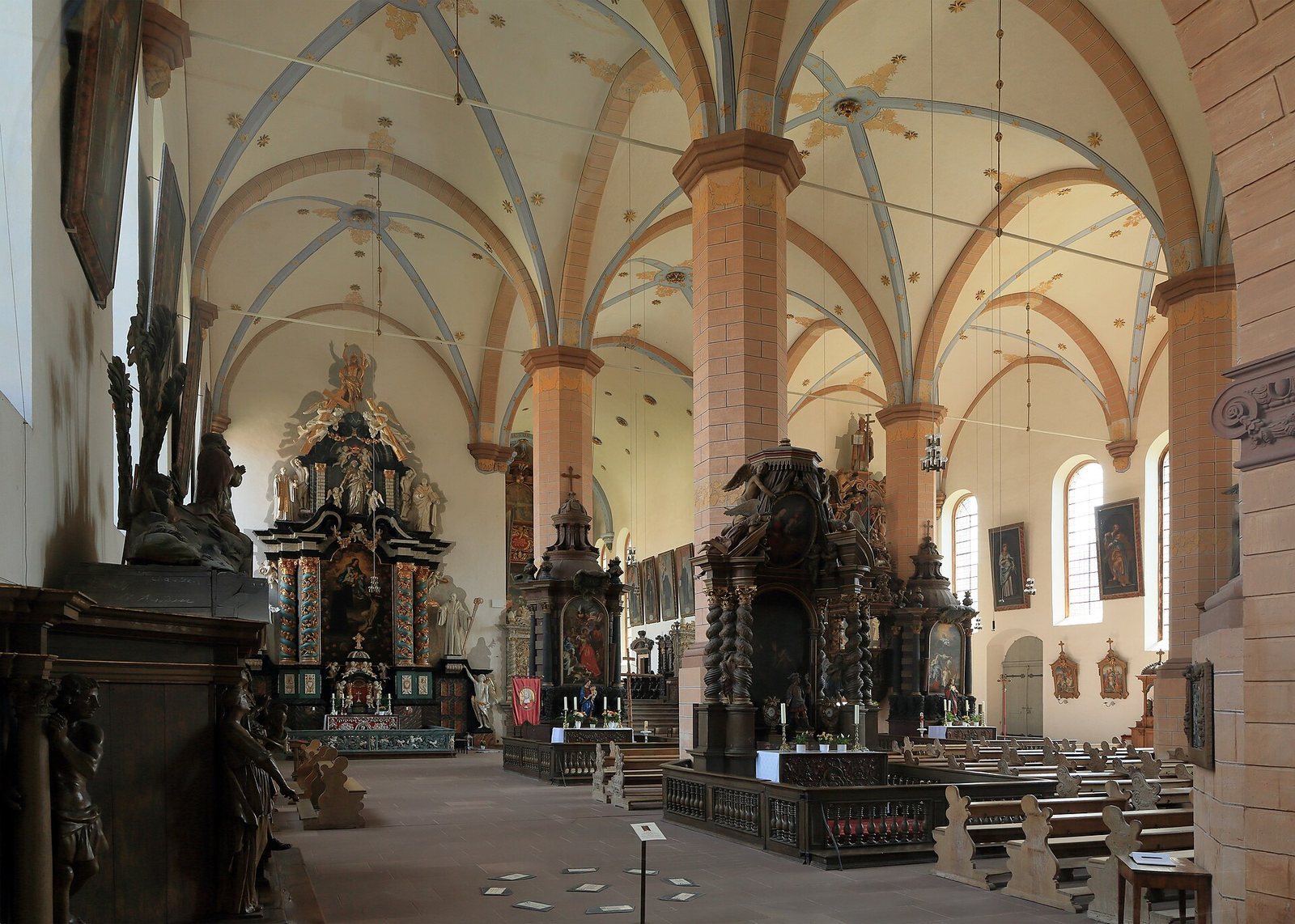
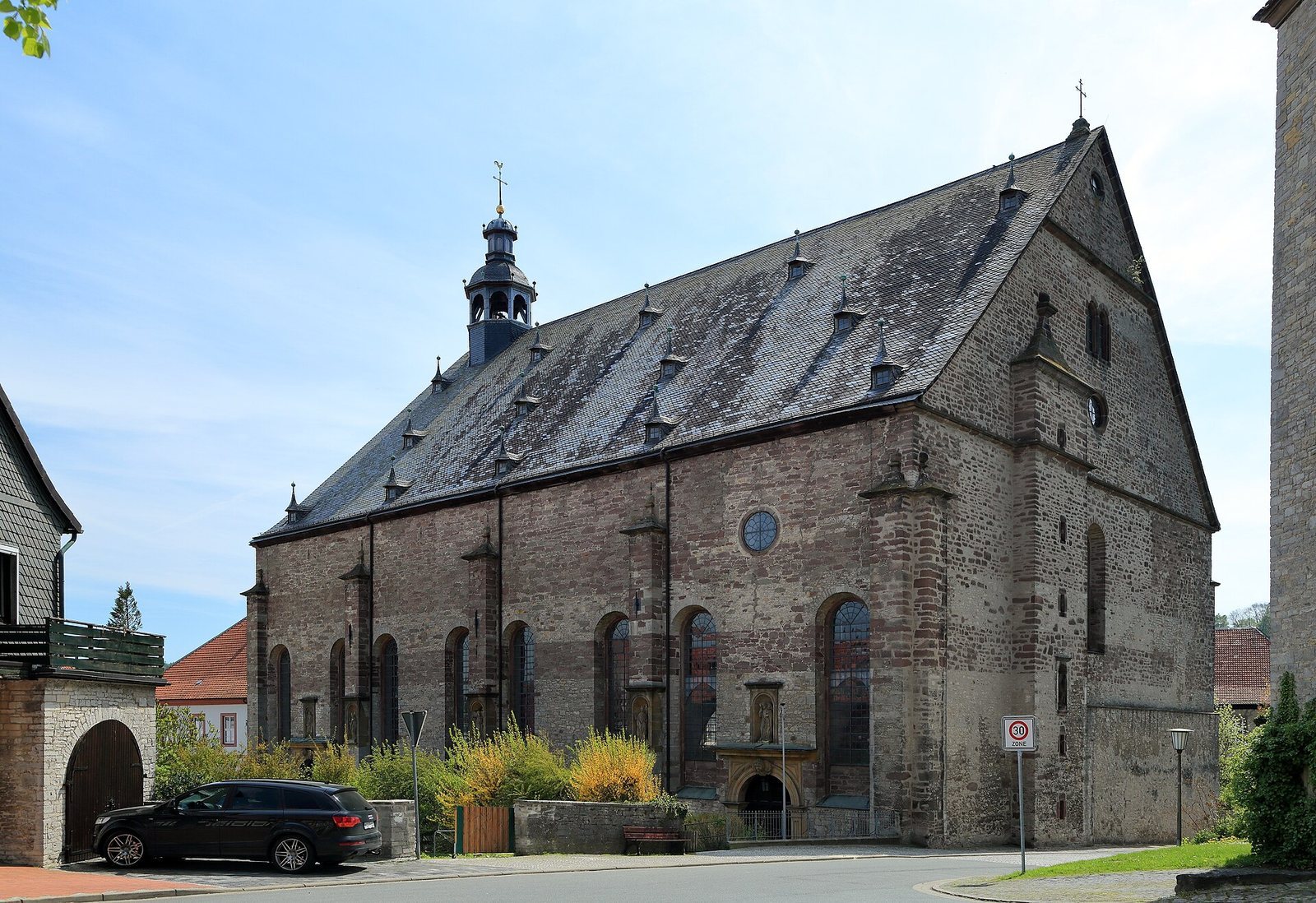
Dedicated to St Adrian and St Dionysius, the church is a three-aisled hall built of rubble stone. It measures 60 metres long and 29 metres wide, with an 18-metre-high nave, a crypt below, and a choir ending in several angled sides. Octagonal piers support both barrel vaults, long curved ceilings, and groin vaults, formed where curved ceilings intersect. The slate-covered gabled roof has 14 dormers and small turrets on each side.
Altars and furnishings
The richly decorated Baroque interior has seven altars, including the high altar, the 15-metre Rosary altar, and altars dedicated to St Benedict, St Joseph, St Catherine, St Dionysius, and St Adrian. Johann Mauritz Gröninger made the high altar and two others. Most of the carved furnishings, including the choir stalls and pulpit, came from Jobst Heinrich Lessen’s workshop. A table-form altar dedicated to St Oliver was consecrated in 1982. A Benedictine lay brother decorated the holy-water basin in the 1710s with polished plaster designed to resemble marble.
Andreas Schweimb supplied the original organ in 1693. The present instrument, built by Philipp Furtwängler & Sons in 1876, retains the earlier case and 24 of its 45 sound-producing registers. A reliquary shrine in the church holds part of Oliver Plunkett’s remains.
Painted decoration and crypt
Restoration work revealed eighteenth-century painted decoration that had been covered in the early twentieth century. Work on the choir screen was completed around 1960, and restoration has also been carried out at the front left side altar. In the crypt, Alfred Ehrhardt painted 14 works across the walls and ceiling in 1926–27. Their Christian subjects include scenes from the traditional lives of Ricdag and Oliver Plunkett. The paintings were whitewashed in 1938 after being condemned as degenerate art. Old photographs drew attention to them again in 2003, and six ceiling paintings were uncovered between 2006 and 2010.
Abbey wings
Abbey wing
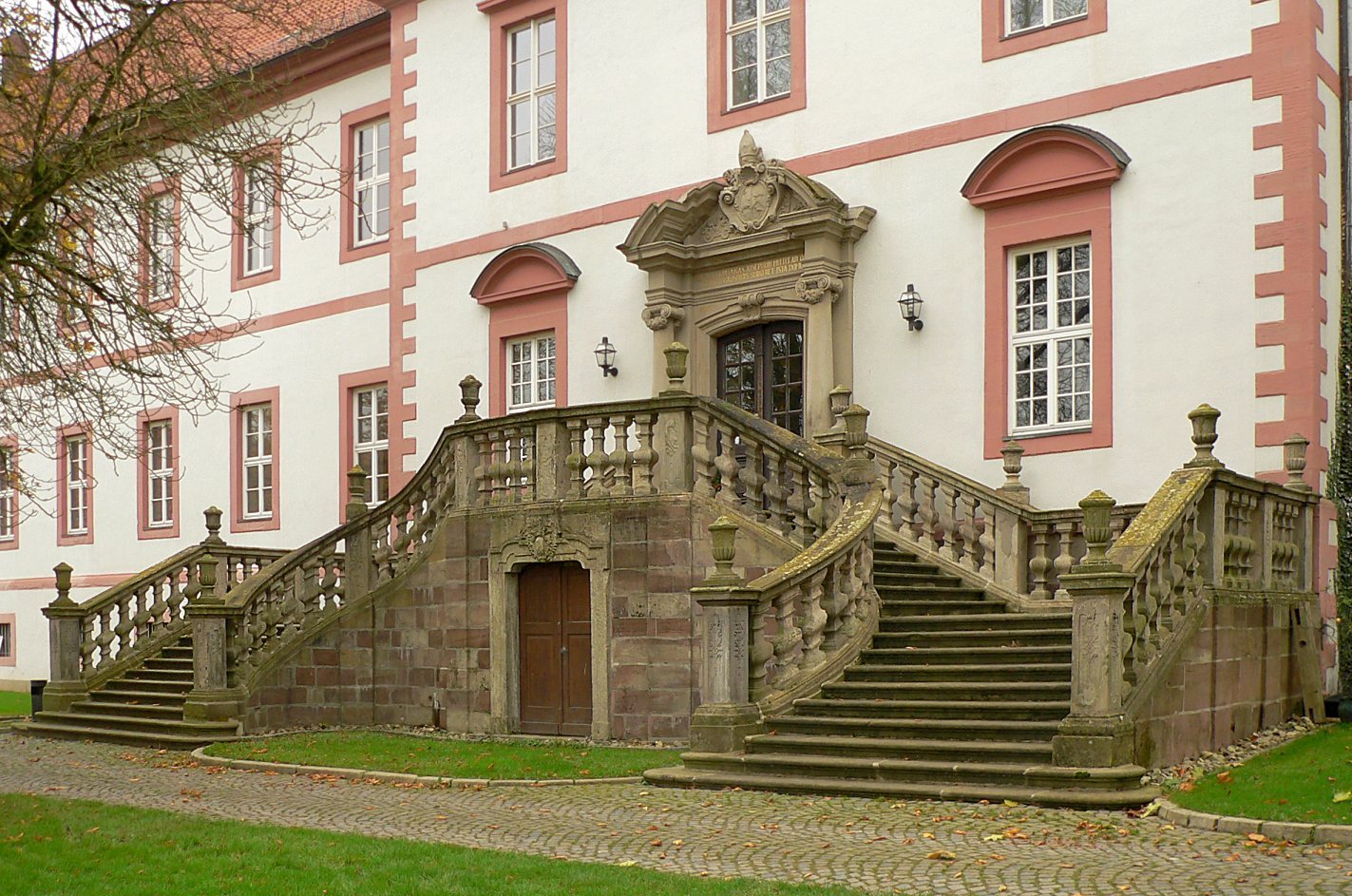
The two-storey Baroque complex began around 1730, after the earlier buildings were demolished because of their poor condition. The new plan was larger, so builders could reuse only some of the old foundations. Stone came from quarries in the nearby Heber and Söhrberg hills. Built during the 1730s, the 90-metre-long abbey wing has a curving open staircase that leads to an entrance hall. Four allegorical figures representing Africa, America, Asia, and Europe stand in the corners of this space, known as the Hall of the Continents. The central section held formal rooms and the abbot’s working rooms. Surviving interiors include the large Abbot’s Hall, the Twelve-Month Room with painted scenes of the yearly cycle, and a refectory decorated with rural scenes.
Convent wing
The 75-metre convent wing, completed by 1750, joins the abbey wing at a right angle. It housed monks and English theology students. After the abbey’s dissolution, the former convent wing served as an administrative office and later for judicial and residential purposes. Lamspringe’s municipal administration now occupies the building.
Estate grounds
Farm buildings and estate
The estate’s stone agricultural buildings, including extensive barns and stables, date from about 1730–50. A plane tree in the farmyard in front of the abbey wing is nearly 20 metres high and about 300 years old. The estate included 500 acres of land under direct cultivation, 3,500 acres of woodland, and extensive fishponds. Its brewery was established in 1717.
Garden and mill
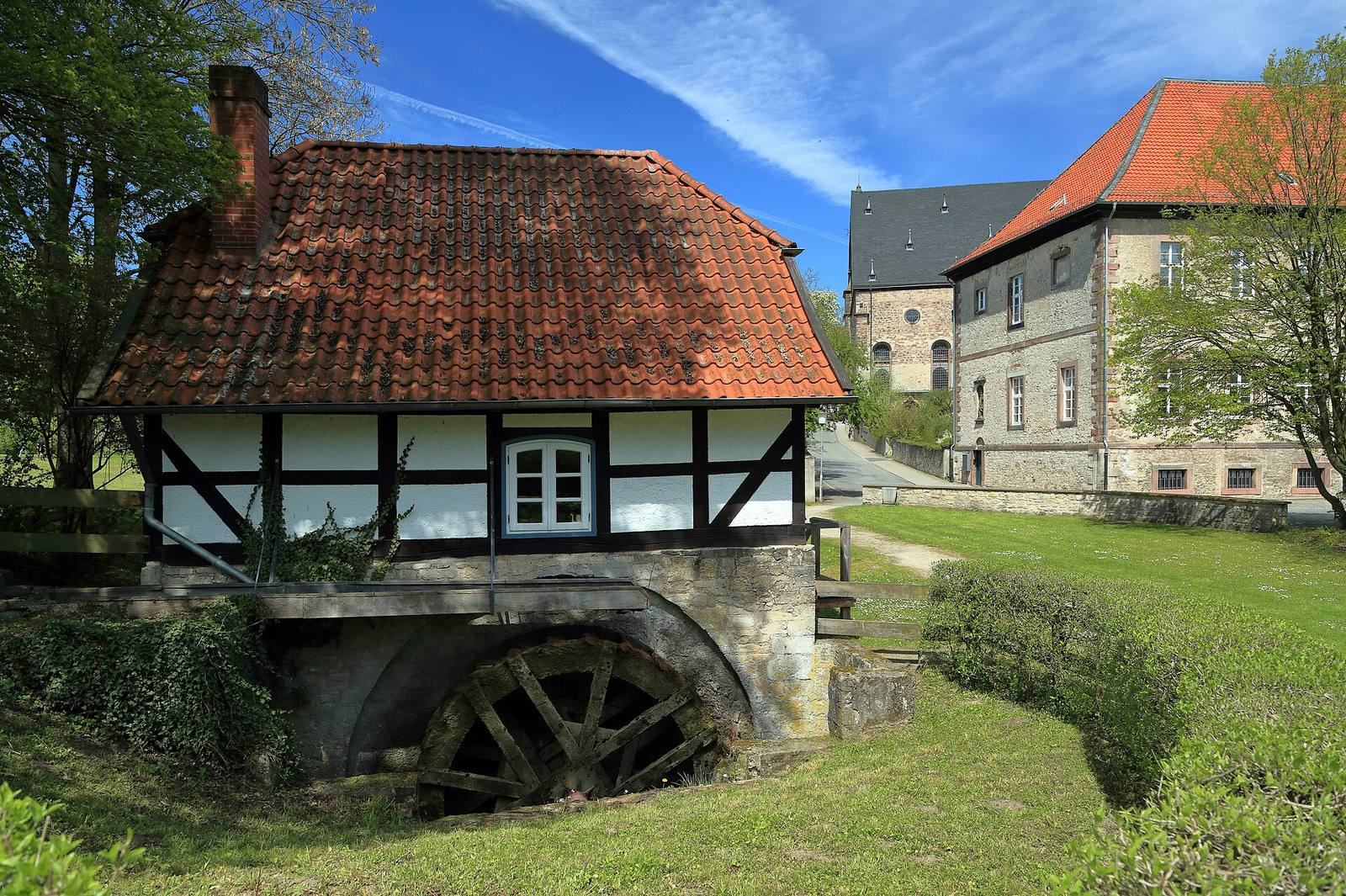
The former walled garden, where the abbey grew vegetables, is now a 5.5-hectare public park. Its features include a grotto at the Lamme spring, the covered Cross Spring, Bakehouse Pond, and Dairy Pond. The abbey mill was rebuilt on its original site in the eighteenth century as a timber-framed building. Water from the Lamme and Cross springs turns its millwheel. Modern sculptures were installed in the park in 1984.
Archaeological evidence
Investigations on the former abbey grounds in 2020 uncovered a well-preserved drain built of limestone masonry around 1730. Two lines of walls probably belong to a late-medieval predecessor complex. The excavated material also included pottery fragments from two medieval globular pots.