La Pierre Couvretière Dolmen: A Late Neolithic Monument in France
Site at a Glance
- Popularity
- Very Low
- Country
- France
- Primary era
- Stone Age
- Eras represented
- Stone Age
- Civilizations
- Unclassified
- Site type
- Burial
- Remains
- Tomb
On this page13 sections
History
Late Neolithic use
La Pierre Couvretière is a Late Neolithic dolmen, a prehistoric megalithic structure often used as a burial monument, beside the Loire in Ancenis-Saint-Géréon, France. The Late Neolithic was the final phase of the Neolithic, a prehistoric period associated with farming and polished-stone technology. Excavations date the monument to this period. It was probably reused several times by communities living along the river, when the Loire’s low-water level stood about 5–8 metres below its present level. These episodes have been compared with settlements of the same period found in the Loire riverbed between Le Bernardeau upstream and La Grillette downstream of the present Ancenis bridge. La Pierre Couvretière is the only dolmen still visible in the Pays d’Ancenis, the local region around Ancenis.
Later history and damage
Charles Gaignard described the monument shortly before the French Revolution, and Eusèbe Girault de Saint-Fargeau wrote about it in 1829. At an uncertain date, its southern half was quarried away. The destruction of its mound caused the capstone to tilt. France classified the dolmen as a historic monument in 1926, a legal heritage-protection designation.
A local legend says God promised Satan exclusive possession of Ancenis’s inhabitants if he could carry three stones into town before the cock crowed. When the bird crowed as Satan was in the Saint-Pierre meadow, he dropped his load and fled to hell. The tale is said to explain the local name “Devil’s Stone.”
Safeguarding and excavation
By the late 1960s, expansion of the Noëlle Ancenis agricultural cooperative had left the surrounding land increasingly used for dumping. A safeguarding effort in 1971–72 considered moving the dolmen, burying it under sand, or improving and retaining it in place. The last option was chosen. Jean L’Helgouach led an excavation in October 1972, followed by another under Daniel Prigent in November 1973. The site later fell into neglect as its surroundings deteriorated. A cleanup in the late 1980s added signs and explanatory panels.
Remains
Setting and surviving structure
Riverside setting and capstone
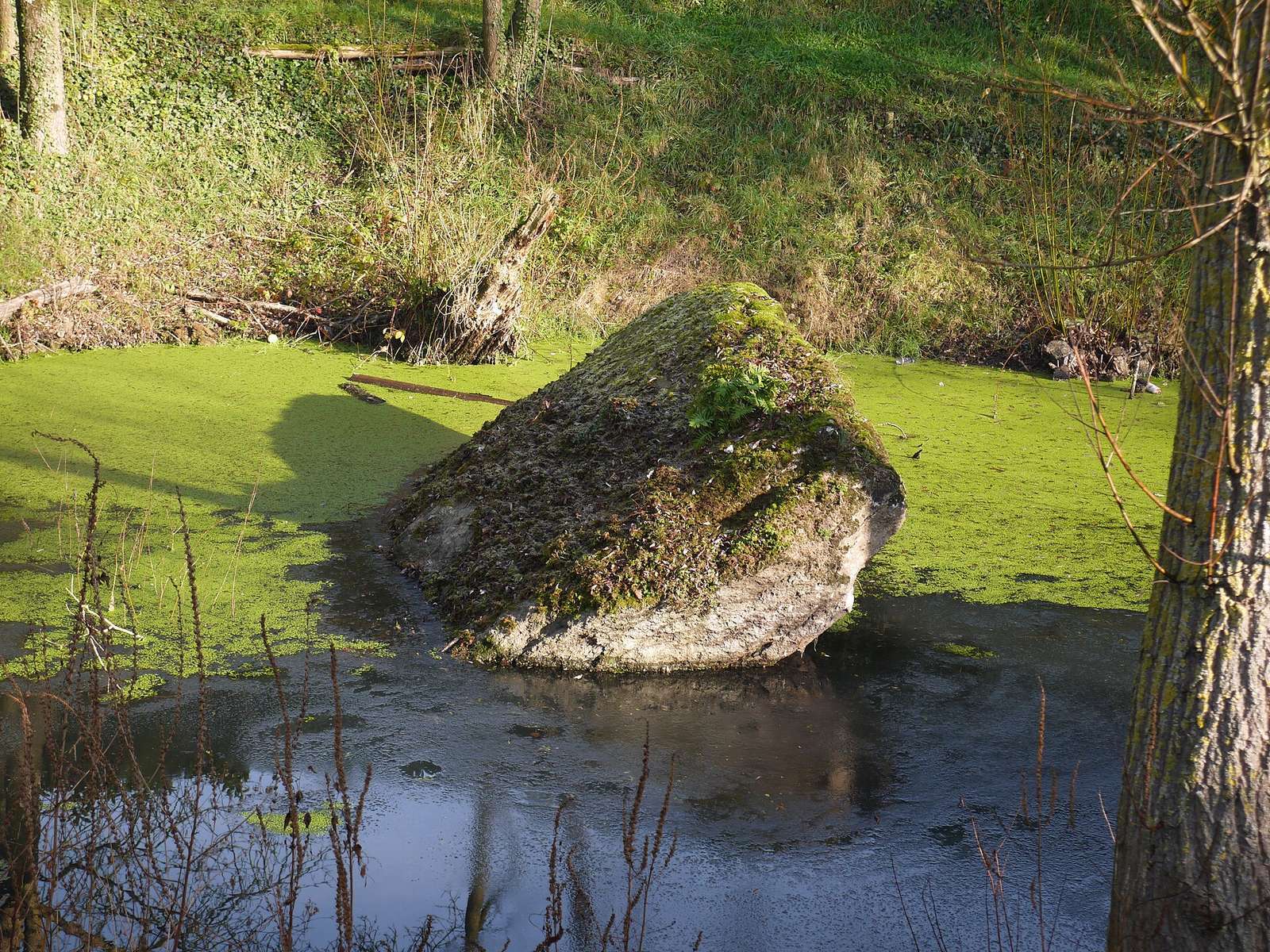
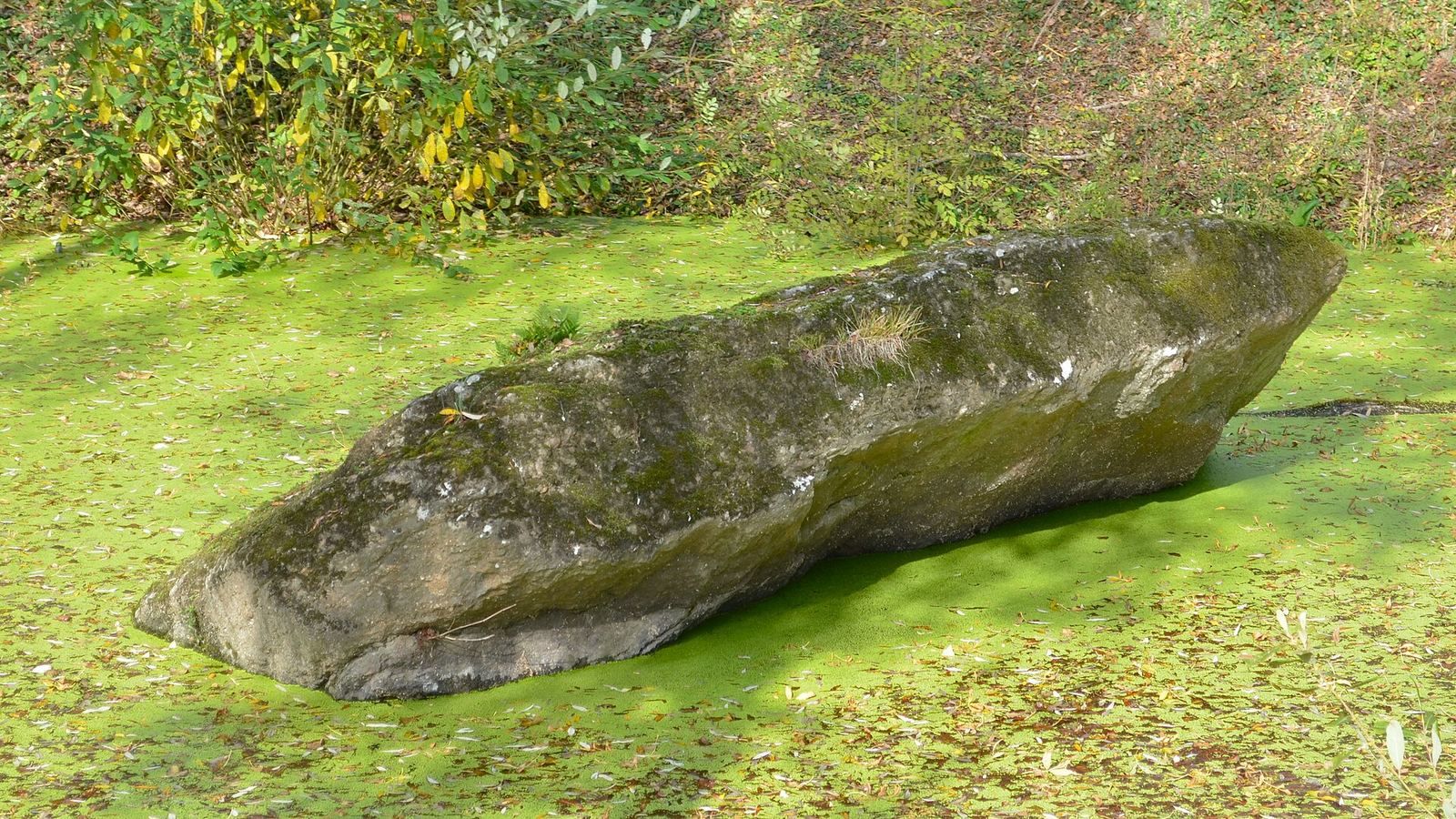
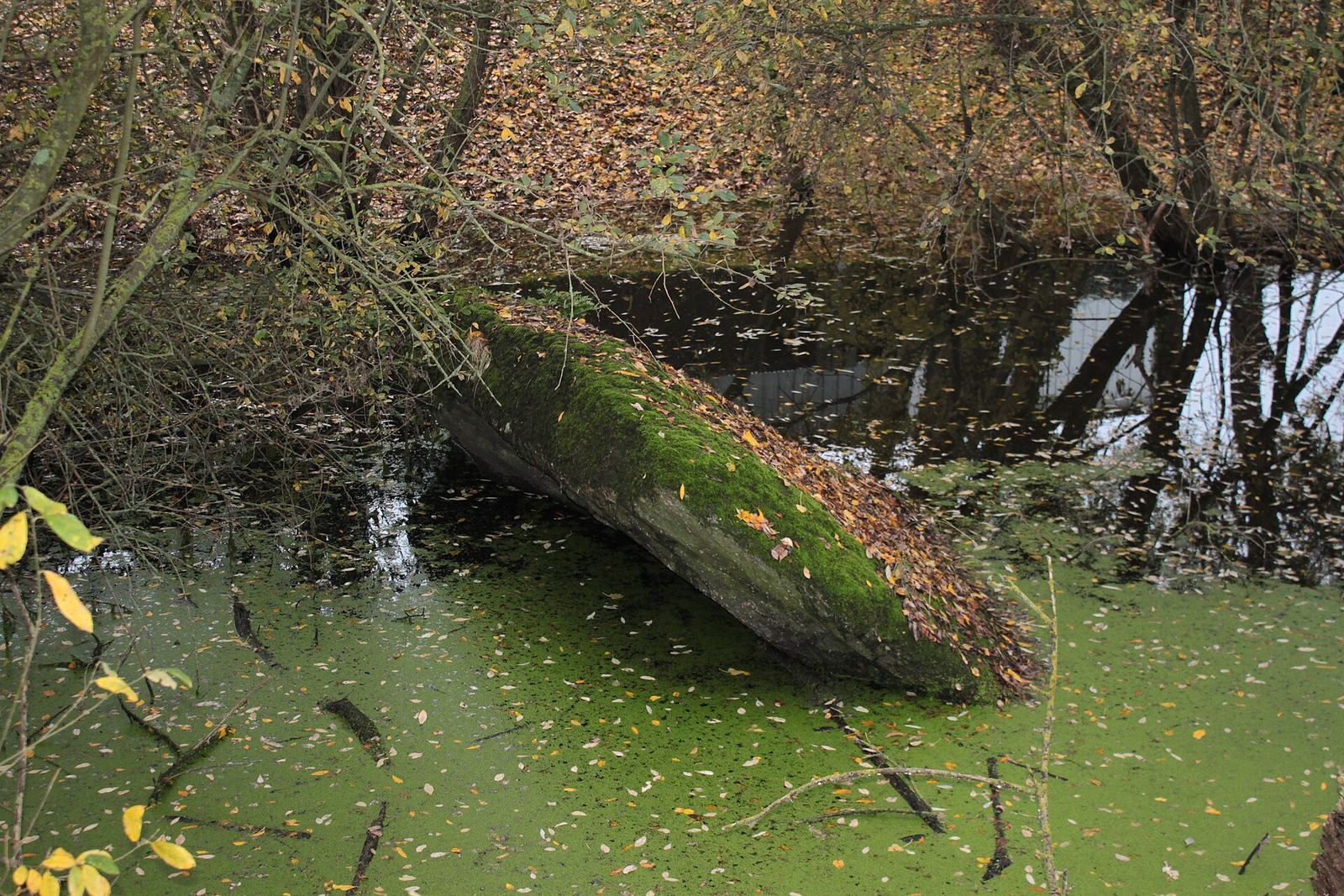
The dolmen stands in the former Saint-Pierre meadow beside the Loire. Before embankments were built, the meadow was a floodplain, and the monument rested on rock at the riverbank, about 1.34 metres above the river’s low-water level. It now lies in a hollow of fill brought in to level the surrounding industrial area, where runoff collects. The square capstone, made of conglomerate, measures 4.20 by 4 metres and is 0.70–0.80 metres thick. It is tilted at about 45 degrees and half submerged in runoff water. In 1829, Girault de Saint-Fargeau described the large, rough, flat stone, then called “Couveclair,” as a parallelogram about 4.13 metres long, 2.64 metres wide, and 0.64 metres thick. He noted that it was sunk about 1.62 metres into the ground, tilted, and held in position by two smaller stones.
Stone supports and mound traces
The structure is classified as a passage dolmen. Its surviving stones include two upright slabs of siliceous sandstone, known as orthostats, and a small gneiss pillar. The eastern slab is embedded 0.60 metres into a fissure in the underlying schist; it is 2.50 metres high, 2 metres wide, and 0.20–0.50 metres thick. The western slab rises 1.50 metres above ground, measures up to 2 metres wide and 0.50 metres thick, and bears a small, human-made cup-shaped hollow. The gneiss, a rock not found locally, implies that the pillar was transported over several kilometres. Excavators also found a fallen sandstone pillar to the west. Its position suggests that the monument was once longer and that the pillar supported another capstone. A few limestone stones at the foot of one upright slab are the only surviving traces of the mound; they may have come from Fourneau hill across the Loire.
Excavated finds
Stone and pottery objects
Objects recovered inside the chamber or among the limestone stones included 76 pieces of flint tools, among them scrapers, a burin, blades, and bladelets. Three arrowheads included triangular, unfinished, and tanged-and-barbed forms. The finds also included 70 pottery sherds decorated with punch marks. They are dated to the Bell Beaker period, an archaeological period associated with distinctive pottery, including vessels shaped like inverted bells, at the end of the third millennium.
Metal objects
The metal finds comprised a gold plaque weighing 1.1 grams and pierced at both ends, and a small copper chisel with a square cross-section. The copper is thought to have come from southern France.
Human and animal remains
Human and animal bones were mixed with the limestone stones, which protected them from the soil’s acidity. The remains yielded radiocarbon dates of 2,880 and 2,990 BP; BP means “before present,” with 1950 as the reference year. Four skulls were found, three belonging to men and one to a child. One or two were described as having a relatively broad-headed form. Analysis of ankle and heel bones indicated at least ten people, a minimum also supported by heavily worn human teeth. Animal remains included cattle, pigs, sheep, goats, horses, a wildcat, and birds, among them a starling and a woodcock.
Earlier reported finds
In 1863, Émilien Maillard wrote that two small objects had been found at the dolmen and called them “Druidic knives.” The antiquarian label does not establish a connection with Druids.