KV43: The Burial Tomb of Thutmose IV
Site at a Glance
- Rating
- 4.8
- Popularity
- Very Low
- Country
- Egypt
- Primary era
- Bronze Age
- Eras represented
- Bronze Age
- Civilizations
- Egyptian
- Site type
- Burial
- Remains
- Tomb
On this page16 sections
History
KV43 is the burial tomb of Thutmose IV in the East Valley of the Kings on the west bank of the Nile opposite Luxor, Egypt. Ancient Egyptians created it during the Eighteenth Dynasty of the New Kingdom, the period of Egyptian imperial power before the later Ramesside dynasties. Thutmose IV, son and successor of Amenhotep II, was buried there with at least two children who died before him, Prince Amenemhat and Princess Tentamun. The tomb preserves evidence of royal burial, ancient looting, restoration, and the later reorganization of the Valley of the Kings.
Burial and Early History
Thutmose IV was placed in KV43 with funerary equipment intended to accompany him into the afterlife. The canopic jars of Amenemhat and Tentamun were also found in the tomb. Canopic jars preserved the internal organs removed during mummification. A third individual may have been buried there as well, possibly the young boy discovered in one of the side chambers.
The tomb was entered and extensively robbed in antiquity. Debris and broken objects partly filled the entrance passage, while robbers forced their way through the blocked and painted doorway leading to the first pillared hall. A palm-fibre rope still attached to a column and extending to the bottom of the well shaft provides physical evidence of this intrusion.
Restoration under Horemheb
By the reign of Horemheb, the last pharaoh of Egypt’s Eighteenth Dynasty, KV43 had been inspected and restored. Two hieratic inscriptions in the antechamber, written in a cursive form of ancient Egyptian script, record a renewal of the burial in Year 8 of Horemheb. They name Maya, an official responsible for the treasury, work in the royal necropolis, and the Festival of Amun at Karnak, as the official charged with the restoration.
The identical handwriting of the inscriptions and the wording of the longer text indicate that Maya probably assigned the inspection and repairs to his subordinate Djehutymose, steward of the southern city. The damage may have occurred during or after the Amarna period, the religious reform era associated with Akhenaten and the official elevation of Aten above the traditional Egyptian gods. Followers of Aten sometimes erased the names and images of other deities from tombs. This explanation remains uncertain, since some figures may instead have been hurriedly completed after Thutmose IV’s sudden death.
Later Reburial and Closure
KV43 probably suffered at least one further robbery, perhaps during the Twenty-first Dynasty. Priests later moved Thutmose IV’s mummy to KV35, the tomb of Amenhotep II, as part of the reorganization of royal burials after the plundering of royal tombs late in the New Kingdom. The mummy was found in KV35 in 1898, five years before KV43 was rediscovered.
After the royal mummy was removed, the tomb was closed, probably with an adobe-brick wall, and its entrance corridor was filled with debris. Some funerary equipment was transferred to KV37. KV43’s relatively isolated position away from the main wadi helped preserve it until its modern discovery.
Rediscovery and Excavation
Howard Carter discovered KV43 in January 1903 while systematically clearing a small valley west of the tomb of Ramesses III. The Antiquities Service carried out the work on behalf of Theodore M. Davis. Carter entered the tomb on 18 January, while Davis was away in Aswan, accompanied by the American amateur Egyptologist Robb de Peyster Tytus.
An alabaster vase bearing Thutmose IV’s name, found higher in the valley in 1902, had led Carter to suspect that the king’s tomb lay nearby. Two intact foundation deposits before the entrance then helped confirm the identification. They contained alabaster vessels and model tools, including an alabaster saucer reused from Hatshepsut, together with other objects bearing the king’s name.
Carter excavated KV43 in 1903 and 1904 and conducted an epigraphic survey in 1904. Valuable funerary equipment had already been removed in antiquity, but the excavation recovered objects associated with royal Eighteenth-Dynasty burials. The most representative pieces are now in the Metropolitan Museum of Art in New York. Pottery fragments, ceramic remains, and embalmed food offerings remain within the tomb. KV43 is identified as the forty-third numbered tomb in the Valley of the Kings.
Remains
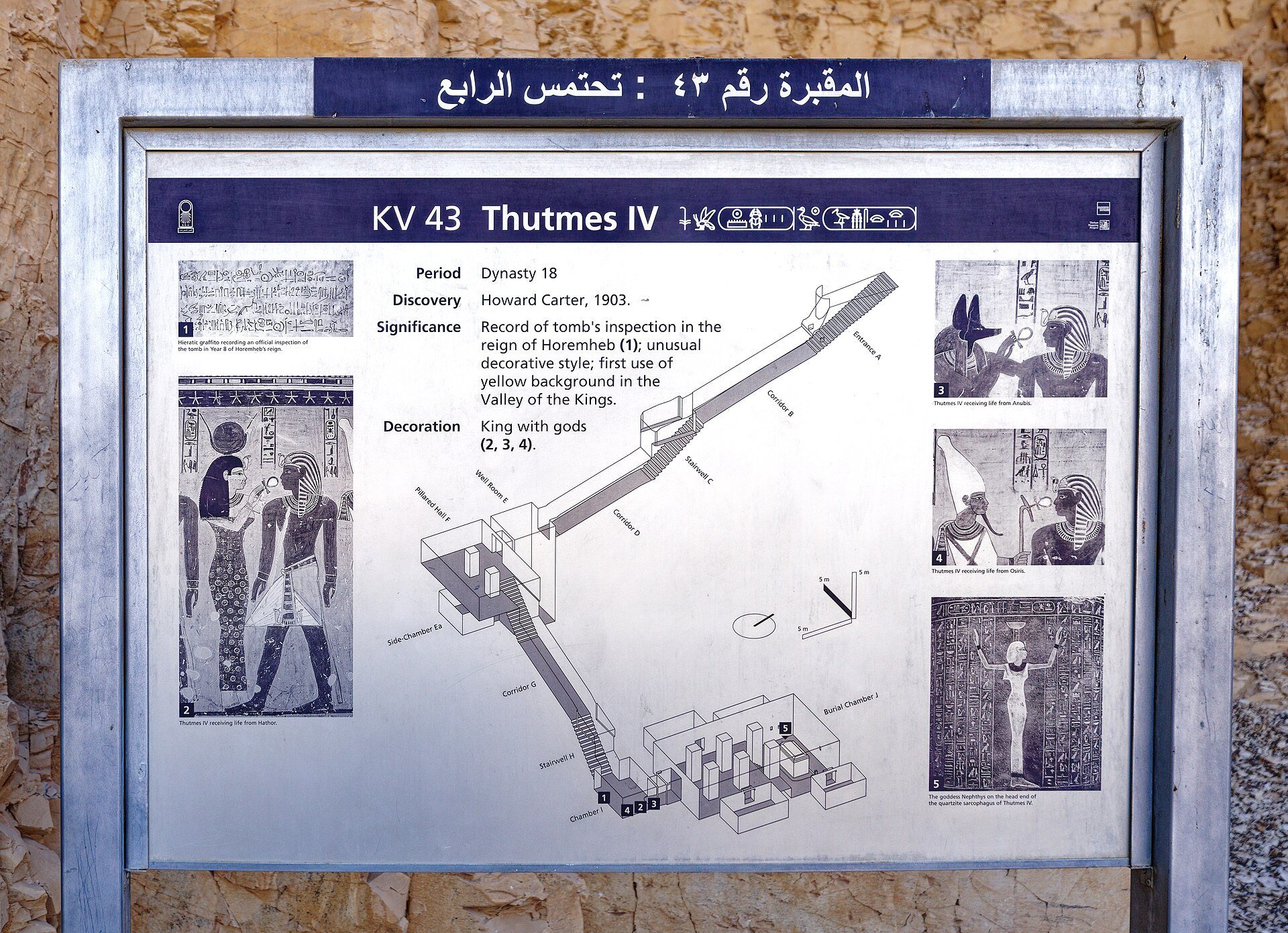
KV43 follows a bent-axis plan related to KV35, the tomb of Amenhotep II, although its cutting and alignment are more precise. The route turns about 90 degrees at the first pillared hall, producing a dog-leg layout characteristic of early Eighteenth-Dynasty royal tombs. The tomb extends approximately 105.73 metres, covers about 407.7 square metres, and has a volume of approximately 1,062.36 cubic metres. Its maximum height is 5.32 metres, its minimum recorded width is 0.89 metres, and its maximum width is 10.26 metres.
Entrance Passage and Well
Entrance Stairway and Corridors
The entrance stairway, known as Staircase A, is roughly cut and unfinished. It descends from an opening in the mountainside directly to Corridor B, with two beam holes near its lower end. The entrance measures about 2.24 metres wide and 8.27 metres long. Corridor B is steeply inclined, approximately 1.98 metres wide, 11.04 metres long, and 1.94 metres high. Staircase C has narrow recesses high on both walls, while its original steps are badly damaged. It measures about 1.98 metres wide, 4.19 metres long, and 5.33 metres high between the foot of the steps and the ceiling.
Corridor D slopes toward Well Chamber E and measures approximately 1.97 metres wide, 8.19 metres long, and 2.24 metres high. The entrances to the well chamber were sealed in antiquity. Traces of the earlier floor level remain just inside the chamber, showing the surface that existed before the well was cut. Well Chamber E measures about 4.16 metres wide, 4.17 metres long, and 2.33 metres high from the level of the doorways. Chamber Ea, at the bottom of the well, measures approximately 4.16 metres wide, 3.2 metres long, and 2.25 metres high and is now inaccessible.
First Pillared Hall and Stairways
Chamber F, the first pillared hall, marks the first change in direction. The passage turns 90 degrees to the left, and the chamber measures approximately 6.15 metres wide, 10.26 metres long, and 2.53 metres high. A damaged staircase begins in its northeastern part and continues toward the inner chambers. This stairway is about 1.99 metres wide, 4.37 metres long, and 3.81 metres high between the stair base and the ceiling of Chamber F.
Corridor G measures approximately 4.97 metres wide, 8.21 metres long, and 2.23 metres high. Staircase H has severely damaged steps and narrow recesses in both walls. It measures about 1.90 metres wide, 3.14 metres long, and 3.95 metres high between the stair base and the ceiling.
Antechamber and Painted Decoration
Antechamber
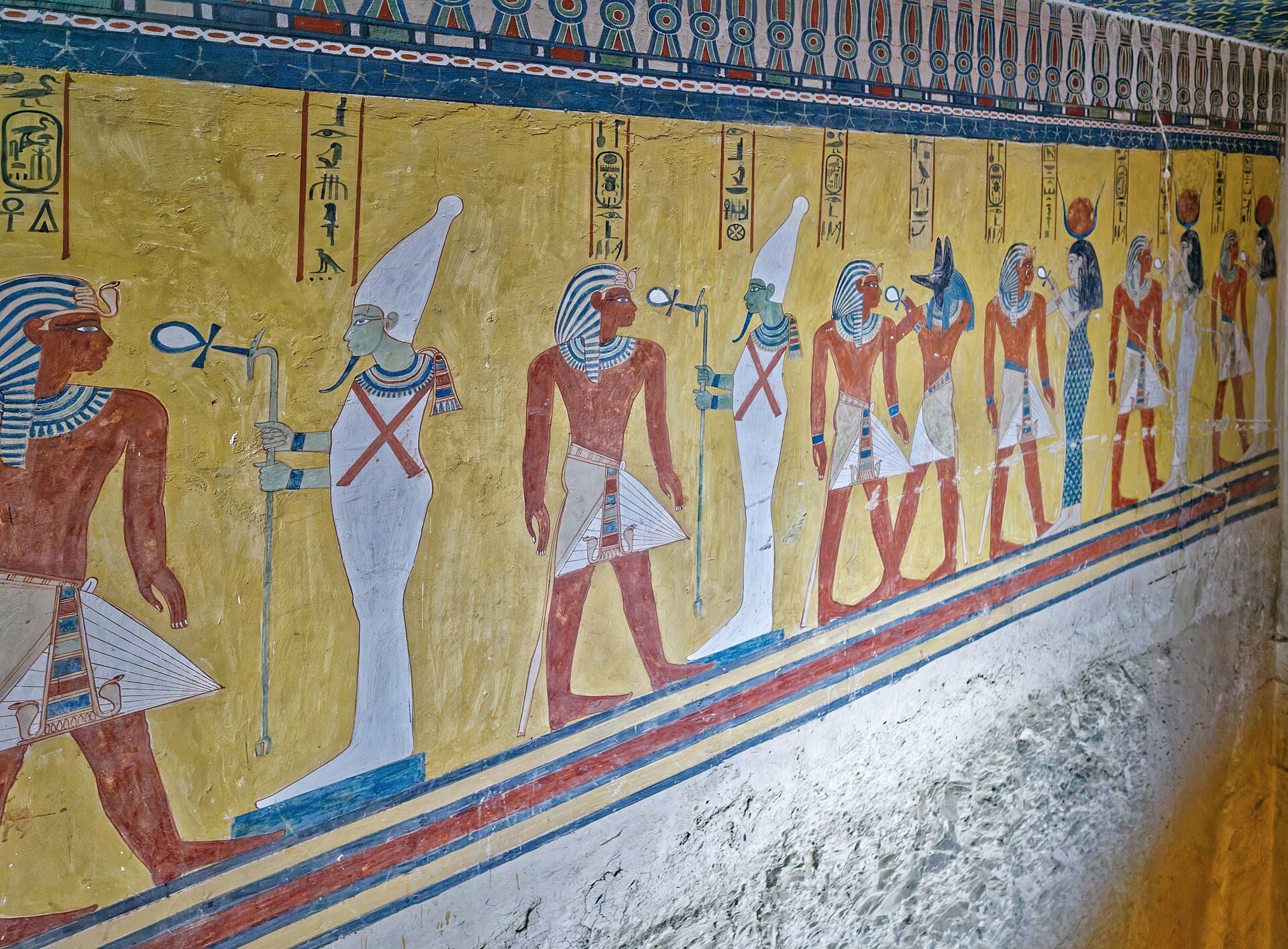
Chamber I is the antechamber before the burial chamber and the last room on the west-east axis. It measures approximately 3.62 metres wide, 5.19 metres long, and 2.23 metres high. Two black hieratic inscriptions on its right wall record the inspection and restoration undertaken during Horemheb’s reign. The antechamber’s painted decoration follows a repeated pattern in which the king stands before different deities.
Well Chamber Decoration
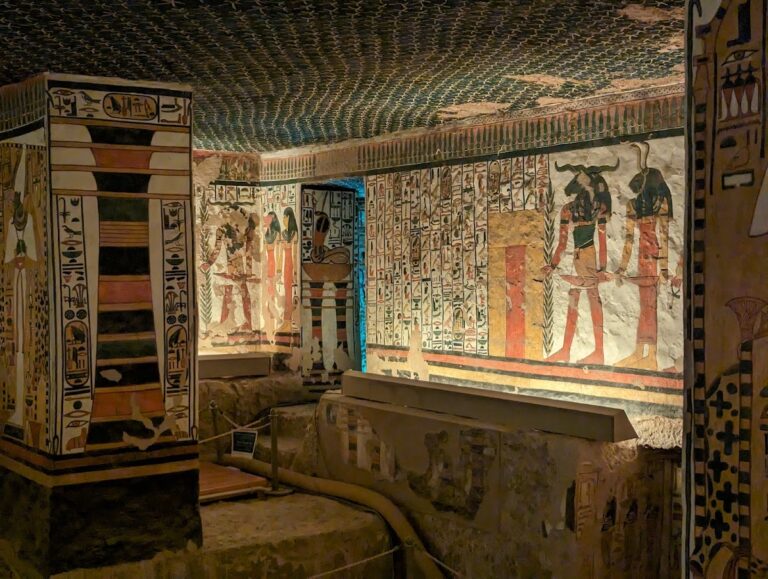
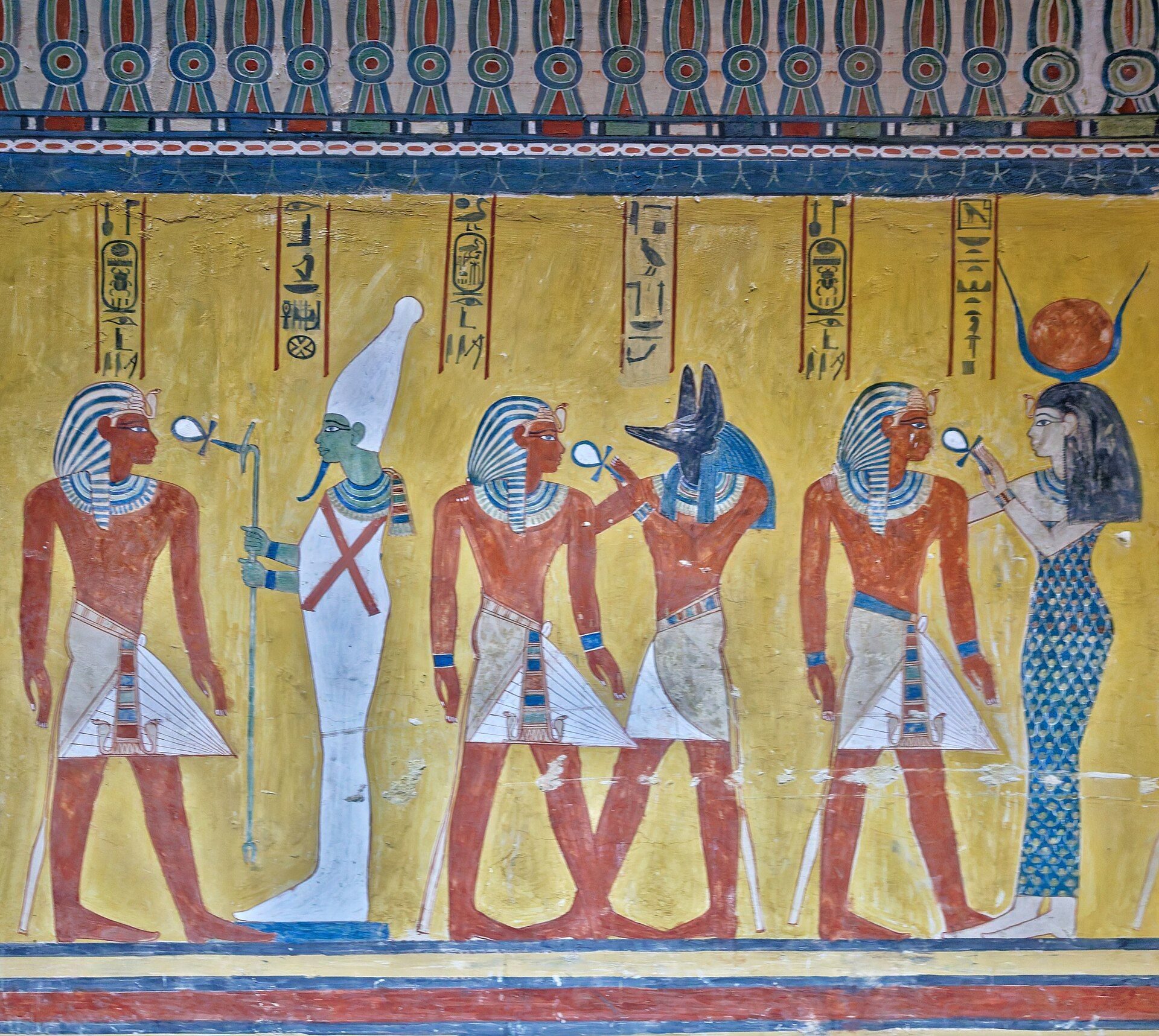
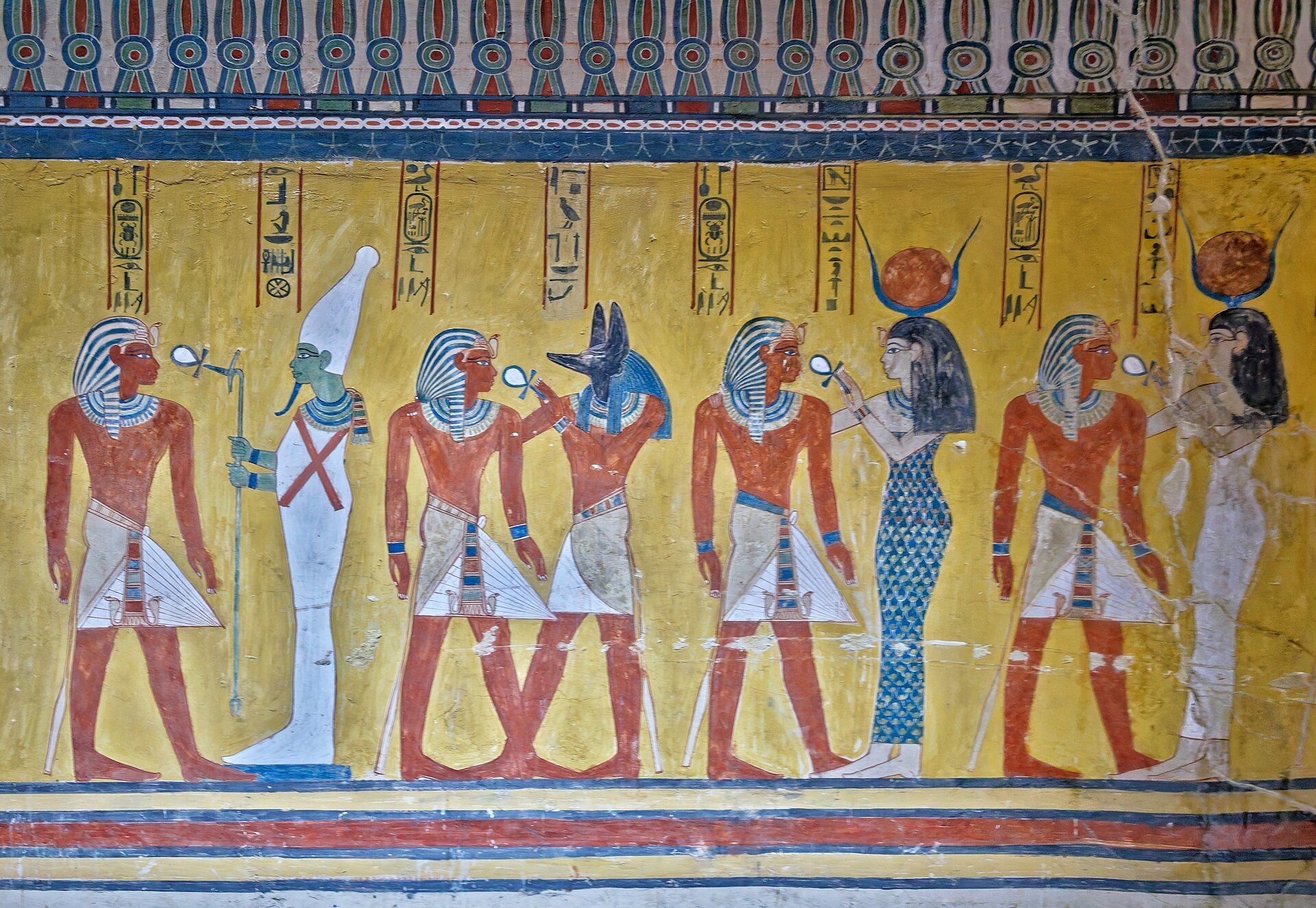
The upper part of the well and the antechamber have decorated ceilings with yellow stars against a blue background. In the well, a kheker frieze, made from repeated looped or tied forms, begins the decorative scheme. One fully painted wall shows Thutmose IV before Osiris, Anubis, and Hathor. Osiris was regarded as ruler and judge of the dead, Anubis was associated with embalming and funerary protection, and Hathor had important protective and funerary associations. Another wall, showing Anubis, remains unfinished.
The paintings have survived relatively well because KV43 suffered less flooding than many other royal tombs. In the late twentieth century, antiquities thieves cut out a figure of Hathor from the east wall in an unsuccessful attempt to sell the divine portrait. The figure was later returned to its place, although the damage remains visible.
Burial Chamber and Side Rooms
Burial Chamber
Chamber J, the burial chamber, has an upper level supported by three pairs of pillars and a lower level for the sarcophagus. A stairway between the last pair of pillars descends to the lower level. The chamber measures approximately 8.36 metres wide, 14.42 metres long, and 4.45 metres high between the lower floor and ceiling. Its lowered rear section forms a crypt for the sarcophagus, an innovation when compared with KV35. Magical niches, among the earliest known examples of features later used to hold protective magical bricks, are also present.
The burial chamber retains a red granite sarcophagus covered with yellow-painted texts and figures. It has a rounded head end and a square foot end. Nephthys appears with raised arms at the head, while Isis is shown in the same pose at the feet. The sides depict the king with Anubis and accompanying text. The sarcophagus lid was found beside the chest, supported by stone slabs and a carved wooden cow’s head. Only two wooden figures remained inside it because Thutmose IV’s mummy had already been moved to KV35.
The chamber also contained remains of a chariot once covered with silver leaf and decorated with scenes of the king killing enemies. Other finds included a red-and-green leather archer’s gauntlet, fragments of a colourful tapestry-woven garment bearing Amenhotep II’s name, black-painted statuettes of the king, stone-vessel fragments, broken fan handles, and parts of a cedar-wood throne.
Four Side Chambers
Four side chambers, Ja through Jd, open from the burial chamber at higher thresholds. They were arranged symmetrically as storage areas for funerary equipment. Chamber Ja measures approximately 5.16 metres wide, 3.11 metres long, and 1.93 metres high. Chamber Jb measures 5.16 by 3.12 metres and is 1.91 metres high. Chamber Jc measures 4.15 by 2.83 metres and is 1.93 metres high, while Chamber Jd measures 5.17 by 3.17 metres and is 2 metres high.
Chamber Ja retains sockets and a wooden lintel that belonged to a door. It contained a mass of linen mummy wrappings. Chamber Jb held mummified meat and birds. Chamber Jc contained broken jars and large quantities of grain. Chamber Jd contained broken faience vessels, shabti figurines intended to perform work for the deceased in the afterlife, and the unwrapped body of a young boy propped against the wall.
The boy may have been Prince Amenemhat, although the identification is uncertain. His canopic jars were found in KV43, as were the canopic jars of Princess Tentamun. These objects connect both children with the burial arrangements in their father’s tomb. Canopic jars belonging to an unidentified third individual were also recovered.
Funerary Equipment
Other excavated material included foundation-deposit models and vessels, limestone, wooden, bronze, and glass-paste objects, canopic vessels, wooden royal and divine statuettes, small boxes, wooden furniture, model boats, gloves, bracelets, amulets, vessels of diorite, limestone, glass, and faience, stone seals, and a gaming board. Together with the inscriptions, paintings, sarcophagus, food offerings, and human remains, these objects preserve evidence for the organization and ritual equipment of an Eighteenth-Dynasty royal burial.