Kurvingrad: A Medieval Serbian Fortress above the South Morava


Site at a Glance
- Rating
- 4.6
- Popularity
- Very Low
- Country
- Serbia
- Primary era
- Medieval
- Eras represented
- Classical, Medieval
- Civilizations
- Byzantine, Roman
- Site type
- Military
- Remains
- Fortified Town
On this page15 sections
History
Kurvingrad, also known as Koprijan, is a medieval Serbian fortress in Serbia above the South Morava valley, near Doljevac and approximately 11 kilometres south of Niš. The medieval settlement was built during the rule of Prince Lazar on earlier Roman and Byzantine fortifications, and its position made it an important military point.
Roman and Byzantine defenses
During the Roman Empire, the site formed part of the tower defenses of the Via Militaris, a major road crossing the Balkans between important military and administrative centres. Its elevated position provided a clear view of the river, while the higher Seličevica mountain protected the fortress from the rear. The location continued to matter under the Byzantine Empire, when the place was known as Kompolos.
Emperor Justinian I, who ruled from 527 to 565, strengthened frontier defenses and built or restored fortifications intended to protect local populations from attacks arriving from the Danube. Kurvingrad may have belonged to this wider program, although its precise identification with the Byzantine fortress remains unresolved. A charter issued by Basil II in 1020 mentions Komplos. Komplos has also been linked with Ad Herculum, later associated with Calis, and with the northern defense of Justiniana Prima, but these identifications remain uncertain.
Koprijan under the Serbian rulers
The medieval town of Koprijan was established on the earlier fortified foundations during the reign of Prince Lazar, a fourteenth-century Serbian ruler. A stone inscription attributes the construction to Nenad, son of the chamberlain Bogdan. Its damaged date has been read as 6880, corresponding to 1372 in the old Serbian calendar. Koprijan later became a border town of the Serbian Despotate, the late medieval Serbian state ruled by despots after the decline of the Serbian Empire.
The fortress was drawn into the succession struggle known as the Ottoman interregnum, which followed the death of Bayezid I and involved competing claims among his sons. Musa Çelebi captured and destroyed the city in 1413. After Musa’s defeat and death, his brother Mehmed I Çelebi returned the fortress to the Serbian despot Stefan Lazarević.
Ottoman conquest and later decline
Ottoman forces captured Koprijan in 1443 and restored it to Đurađ Branković in 1444. The settlement came under more permanent Ottoman occupation in 1451. The Peace of Szeged, also concluded in 1444, mentions Koperhamum and Procopius, names that have been considered possible evidence linking the Byzantine Kompolos and medieval Koprijan with present-day Kurvingrad.
An Ottoman census of 1498 recorded a village called Kurvingrad with approximately 20 to 40 households. Its population declined further after plague affected the Nišava District in 1516. Koprijan was probably robbed, burned, and destroyed during later Ottoman incursions. Stone from the settlement was then reused in Ottoman military construction, later in Niš Fortress, and during the twentieth century in local houses.
The ruins were described by the nineteenth-century travel writer Ami Bue during the first half of that century. In October 1918, during World War I, the site served as a German command position on the defensive front against the Serbian army. Serbian troops crossed Seličevica and reached the German forces from behind, outflanking the position and compelling the Germans to abandon Niš without a fight.
Archaeology and protection
Archaeological investigations in 1933 exposed the foundations of a Moravian-style church beneath the fortress and revealed earlier structural remains in the surrounding area. A stone inscription connected with Koprijan was also identified at Niš Fortress in the same year. In November 1947, the fortress and its surroundings were placed under state protection as a general people’s cultural property. Kurvingrad is also registered as a cultural monument of great importance of the Republic of Serbia.
The name Kurvingrad is commonly translated as “Whoretown.” Several explanations have been proposed for it. Legends connect the name either with a woman who opened the town gate to an enemy during a siege or with a wealthy woman who allegedly visited the nearby Monastery of Saint John at Orljane to meet its priest. Other interpretations associate it with an Ottoman derogatory naming practice or with the Hungarian king Matthias Corvinus, although the latter connection lacks sufficient evidence.
Remains
Kurvingrad occupies the slopes of Seličevica above the South Morava and the town of Doljevac. The medieval settlement followed an irregular quadrilateral plan measuring about 80 by 50 metres. Massive stone ramparts enclosed the town and were strengthened by five towers, while a dry defensive trench formed an outer obstacle. Erosion has reduced the surviving trench to roughly 2 by 2 metres, although it was formerly deeper.
Fortifications and internal enclosure
Ramparts and towers
The walls were built mainly from undressed grey-green stone, with earlier red-brick construction also present at the site. Surviving ramparts average 4 to 5 metres in height, while the original height was greater but cannot be established from the remains. The northern and eastern ramparts and their towers are relatively well preserved. The southwest and central towers survive on the western side, and the central and southwest towers are also the surviving members of the southern group.
Main gate and Little Town
The principal entrance stood near the northeastern corner and was protected by a tower or donjon. On the highest part of the hill, along the eastern rampart, a smaller fortified enclosure known as the Little Town terminated in a tower above the main gate. The Little Town can still be traced only faintly. Fragments remain from the gate-protection tower, while the structure known as the Donjon Tower survives as a larger pile of stones.
Houses within the settlement were constructed with wooden beams, and their foundations preserve evidence of domestic buildings whose original room heights cannot be determined. A 12-square-metre structure, sunk 1.5 metres into the ground inside the Little Town, is probably a cistern, a built reservoir for storing water. Its capacity may have supplied about 1,000 people during a siege. The way water entered the fortress is unknown, leading to the possibility of underground channels linking it with the South Morava.
Churches and religious remains
Saint John’s Church
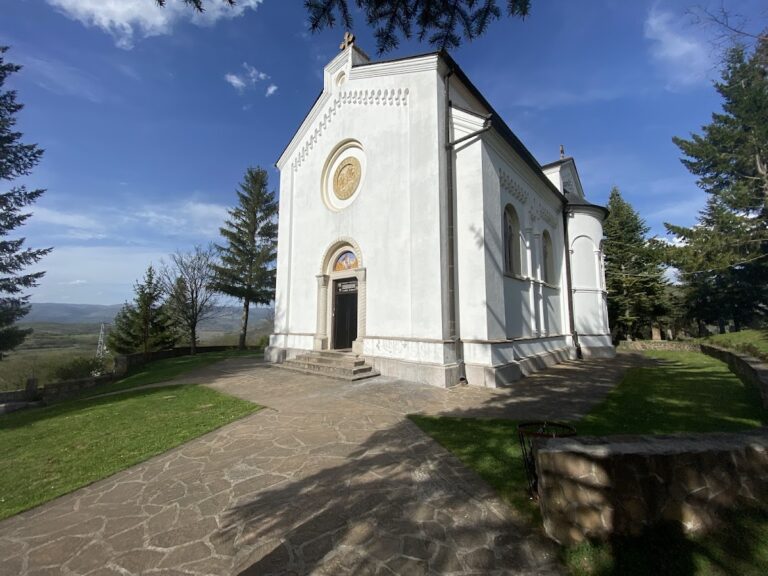
Saint John’s Church is identified as the ceremonial centre of the fortified town. Its position within the settlement reflects the religious role maintained alongside the fortress’s defensive and administrative functions.
Moravian-style church
Below the fortress, excavations uncovered the foundations of a separate church built in the Moravian style, a late medieval Serbian tradition associated with distinctive church plans and richly treated masonry and decoration. Its narthex, the entrance vestibule of a church, had a rough mosaic floor. Other sections used alternating tiles of white marble and green stone, each measuring approximately 20 by 20 centimetres.
Inscriptions and earlier remains
Koprijan inscription
The Koprijan inscription is a white, oval stone panel measuring approximately 114 by 123 centimetres. Its upper side is flat and about 26 centimetres wide, while the lower back wall is also described as 26 centimetres wide. A pillar-like section about 16 centimetres wide carries Serbian Church Slavonic text in the Cyrillic alphabet, with letters approximately 3 centimetres high.
The inscription names Nenad, son of Bogdan, as the builder of Koprijan during the time of Prince Lazar. Damage along the edges has made the date uncertain, although it has been read as 6880, corresponding to 1372 in the old Serbian calendar. The stone is now held by the National Museum in Niš. It was found among stones and unused building materials at Niš Fortress and was probably moved there during a later Ottoman incursion, so its original position at Koprijan cannot be established.
Byzantine remains around Doljevac
The surrounding area contains Byzantine remains associated with a basilica and several graves in the neighbouring village of Doljevac. Excavation of their foundations also revealed earlier buildings whose materials and construction methods indicate dates between the sixth and eighth centuries. These remains have contributed to the interpretation of Kurvingrad as a site connected with the Byzantine Kompolos, although the identification remains uncertain.
Nearby sites