Skull Tower: An Ottoman Warning and Serbian Memorial in Niš
Site at a Glance
- Popularity
- Very High
- Country
- Serbia
- Primary era
- Modern
- Eras represented
- Modern
- Civilizations
- Ottoman, Serbian
- Site type
- Civic
- Remains
- Monument
On this page9 sections
History
Skull Tower is an Ottoman-built memorial in Niš, Serbia, made from the skulls of Serbian fighters after the 1809 Battle of Čegar. Raised during the First Serbian Uprising, a revolt against Ottoman rule that began in 1804, it was intended to frighten local residents and discourage further resistance. It later became a Serbian memorial associated with the struggle for independence.
The Battle of Čegar and construction
The battle took place in May 1809 on Čegar Hill near Niš. About 3,000 rebels commanded by Stevan Sinđelić faced a much larger Ottoman force. Rivalry between commanders Miloje Petrović and Petar Dobrnjac contributed to poor coordination, leaving Sinđelić’s fighters without support from other rebel detachments. Ottoman troops suffered thousands of casualties in repeated assaults before breaking through the Serbian lines; Serbian losses have been estimated at about 4,000.
Fearing capture and execution by impalement, Sinđelić set off gunpowder and ammunition stored in the rebel position. The blast killed him, those nearby, and advancing Ottoman soldiers. Hurshid Pasha, a senior Ottoman official and governor of Rumelia, ordered the skin removed from the fallen rebels’ heads, stuffed with straw and cotton, and sent to Constantinople for Sultan Mahmud II, the Ottoman ruler. The remaining skulls were incorporated into the tower, erected between June and autumn 1809. Hurshid paid 25 groschen, a historical coin used in the region, for each head delivered.
Ottoman rule and the tower’s changing purpose
The tower was meant to intimidate Niš’s inhabitants, and the Ottoman Empire also used structures made from rebel fighters’ skulls to discourage resistance. Over time, skulls fell from the walls or were removed. Despite prohibitions, local people secretly took some for burial in nearby cemeteries; others were carried away as souvenirs or lost to exposure to rain, frost, and wind.
The French poet Alphonse de Lamartine visited in 1833, and his writing brought the monument to European attention and encouraged Western travelers to visit Niš. The British travel writer Alexander William Kinglake also wrote about it in a work published in 1849. Felix Kanitz later recorded that a special tax collected in settlements around Niš had helped pay for the tower. In 1860, Mehmed Pasha built a fountain beside it, and a small reception lodge for senior Ottoman officials arriving in Niš followed in 1864.
In 1861, Midhat Pasha, the last Ottoman governor of Niš, ordered the tower dismantled. It no longer deterred rebellion and instead stirred resentment by recalling Ottoman brutality. The remaining skulls were taken down, but the tower itself survived after local Muslims intervened to prevent its destruction.
Preservation and the chapel
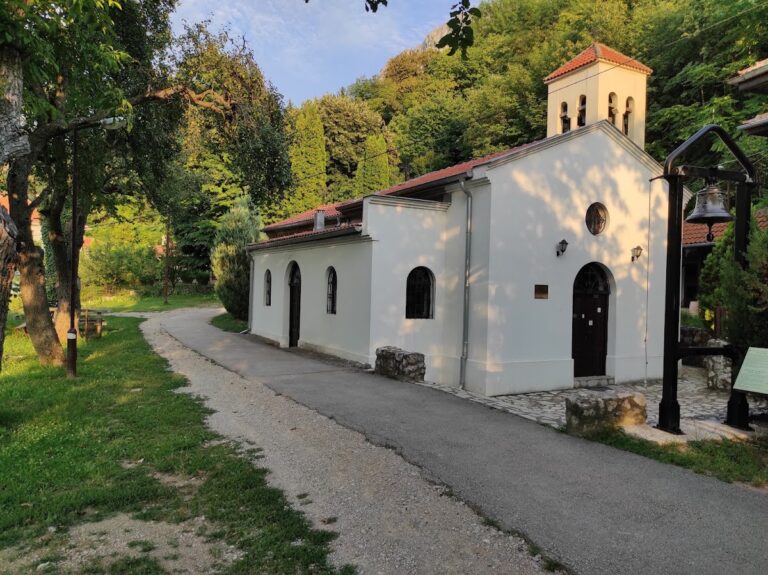
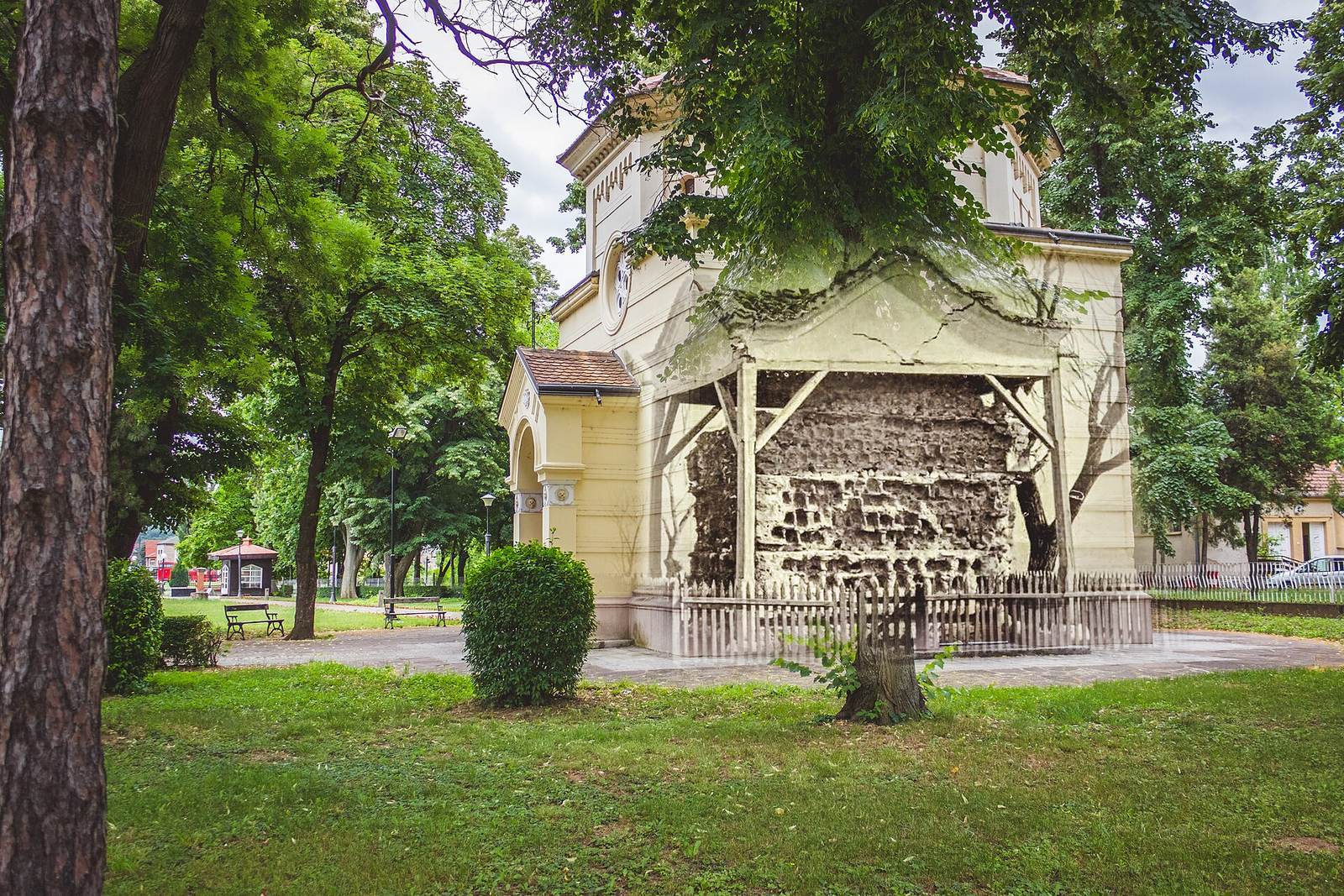
After Ottoman rule in Niš ended in 1878, the Royal Serbian Army searched the town and surrounding area for missing skulls. Niš residents raised money for a protective roof and fence. Work on a chapel to enclose the tower began in 1892, with funds also gathered across Serbia; the chapel’s foundations were consecrated in 1894. The enclosure shielded the tower from the weather, although damp and temperature changes continued to cause damage.
The chapel was renovated in 1937. During cleaning, workers found several skulls in the structure’s central part and returned them to the walls. A bust of Sinđelić was added in 1938, and the restored tower was consecrated on 1 June that year. In 1948, the tower and chapel received Serbia’s designation for monuments of exceptional importance. The chapel was renovated again in 1989, and the complex retained that designation as of 2026.
Commemoration and cultural memory
Skull Tower became a place of Serbian pilgrimage. Many Serbs in Serbia and abroad regard it as an emblem of the struggle for independence from Ottoman rule and of Serbian national identity. The complex now serves as a museum. The tower also inspired later works: Dušan Radić composed the vocal work Ćele kula in 1957, Vasko Popa included a cycle named for it in his 1971 collection Uspravna zemlja, and it appeared on the cover of Riblja Čorba’s 1985 album Istina. The cover montage, designed by Jugoslav Vlahović, placed the band members’ faces among the skulls.
In 2024, Serbian anthropologists began a forensic facial reconstruction project, which estimates a person’s appearance from skeletal remains, using the skulls that remain. They did not conduct DNA analysis because it could damage the skulls and the structure.
Remains
The monument complex stands on elevated ground in eastern Niš, in the Trošarina neighbourhood, near the former Constantinople road and the old eastern entrance to the city at Stambol Gate. Its central feature is a hollow, roofed tower enclosed by a chapel. The tower’s outward-facing skulls and its compact, square form distinguish it within the larger memorial complex.
The tower’s construction
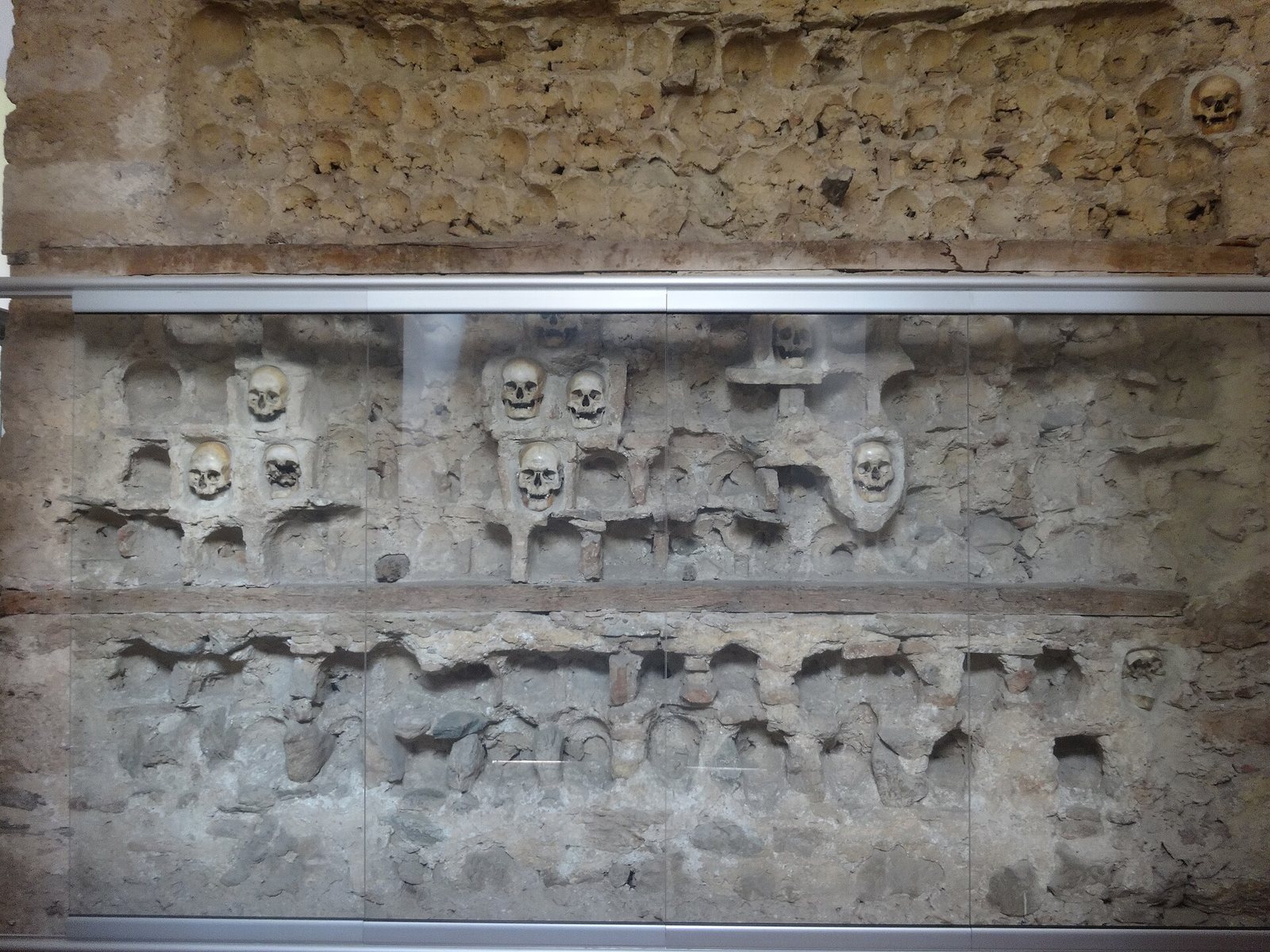
The original tower stood about 4.5 metres high on a square base measuring approximately 4.15 by 4 metres, with walls about half a metre thick. Four supporting walls leaned against one another to enclose a hollow interior. Stone, mortar, and beams formed the structure apart from the skulls, which were set in regular outward-facing rows on the exterior. The original arrangement is described as 14 rows on each side, with 17 skulls in every row, for a total of 952.
Recorded counts and surviving skulls
Historical descriptions give differing counts and ways of describing the rows. Isidor Stojanović counted 56 rows around the tower, with 17 skulls in each. In 1860, Kanitz described 16 rows of 16 openings on each side, or 1,024 openings, and noted that skulls had almost entirely disappeared. In 1882, Živan Živanović counted 511 skulls: 123 on the north side, 103 west, 105 east, and 180 south. As of 2026, 58 skulls remain embedded in the walls. Lamartine described skulls whitened by sun and rain, some with hair still attached, fragments beneath the tower, and wind passing through their openings. His estimate of 15,000 to 20,000 skulls greatly exceeded the stated original total. One skull found deep inside the wall after 1878 was sent to the National Museum in Belgrade; another, believed to be Sinđelić’s, is displayed separately in a glass case beside the tower.
Chapel and memorial features
The chapel encloses the tower, and the two structures form the protected monument complex. After 1878, a protective canopy topped with a cross was placed over the tower, which was also fenced; Đorđe Krstić’s 1883 painting depicts it beneath that canopy. A plaque placed near the chapel in 1904 bears the dedication “To the first Serbian liberators after Kosovo.” The complex also includes the 1938 bust of Sinđelić, a separate monument to him at the entrance, and a bridge across the Gabrovac River at the entrance to the memorial grounds. A replica of the tower is exhibited at the Military Museum in Belgrade.