Kungs-Husby Church: A Medieval Church in Sweden
Site at a Glance
- Country
- Sweden
- Primary era
- Medieval
- Eras represented
- Medieval, Early Modern, Modern
- Civilizations
- Swedish
- Site type
- Religious
- Remains
- Church
On this page17 sections
History
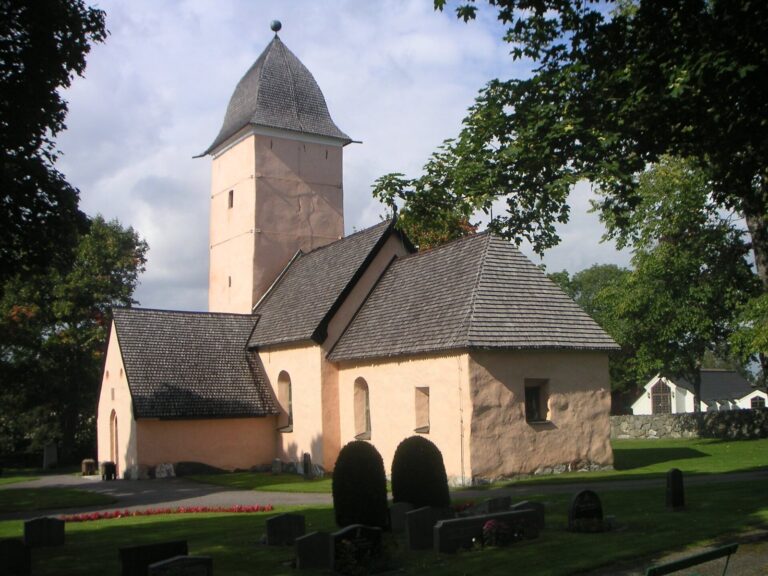
Kungs-Husby Church is a medieval church in Sweden, built on the site of an earlier church in a village that had served as a royal estate and administrative center. A fragmentary twelfth-century baptismal font points to the earlier church. The present building was consecrated in the fourteenth century and later enlarged and altered.
Medieval church and later changes
The church’s three eastern bays and sacristy were built in the first half of the fourteenth century. In the second half of the fifteenth century, a porch was added and brick vaults replaced an earlier wooden ceiling. The church’s original silver was mostly lost in 1531 and 1545, when the Crown levied taxes.
Damage and eighteenth-century enlargement
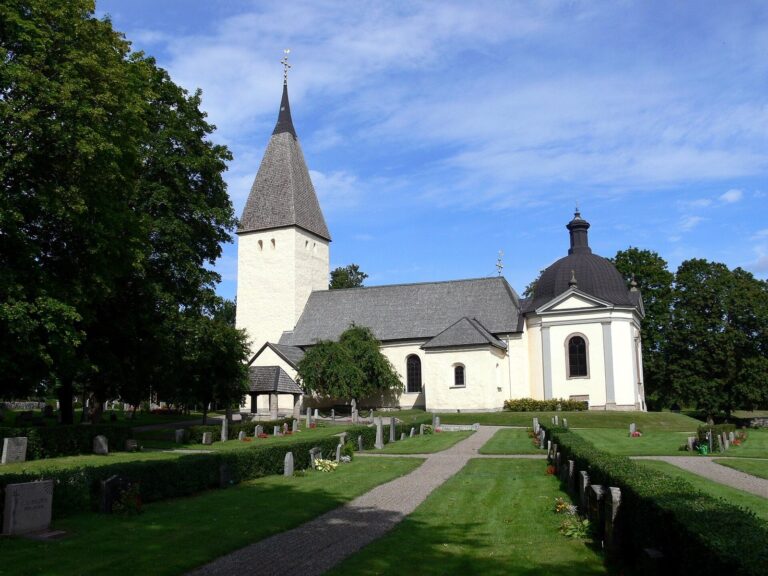
A thunderstorm damaged the church in 1676. Repairs continued until 1770, when the vault paintings were also whitewashed. Earlier in the eighteenth century, existing windows were enlarged and new ones added. Between 1755 and 1757, the nave was extended westward, bringing the church to its present size.
Rediscovery and later history
The vault paintings came to light in 1859. Johan Zacharias Blackstadius restored them the following year, staying relatively close to the surviving work while largely recreating paintings in areas damaged by the storm. The interior underwent a thorough restoration in the 1950s.
Since 2006, the church has belonged to Veckholm Parish, after previously belonging to Kungs-Husby Parish. It is part of Uppsala Diocese, a regional district of the Church of Sweden.
Remains
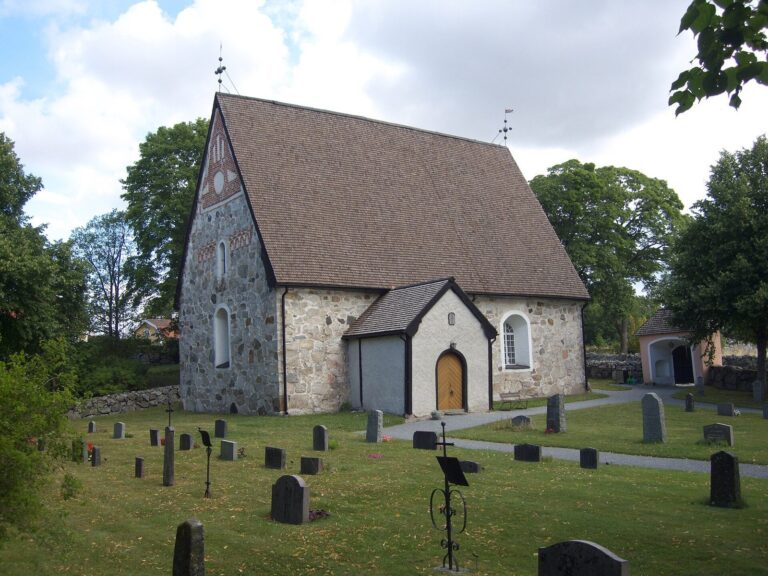
The gray-stone church has a nave, the main worship space, and an eastern chancel, the area around the altar. The building, its churchyard, and a separate bell tower preserve architectural features and furnishings from several periods.
Church building
Plan and exterior
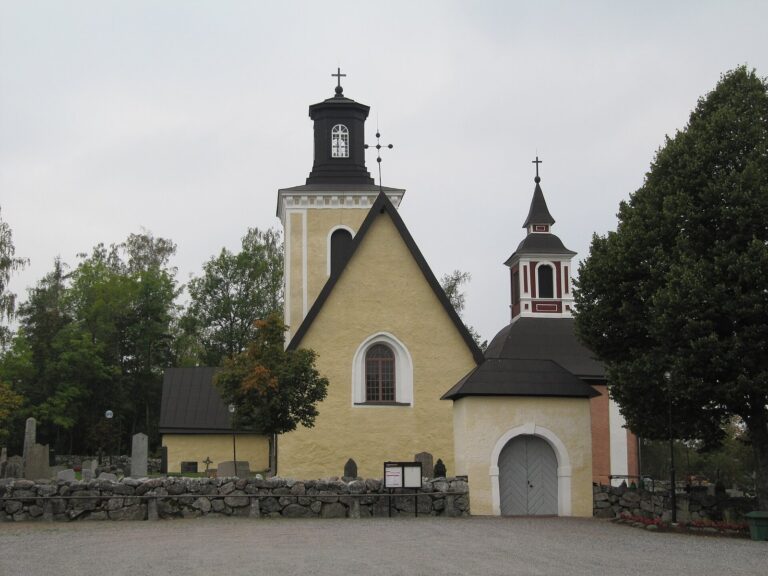
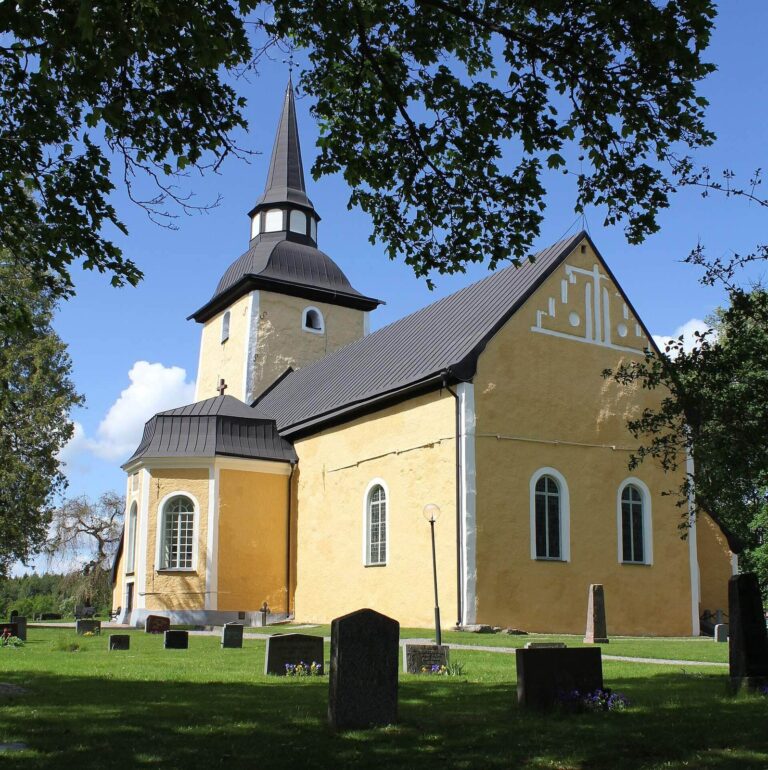
The nave is divided into four bays, or sections, with the easternmost forming the chancel. A sacristy, a room for vestments and religious objects, adjoins the chancel on the north; a porch projects from the nave’s southwest side. Yellow plaster covers the exterior walls, with white surrounds, and the roof is clad in tarred pine shingles. Two carved boards decorate the east gable. One has stylized leaf ornament and may date to the fourteenth century. The original chancel-window surround and pointed windows in the south wall are now represented by niches on the exterior.
Vaults and wall paintings
Star vaults, whose ribs form star-like patterns, cover the older parts of the church. The western extension has a brick cross vault, formed where two barrel-shaped ceilings intersect. Clear traces of a wooden trefoil vault, a ceiling with three lobes, survive in the attic. Around 1500, an unknown artist painted the brick vaults with scenes based largely on the Biblia pauperum, or “Bible of the poor,” an illustrated medieval work that paired episodes from the Old and New Testaments. One painted detail depicts Saint Jerome, a Christian scholar associated with the Latin Bible.
Churchyard and bell tower
Wall, gates, and runestones
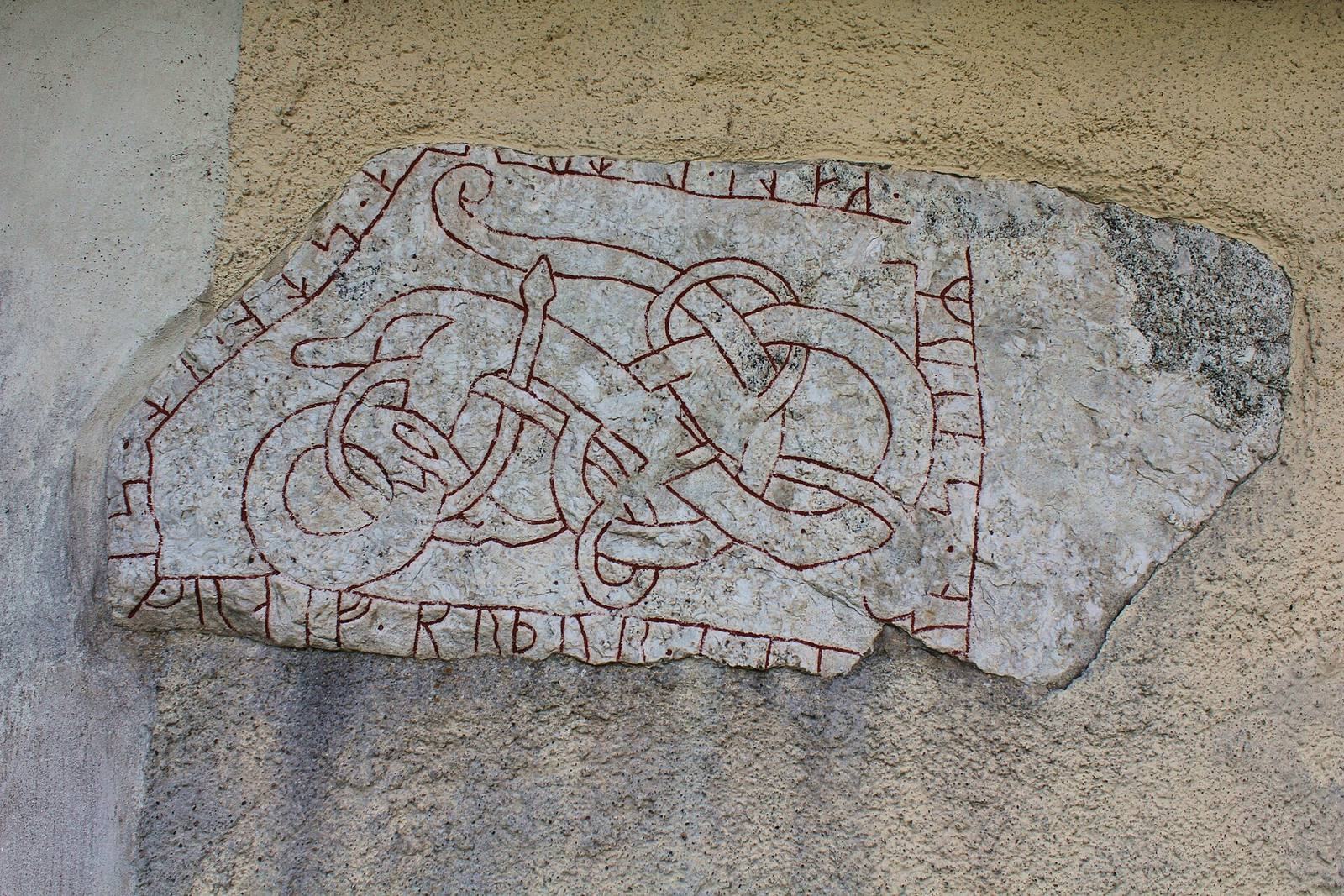
A stone wall encloses the churchyard, with covered gates on its east and northwest sides. Runestones U 707 and U 708 are built into the wall. A third, U 709, stands in the porch. Runestones are stones bearing inscriptions in runic writing, often commemorative.
Bell tower and bells
The timber-clad bell tower stands northeast of the church. It is coated with tar and topped by a blunt spire. Built in 1774, it replaced an earlier tower probably erected in 1647. Two bells hang inside. Gerhard Meyer cast the smaller bell in Stockholm in 1725. The one-ton larger bell was recast there by Gerhard Horner in 1819 after cracking during ceremonial ringing for King Karl XIII on 25 March 1818. Its earlier form bore runes and may have been as old as the earliest church.
Sculpture and furnishings
Madonna and saint figures
A painted stone Madonna, an image of Mary, stands in the chancel. Probably made in the Rhineland, it is a German work from the mid-fourteenth century. Four late-medieval wooden figures of saints probably once formed part of an altarpiece, an artwork or sculptural group placed on or behind an altar.
Crucifixes and crosses
Five works depict Christ. A small triumphal crucifix, associated with the chancel arch, is probably a thirteenth-century Swedish work. Another, earlier medieval crucifix was altered in the later Middle Ages; its figure has a bent head and overlapping feet. The church also holds a larger fourteenth-century triumphal cross, a fifteenth-century processional crucifix carried in religious ceremonies, and an older processional cross in fourteenth-century style. The last was found in the bell tower in 1912.
Font, altar, and pulpit
The limestone baptismal font has a fifteenth-century bowl, while its base and central knob are older. Carpenter Broman of Flakängen in Torsvi made the altarpiece and altar rail in 1771. Installed in 1789, the pulpit was made in Uppsala by carpenter J. C. Krüger to designs from the Office of the Superintendent of Public Buildings, a Swedish state office responsible for public-building design and oversight.
Organ
Pehr Gullbergson built the mechanical organ in 1833 or 1834, making it his first instrument. It has a slider chest, a wind system that directs air to pipes through movable sliders, and a stated compass of 54/20. Gullbergson added a Fagott 8-foot stop, a control for selecting a set of pipes, in 1859; Johan Eriksson altered the Principal 8-foot stop in 1898. The façade was designed by architect Carl-Gustaf Blom-Carlsson. Robert Gustavsson Orgelbyggeri restored the organ in 1979.
Communion vessels and metalwork
A gilded communion chalice and paten, the plate used with a chalice, were present by the seventeenth century, as was a separate chalice and paten for communion to the sick. Other furnishings include a small pewter bottle and an older pewter bottle used as a wine jug. A pair of angular pewter candlesticks was purchased at Christmas in 1724 for 15 daler, a historical Swedish currency unit. An ungilded wafer box was donated in 1703, an ungilded silver jug was made in 1726, and a second wafer box was donated in 1839.