Läby Church: A Medieval Lutheran Church in Sweden
Site at a Glance
- Country
- Sweden
- Primary era
- Medieval
- Eras represented
- Medieval, Early Modern, Modern
- Civilizations
- Swedish
- Site type
- Religious
- Remains
- Church
On this page14 sections
History
Läby Church is a medieval Lutheran church in rural Uppsala, Sweden, probably dating to around 1200 and perhaps originating as a Romanesque building, a style of medieval European architecture. It belongs to the Diocese of Uppsala and Norra Hagunda parish.
Medieval origins and expansion
The church’s earliest history is uncertain. Its oldest parts may date to the thirteenth century, and the sequence of later building work cannot be established precisely. At a later stage, the church was extended eastward, taking on its present choir and hall-church form, with nave and choir forming a unified space of similar width. This expansion may have been part of a major remodeling around 1600, when a sacristy, a room for preparing and storing items used in worship, was added on the north side and a porch on the south. The porch roof was not completed until after 1669.
Eighteenth- and early nineteenth-century changes
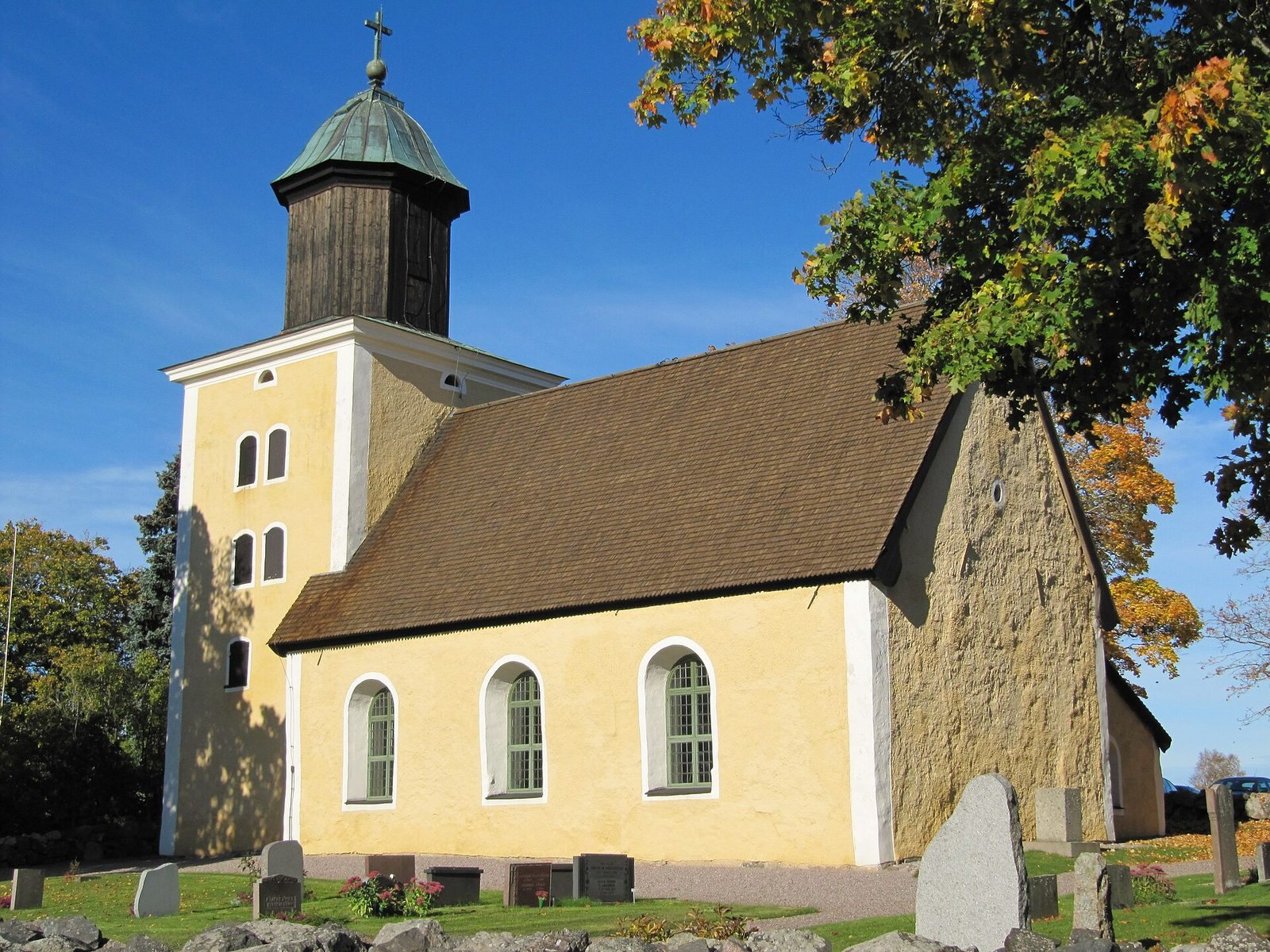
During the eighteenth century, the window openings were enlarged, and closed pews were installed in the 1770s. From 1801 to 1803, a tower with a lantern was built at the west end. The south porch was demolished, its entrance blocked, and some of its stones reused in the tower. The church bells were transferred from a separate belfry into the new tower.
Closure and restoration
In 1860, Läby Church ceased to be used for worship after Vänge Church was enlarged to accommodate Läby’s residents. Läby parish merged with neighboring Vänge parish in 1890, and its congregation moved to Vänge Church, leaving Läby Church abandoned.
In the 1920s, the congregation decided to return. Architect Birger Jonzon led a restoration and reconstruction in the National Romantic style, a movement drawing on national history and traditional forms. Archbishop Nathan Söderblom was involved in reviving the church, and furnishings removed earlier were brought back.
Remains
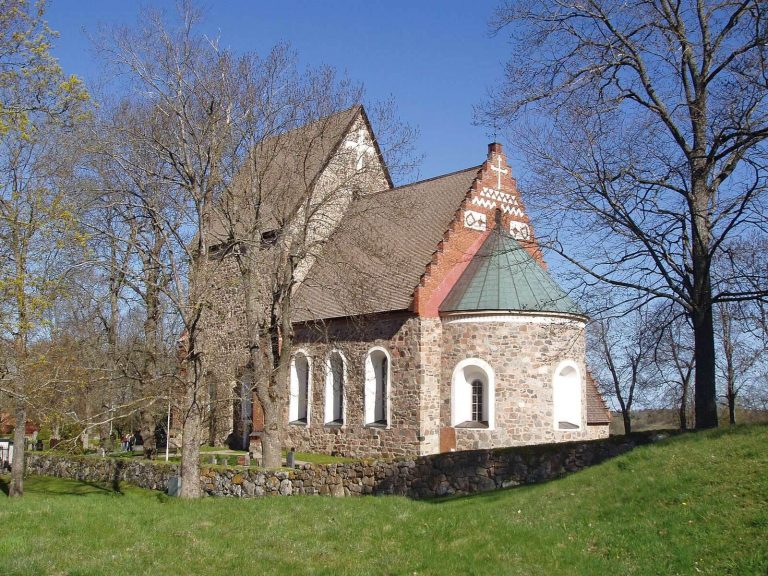
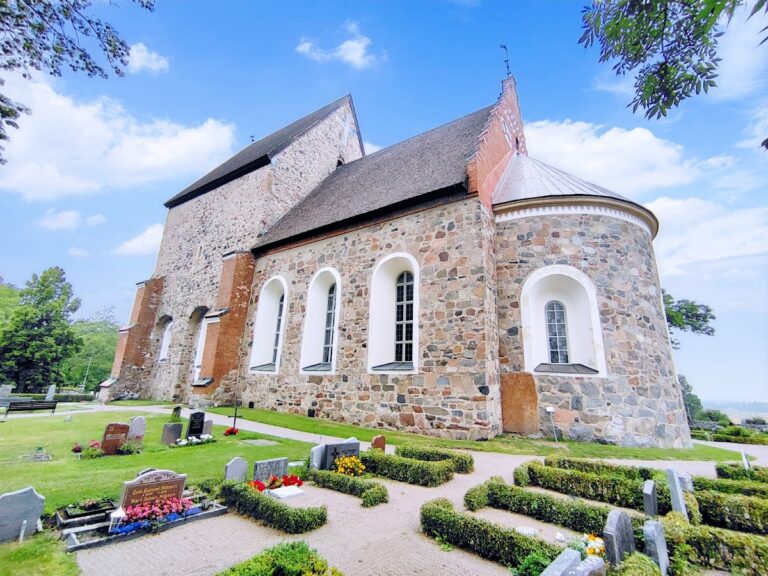
Built of fieldstone, the church has a rectangular nave and an east choir of equal width with a straight end. A sacristy adjoins the northeast side, while the tower and its entrance stand at the west. The building occupies a rural setting on the road between Uppsala and Sala, about eight kilometres west of central Uppsala. It is the rural church closest to the city and one of the smallest churches in Uppsala County and the Diocese of Uppsala.
Churchyard and exterior
Churchyard
The churchyard retains approximately its medieval extent. Its surrounding stone wall dates to the latter part of the eighteenth century, when it replaced a wooden enclosure.
Church building
The exterior is covered in roughcast, a coarse plaster finish, with smooth plaster at the corners and around openings. Lime paint gives the roughcast an ochre-yellow color and the smooth areas a white finish tinted with ochre. The nave has a gabled roof of tarred shingles, and the sacristy a shingled lean-to roof. The tower carries an eight-sided wooden lantern, an upper structure on the tower, beneath a copper-covered roof topped by a copper-clad cross.
Interior and furnishings
Interior and ceiling
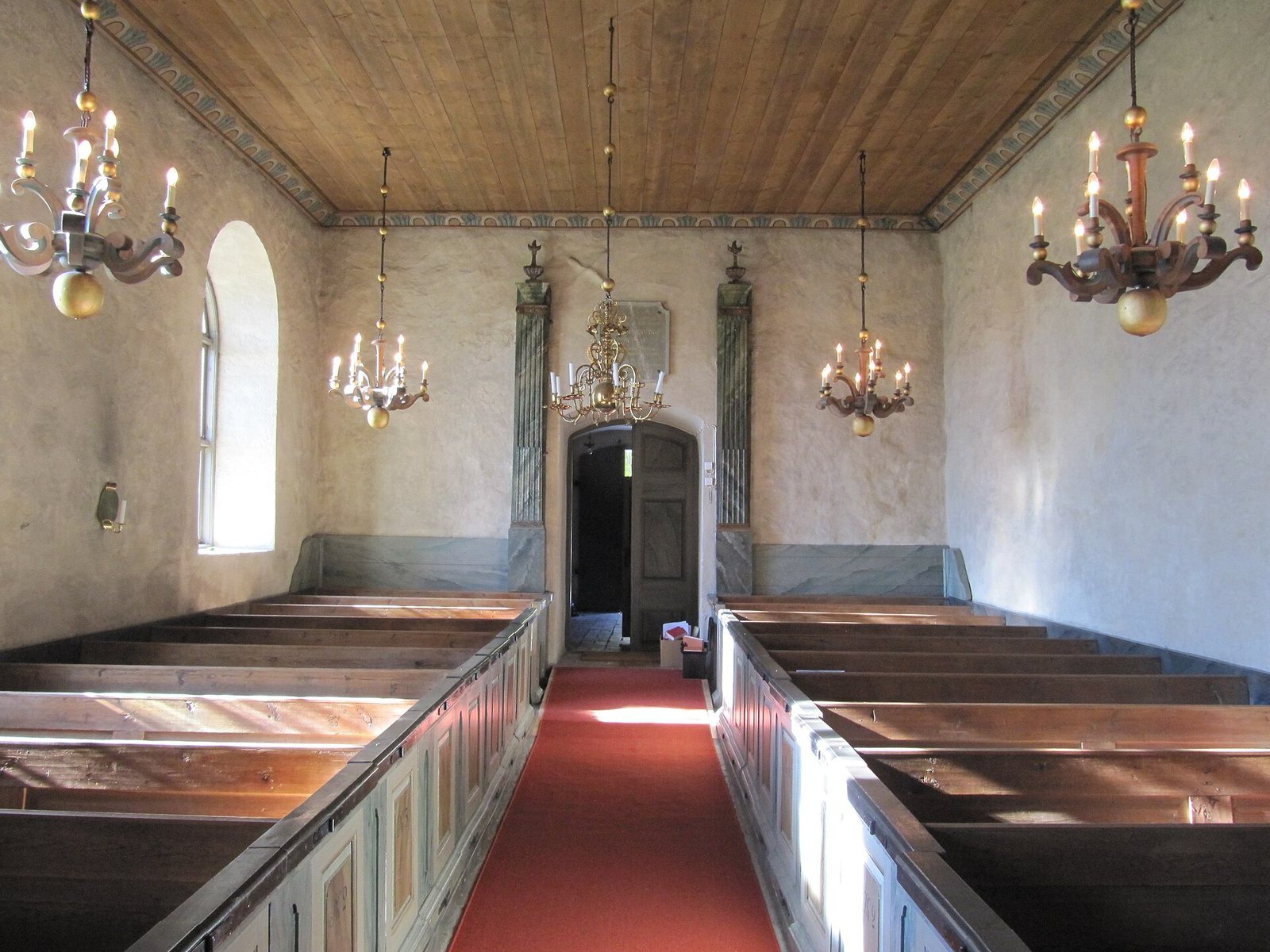
The interior has undecorated walls and a flat ceiling. The ceiling received its decoration during the restoration of the 1920s.
Altar-pulpit
A combined altar and pulpit, made by master carpenter Magnus Granlund in 1753, stands on the medieval altar. Its central relief depicts the Transfiguration of Christ and also serves as the altarpiece. The design reflects Pietism, a Protestant movement that stresses personal religious devotion. The altar-pulpit was sold to the Nordic Museum in 1909 and returned to the church in 1928.
Medieval sculptures
A wooden sculpture of Christ, dating to the latter part of the twelfth century, represents him as a crowned king. It came from a triumphal cross, a large cross traditionally placed between nave and choir, and is now in the Swedish History Museum. A separate sculpture of Saint Anne with the Virgin and Child, dating to the mid-fourteenth century, is also held there.
Vessels, bell, and lighting
A communion vessel dates to the first half of the fourteenth century; its bowl was enlarged in 1749. A cracked bell stands to the right of the choir. Its inscription says it was cast in 1574 for Hjälsta Church. It may be the same bell handed over from Uppsala Castle in 1578. A metal-alloy chandelier was donated in 1684, while a crystal chandelier given in 1849 hangs in the sacristy.
Vestments and organ
Two medieval red-velvet chasubles, outer vestments worn by priests during worship, were at the church in the 1860s. A red silk-brocade chasuble was donated in 1934. A three-stop organ was in the church in 1869. The present mechanical organ was built in 1956 by Olof Hammarberg of Gothenburg. Its slider chest uses sliding valves to direct air to selected pipes; its facade was designed by H. Tafvelin. The organ stands on a short flight of steps in the south part of the church.