Church of Saint Gregory of Neocaesarea in Polyanka, Moscow: A Seventeenth-Century Royal Parish Church


Site at a Glance
- Rating
- 4.9
- Popularity
- Low
- Country
- Russia
- Primary era
- Early Modern
- External website
- Open
- Eras represented
- Early Modern, Modern
- Civilizations
- Russian
- Site type
- Religious
- Remains
- Church
On this page12 sections
History
The Church of Saint Gregory of Neocaesarea in Polyanka is a Russian Orthodox parish church in Moscow, Russia, built in the seventeenth century in the richly ornamented Russian uzorochye style. It belongs to the Moscow Diocese and Moskvoretsky Deanery and stands in the Yakimanka District. Its principal dedication is to Saint Gregory of Neocaesarea, a third-century Christian bishop and theologian also known as Gregory the Wonderworker.
Foundation and seventeenth-century construction
Tradition connects the church’s foundation with Grand Prince Vasily II. During his captivity among the Tatars, he is said to have vowed to build a church dedicated to the saint whose feast day marked his return. On 17/30 November 1445, he reportedly saw the white-stone Kremlin from a location slightly southeast of the present church. The first building on the site was wooden and was later destroyed by fire.
A replacement wooden church stood there by 1632. In 1667, construction began on a new stone church beside it, allowing worship to continue in the older building. Detailed payments from the royal treasury survive from 1668, and the work was completed in 1679. The project began with the blessing of Patriarch Nikon under the direction of Andrei Savin Postnikov, who had served as rector of the wooden church since 1660. Postnikov later became Tsar Alexei Mikhailovich’s confessor and a senior priest of the Annunciation Cathedral in the Moscow Kremlin.
Alexei Mikhailovich became the church’s principal patron, contributing substantial funds and personally following the progress of construction. Patriarch Joachim of Moscow consecrated the church on 1 March 1679, dedicating the principal altar to Saint Gregory of Neocaesarea. Tsar Feodor Alexeyevich attended the ceremony. The church also had close connections with later patriarchs: Joasaph II served there in 1670, Joachim in 1672, Adrian in 1696, and Tikhon in the early twentieth century.
Royal parish and later additions
The church acquired the popular name “Red,” meaning beautiful, and this name remained in official documents until the end of the eighteenth century. It held the status of a court church, meaning that it was associated with and served a ruling court or dynasty. Members of the ruling family regularly visited it, including Grand Duchess Elizabeth Feodorovna.
A side chapel dedicated to Saint Gregory the Theologian was added in 1767 at the expense of the parishioner Gregory Likhonin, who named it for his patron saint. Saint Gregory the Theologian, also called Gregory of Nazianzus, was a fourth-century theologian and archbishop known for his writings on Trinitarian doctrine. In 1834, a second chapel was added for the Bogolyubovo Icon of the Mother of God. Its design was prepared by Nikolai Kozlovsky, Fyodor Shestakov, and Vasily Balashov. The icon had been venerated during the cholera epidemic of 1830.
The church was not damaged during the Patriotic War of 1812. Its first thorough restoration took place in 1859, after which Metropolitan Philaret of Moscow consecrated the restored building. The painted decoration was renewed in 1896, followed by a consecration performed by Sergius, Metropolitan of Moscow and Kolomna.
Soviet closure and return to worship
The church’s valuables were confiscated in 1922. In 1930, the Moscow Soviet ordered the tented bell tower demolished to widen the pavement. Historians prevented the destruction, although a passage was cut through the tower’s lowest level instead. The authorities ordered the church closed during the 1930s, and a formal closure decision was recorded in 1938. The building was then assigned to secular cultural use.
Archpriest Boris Ivanovsky, who had served at the church from 1931, was executed at the Butovo firing range on 10 December 1937. The Russian Orthodox Church canonized him in 2000. During the Soviet period, icons and other church valuables were removed and transferred to museums. The Tretyakov Gallery received the Eleusa-Kykkos Mother of God by Simon Ushakov, a Passion of Christ cycle by Georgy Zinoviev, and numerous other icons. The carved Royal Doors from the principal iconostasis went to the Shchusev Museum of Architecture, while other icons were transferred to the State Historical Museum and the Russian Museum in Saint Petersburg.
The deteriorated building underwent comprehensive restoration in 1965 and was placed under state protection as a monument of history and culture. It subsequently housed the Vuchetich All-Union Production and Art Combine. In 1990, at the request of Alexy II, Patriarch of Moscow and All Rus from 1990 to 2008, the Moscow Soviet returned the church to the faithful. Services resumed in 1994, and restoration was completed by 1996. Alexy II consecrated the principal altar on 30 November 1996.
The church is now an active parish of the Russian Orthodox Church. Regular services and sacraments are held there, and the parish maintains a sisterhood dedicated to the Derzhavnaya Icon of the Mother of God, an Orthodox gymnasium, and a baptistery for adult baptism. The building is a federally significant cultural-heritage monument of the Russian Federation and has remained under state protection as an architectural and historical monument since the Soviet-era restoration.
Remains
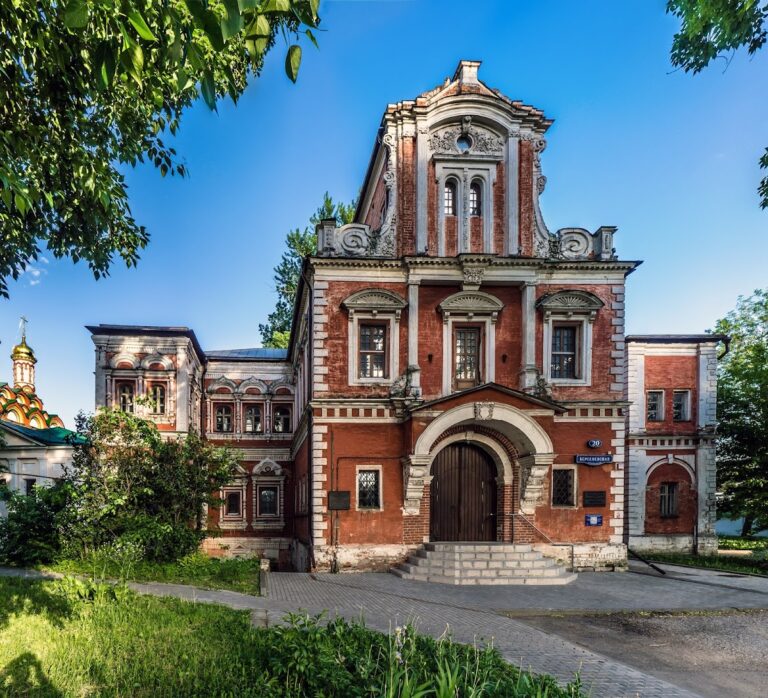
The surviving church is a seventeenth-century brick monument in the Russian uzorochye style, a form of architecture distinguished by varied volumes, elaborate brick and tile decoration, keel-shaped gables, and colorful surfaces. Its principal building is crowned by five onion domes set on blind drums, cylindrical supports without windows. A single tented bell tower accompanies the church. Three rows of kokoshniks, decorative keel-shaped gable elements, rise above the main building, creating a crown-like upper profile. Crowns also surmount the crosses, reflecting the building’s status as a royal church.
Exterior decoration and construction
The church was built of brick, hewn timber boards, and white Myachkovo stone, the same stone used in the cathedrals of the Moscow Kremlin. The master builders were probably Ivan Kuznechik and Karp Guba, while Ivan Volzhinsky and Ivan Rykachev supervised the construction. The original exterior was painted with red lead pigment and white simulated joints. Vertical bands extending toward the bell-tower tent carried twisted patterns, while the kokoshniks and the bell tower’s small dormer openings were painted in different colors.
Ornamental ironwork enhanced the windows. The bars formed a rectangular lattice with diamond shapes and attached concentric circles. The most renowned exterior feature is the glazed-tile frieze, made from 9,000 polychrome ceramic tiles arranged in a “peacock eye” pattern. Stepan Ivanov, known as Polubes, produced the tiles with Ivan Maksimov and other Belarusian craftsmen. Their colors have retained their original brightness.
Bell tower and chapels
Tented bell tower
The bell tower is topped by a steep tent-shaped roof, a characteristic form of traditional Russian architecture. The small dormer openings in the tent formed part of the original painted exterior scheme. The 1930 intervention cut a passage through the lowest level after the threatened demolition was prevented. The bell tower survived and remains an identifiable component of the church complex.
Side chapels
The 1767 chapel of Saint Gregory the Theologian repeats the architectural forms of the seventeenth-century church. The chapel built in 1834 for the Bogolyubovo Icon of the Mother of God differs in appearance, combining the Empire style, a monumental early nineteenth-century style derived from French Neoclassicism, with pseudo-Gothic elements that imitate Gothic forms.
Interior decoration and sacred furnishings
Paintings and iconostasis
Wall paintings were produced by artists from Kostroma, including Guriy Nikitin and Sila Savelyev, and by the Pereslavl painters Semyon Dmitriev and Dmitry Plekhanov, among others. Royal iconographers from the Armoury Chamber painted the iconostasis, the screen separating the sanctuary from the nave and carrying rows of icons, under the leadership of Simon Ushakov. The three altars were dedicated to Saint Gregory of Neocaesarea, Saint Gregory the Theologian, and the Bogolyubovo Icon of the Mother of God.
The restoration of 1859 renewed the paintings in the principal altar and in the central cube-like body of the church. It also re-gilded the silver coverings on six icons in the first tier of the iconostasis and cleaned icons in its other tiers. A 1939 inspection recorded that the valuable seventeenth-century iconostasis had been broken up and that the eighteenth-century chandelier was missing. The former icons and carved Royal Doors removed during the Soviet closure are held in the Tretyakov Gallery, the State Historical Museum, the Shchusev Museum of Architecture, and the Russian Museum.
Relics and venerated images
The church preserves a fragment of the relics of Saint Gregory of Neocaesarea. Queen Paraskeva Feodorovna gave the relic to Prince Gregory Volkonsky, who transferred it to the church in 1811. After it had been lost, Anthony Bloom, Metropolitan of Sourozh, returned it in 1998.
Other relics preserved at the church include fragments associated with Saint Gregory the Theologian, Matrona of Moscow, Demetrius of Thessaloniki, Panteleimon the Healer, Philaret and Innocent of Moscow, the Holy Fathers of the Kiev Caves, Barbara, Tryphon, Jerome of Stridon, Sergius of Radonezh, Alexander Nevsky, Mitrophan of Voronezh, Demetrius of Rostov, Joasaph of Belgorod, Tikhon of Zadonsk, Pimen the Great, Nilus of Stolobensk, David and Athanasius of Serpukhov, and Simeon of Verkhoturye. The church also has a venerated copy of the Bogolyubovo Icon of the Mother of God and a fragment of the True Cross.
Nearby sites