Krukenburg: A Hilltop Castle Ruin in Germany


Site at a Glance
- Rating
- 4.6
- Popularity
- Low
- Country
- Germany
- Primary era
- Medieval
- Eras represented
- Medieval
- Civilizations
- Holy Roman Empire
- Site type
- Military
- Remains
- Castle
On this page8 sections
History
Krukenburg is a hilltop castle ruin in Germany, near Helmarshausen, now part of Bad Karlshafen. Its earliest major structure was a church begun in 1107 and completed in 1126, creating a Christian center that later stood within a fortified castle complex.
The church and its Christian setting
Heinrich II of Werl, Bishop of Paderborn, dedicated the church to John the Baptist. This dedication suggests that the site hosted numerous baptisms and functioned as an early Christian cult center, possibly before Helmarshausen Monastery was founded in 997.
The church followed the model of the Church of the Holy Sepulchre in Jerusalem, the major Christian sanctuary traditionally associated with the crucifixion, burial, and resurrection of Jesus. Tradition attributes the plans to Wino, one of the monastery’s first abbots, who is said to have brought them back after a pilgrimage to Jerusalem around 1030.
Fortification and ecclesiastical lordship
Disputes among the dioceses of Cologne, Paderborn, and Trier led to the construction of a castle complex around the church between 1215 and 1220. The fortifications were intended to protect Helmarshausen Monastery, and their construction is attributed to Engelbert I, Archbishop of Cologne.
In 1223, the Diocese of Cologne pledged Krukenburg to Count Hermann of Everstein. A pledged castle was held by another lord or institution as security for a debt or political agreement until the pledge was redeemed. In 1336, the castle was pledged to the Prince-Bishopric of Paderborn, a territory ruled by a bishop who also exercised secular power. Paderborn built the Paderborn House there in 1338.
Hessian conquest and later decline
Until the second half of the fifteenth century, Krukenburg remained within the territorial lordship of the Paderborn bishops. Castle governors from the Wintzingerode family represented that authority; the family had held pledged shares in the castle since 1377. From the fourteenth century, castle officials also used the designation “von Krukenberg.”
Conflict between Landgrave Ludwig II of Hesse and Paderborn brought the castle under the landgrave’s control in 1465. It came under Hessian protection in 1479, although Paderborn recovered part of it in 1496 and appointed an official to administer that share. Landgrave Moritz of Hesse-Kassel bought back Paderborn’s share in 1597.
After 1617, Krukenburg gradually fell into disrepair. Large parts of the complex were later demolished so that their building materials could be reused. The ruins were restored during the 1970s.
Remains
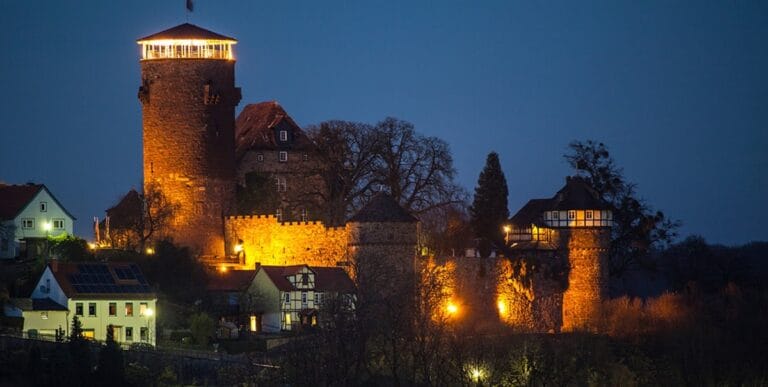
Krukenburg occupies the summit of the 184.2-metre Waltersberg, about 80 metres above a loop of the Diemel River. The river joins the Weser roughly 1.4 kilometres northwest of the ruin, in the central area of Bad Karlshafen. The site lies approximately 290 metres north of Helmarshausen and about 500 metres southwest of Nollendorf.
Rotunda church
At the center of the complex stands the church, whose plan forms a cross around a circular central space. This rotunda, a circular building or central circular space, measures more than 13 metres in diameter. Its central-plan design reflects the church’s historical model in Jerusalem, while the surviving structure remains the architectural core of the castle ruins.
Castle defenses
The castle enclosure was built around the church. It included strong walls with towers, a moat, a gate, and a keep, the principal fortified tower used for defense and residence. These defensive elements remain recognizably preserved within the ruin and show how the earlier religious foundation was incorporated into a fortified complex.
Residential buildings
The complex included the Paderborn House, built in 1338, and the Mainz House, which served as an abbot’s residence. A residential tower was added between 1401 and 1405. These buildings formed the residential and administrative parts of the castle alongside the central church and its surrounding defenses.