Raffenburg: A Medieval Hilltop Castle in Hagen, Germany


Site at a Glance
- Rating
- 4.1
- Popularity
- Low
- Country
- Germany
- Primary era
- Medieval
- Eras represented
- Medieval
- Civilizations
- Holy Roman Empire
- Site type
- Military
- Remains
- Castle
On this page13 sections
History
Raffenburg is the ruin of a medieval hilltop castle in Hagen, Germany, probably founded during the first half of the thirteenth century. It belonged to Kurköln, the ecclesiastical principality and electorate ruled by the archbishops of Cologne within the Holy Roman Empire. The castle probably served as a border fortress protecting Cologne’s territory against the emerging County of Limburg.
Foundation and territorial role
Raffenburg may have been established after the killing of Archbishop Engelbert of Berg in 1225, or in connection with the foundation of Hohenlimburg Castle directly opposite it. Its position on the wooded Raffenberg gave it a role in the administration and defense of Kurköln’s lands. The Holy Roman Empire provided the wider political framework, linking German ecclesiastical and secular lordships without forming a centralized nation-state.
The castle continued to be granted as a fief into the fourteenth century. Coins and pottery point to another phase of expansion and settlement after the castle’s destruction in the late thirteenth century. An office of Schultheiß, an official involved in local judicial or administrative government, was once interpreted as evidence for a town beside the castle. It is now connected with the archiepiscopal administration of the Cologne lordship of Volmarstein.
The siege of 1288
Raffenburg was besieged by Count Eberhard II of the Mark from 7 May 1288 during the War of the Limburg Succession, a conflict over the inheritance of the County of Limburg. Several attempts to take the castle with siege equipment failed. According to the chronicle of Levold of Northof, the defenders eventually surrendered after running out of water.
A local story later gave the castle a robber knight named Humbert. In the legend, Humbert agreed to surrender if his wife could leave with whatever she could carry in three trips. She carried Humbert out first, then their son, and finally attempted to carry away so much gold and jewelry that she collapsed at the foot of the hill. This tale belongs to local tradition rather than to the documented history of the siege.
Archaeological study
Andreas Korthals produced the first historical scholarly study of Raffenburg in 1997 as a master’s thesis at Ruhr University Bochum. In 2010, Michael Baales, Ralf Blank, and Jörg Orschiedt published an archaeological and historical description of the castle, its associated defenses, and the surrounding settlement. Eva Cichy and Ralf Blank presented the first systematic archaeological and historical classification in 2020.
A second earthwork, the Franzosenschanze, lies approximately 600 metres south of Raffenburg. Its ditches remain visible in the forest. The earthwork cannot be dated or classified precisely, but it probably belonged to the castle complex.
Remains
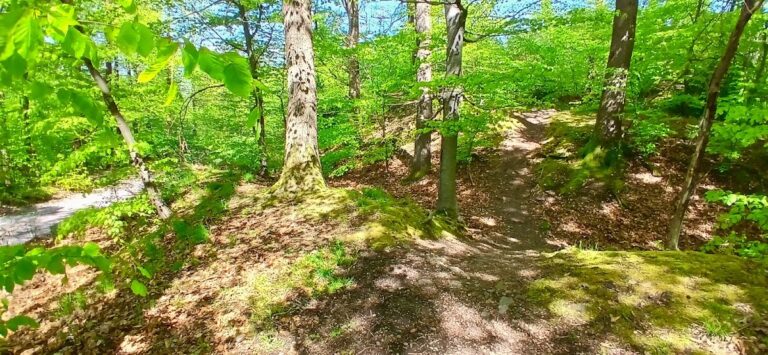
Raffenburg occupied the summit of the wooded Raffenberg at approximately 240 metres above sea level, west of Hohenlimburg and east of Hagen-Holthausen. The hill lies within the Raffenberg nature reserve. The B 7 follows the north-eastern side of the hill, while the Lenne floodplain lies more than 120 metres below. The castle formed the centre of a wider fortified and settled area.
Castle layout and defenses
Inner castle and curtain wall
The oval inner area measured approximately 60 by 80 metres. A curtain wall about 120 centimetres thick surrounded the castle, together with a ditch. The main entrance stood on the eastern side. The surviving remains are partly original and partly conserved, and the parts of the complex can still be traced among the trees.
Keep and residential buildings
A tower stood at the centre of the courtyard and served as the keep, the principal defensive tower. It had an internal diameter of approximately 3.5 metres and walls 260 centimetres thick. The castle also contained two palas buildings, the principal residential or representative structures of a medieval castle, each with cellars. Stables, a cistern, and accommodation for the garrison completed the recorded arrangement.
Gatehouse and associated earthworks
The cellar of the gatehouse was conserved in 1978. Together with the ditch, curtain wall, central tower, and additional defenses, it forms part of the traceable ground plan. The Franzosenschanze, south of the main castle, survives as a separate earthwork with visible ditches and is probably associated with the wider castle complex.
Archaeological finds
Earlier objects and medieval domestic life
The hill has produced objects from periods before the medieval castle. An axe from the Late Bronze Age, approximately 1500 to 1000 BC, was discovered in 1835. A kidney-shaped ring of tin bronze from the Early Iron Age, approximately the eighth to sixth centuries BC, was found in 1991.
Medieval finds include an earthenware pan from the thirteenth or fourteenth century, a near-stoneware ceramic cup from the late Middle Ages, and a stoneware handled jug from the thirteenth or fourteenth century. The pan came from the 1932–33 excavation, while the jug was recovered during the 1932 excavation. A silver Gros Tournois, or tournois gros, belongs to the thirteenth or fourteenth century.
Weapons and fittings
Military and household equipment reflects the castle’s medieval occupation. Iron arrowheads and crossbow bolts from the thirteenth century were found at the site. A limestone projectile from a siege engine, possibly used during the 1288 siege, was recovered in the 1932–33 excavation. Thirteenth-century forged-iron caltrops, small spiked devices scattered on the ground to hinder movement, may also relate to the conflict.
Other finds include a thirteenth-century iron chest fastening, a partly gilded non-ferrous-metal lock and hinge, and a forged-iron window cross. A rowel-and-prick spur from the thirteenth or fourteenth century was recovered during the 1932 excavation. In 2018, Horst Klötzer discovered an iron dagger with a non-ferrous-metal pommel, dating from the thirteenth or fourteenth century.
Raffenberg Monument
Approximately ten metres east of the castle grounds stands the sandstone Raffenberg Monument. Erected in 1837 and renovated in 1983, it commemorates Emil Friedrich I, ruling prince of Bentheim-Tecklenburg, who was born on 12 May 1765 and died on 17 April 1835. Its front inscription names the prince. A memorial verse about his death appears on the right side, a verse concerning hope, faith, and reunion after death appears on the left, and the rear cites the Gospel of John 14:16–19.