Burg Herstelle: A Historic Castle Above the Weser Valley in Germany

Site at a Glance
- Rating
- 4.5
- Popularity
- Very Low
- Country
- Germany
- Primary era
- Modern
- External website
- Open
- Eras represented
- Medieval, Early Modern, Modern
- Civilizations
- Holy Roman Empire, Kingdom of Prussia
- Site type
- Domestic
- Remains
- Castle
On this page15 sections
History
Burg Herstelle is a historic hilltop castle in Germany, above the Herstelle district of Beverungen in the Weser valley. The site was first mentioned in 1292 as property of the Paderborn bishopric, while its present castle was built between 1825 and 1832 in a Neo-Gothic style that revived the idea of the medieval stronghold.
Charlemagne and the early medieval tradition
During the Saxon Wars, Charlemagne, the Frankish king and later Roman emperor whose expansion shaped the political and religious history of Saxony, established a winter camp at Herstelle in 797 and founded a chapel there. He called the place Heristal Saxonicum. The location of this camp or royal residence has not been identified, and its presence within the modern municipality of Herstelle remains uncertain.
The winter quarters continued unusually late, until May 798. Herstelle was not developed as extensively as the established royal residence at Paderborn. The reason Paderborn became a bishop’s seat the following year is not recorded, although Charlemagne’s assistance to Pope Leo III, who had fled to Paderborn, may have contributed to that development. Later archaeological and historical work has not conclusively established Charlemagne’s presence at Herstelle. A Carolingian denarius, a small silver coin of Charlemagne’s dynasty, was found on the Weser slope southwest of Herstelle’s built-up edge. Minted between 793/794 and 812/813, it was not recovered from the castle itself.
Episcopal castle and destruction
The medieval castle was pledged during the first half of the fourteenth century. Bishop Simon II of Paderborn subsequently installed the Falkenberg knights as officials there, placing the stronghold within the administrative system of the Paderborn bishopric.
On 24 July 1464, troops commanded by Landgrave Ludwig II of Hesse destroyed Burg Herstelle and the settlement during the Hessian-Paderborn Feud, a conflict connected with Burg and the town of Calenberg. With support from the bishopric, the inhabitants rebuilt both castle and village by the end of the fifteenth century.
War, rebuilding, and decline
The castle was plundered and burned again during the Thirty Years’ War, the major European conflict of 1618–1648. Around 1650 it underwent an almost complete reconstruction. Despite this rebuilding, the complex fell into definitive decay at the beginning of the nineteenth century.
The nineteenth-century castle
Fernandine Heereman von Zuydtwyck, daughter of Werner Adolph von Haxthausen, acquired the complex in 1823. She commissioned Johann Claudius von Lassaulx, an architect from Koblenz, to build a new castle slightly west of the medieval one. Construction lasted from 1825 to 1832, and the completed building deliberately revived the earlier castle’s form and associations.
During the nineteenth century, Burg Herstelle became a meeting place for prominent artists and scholars, including Annette von Droste-Hülshoff and the Brothers Grimm. Successive owners used it as a recreational residence until 1983. The Hörning family acquired the complex in 2007, after which extensive restoration took place. The castle remains privately owned, while parts of the complex have again been used for cultural purposes. Burg Herstelle was named Monument of the Month in Westphalia-Lippe in August 2016 and received first prize in North Rhine-Westphalia’s Federal Prize for Craftsmanship in Heritage Conservation in 2017.
Remains
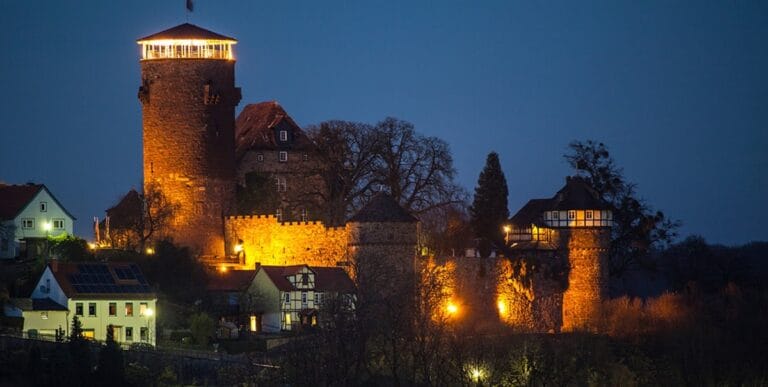
The surviving complex occupies an elevated rise above Herstelle overlooking the Weser. Its historic fabric combines remnants of the medieval castle with eighteenth-century service buildings and the nineteenth-century residence. Sections of the circular enclosing wall, a former episcopal administrative building, and a barn remain alongside the rebuilt castle.
Medieval and episcopal remains
Enclosing wall
Sections of the medieval circular enclosing wall survive on the elevated castle site. They belong to the earlier defensive complex and preserve part of its boundary, although the later castle stands slightly west of the medieval one.
Administrative building and barn
The former Paderborn episcopal administrative building dates from 1798. It is a single-storey, five-bay rendered structure with a mansard roof, whose lower slope is steeper than its upper slope. A barn from 1757 also survives within the historic complex.
Nineteenth-century castle
Main house and stair tower
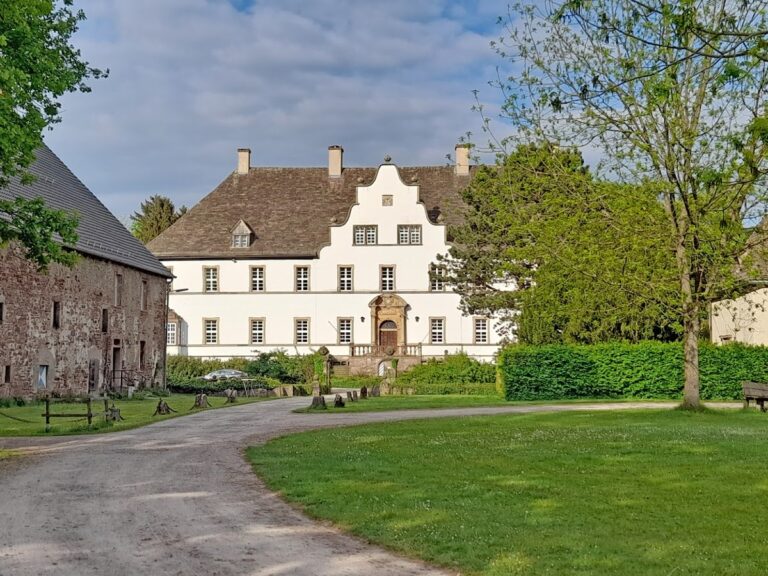
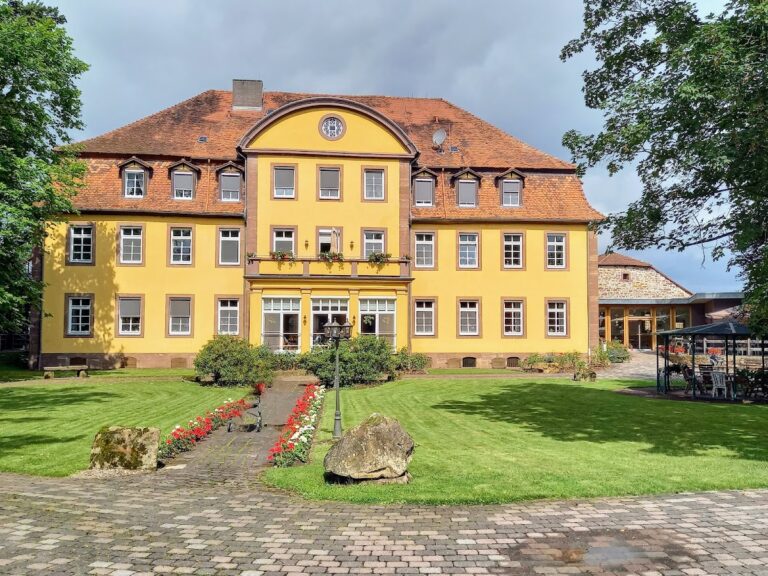
Completed in 1832, the present castle is a three-storey building. Its main house is built of unrendered rubble stone and represents the medieval palas, the principal residential and representative hall of a castle. A round stair tower attached to the right side recalls a medieval fortified tower through its round-arch frieze and crenellated parapet.
The main building and stair tower stand behind a short stone bridge reached by a seven-step staircase. The facades are organized with pilaster strips, layered wall construction, and a round-arch frieze beneath the eaves. Red-sandstone window surrounds carry profiled triangular gables. A high gabled roof covered with Weser sandstone slabs rises above the building, with dormer windows arranged in two rows.
Entrance and winter garden
The entrance is formed by a two-leaf Neo-Gothic portal with tracery decoration and a high surround of Weser sandstone. Across the full width of the western side, a winter garden is attached at the level of a high basement.
Karlstein and early historical evidence
Karlstein memorial
Karlstein is a flat rock formation several hundred metres from the castle, on a cliff above the Weser. It was created in 1835, when the rock was blasted during construction of a road that is now the Bundesstraße 83. Afterward, the oldest cross stone in Westphalia was moved to Karlstein and marked with the year 797 as a memorial to Herstelle’s early history.
The cross is often called the Boniface Cross, although its origin is undocumented. It has been described as possibly Old Frankish and may have been made by a stonemason accompanying Charlemagne. Another possibility is that it originated at Burg Herstelle, since its proximity to the castle and the timing of the nineteenth-century building work support that interpretation. No proof establishes either explanation.
Carolingian coin
The Carolingian denarius found on the Weser slope southwest of Herstelle’s built-up edge provides a material connection with the period associated with Charlemagne. The coin was minted between 793/794 and 812/813, but its findspot was outside the castle itself.
Nearby sites