Kronborg Castle: Denmark’s Strategic Renaissance Stronghold

Site at a Glance
- Rating
- 4.6
- Popularity
- High
- Country
- Denmark
- Primary era
- Early Modern
- External website
- Open
- Eras represented
- Medieval, Early Modern
- Civilizations
- Danish
- Site type
- Military
- Remains
- Castle
On this page13 sections
History
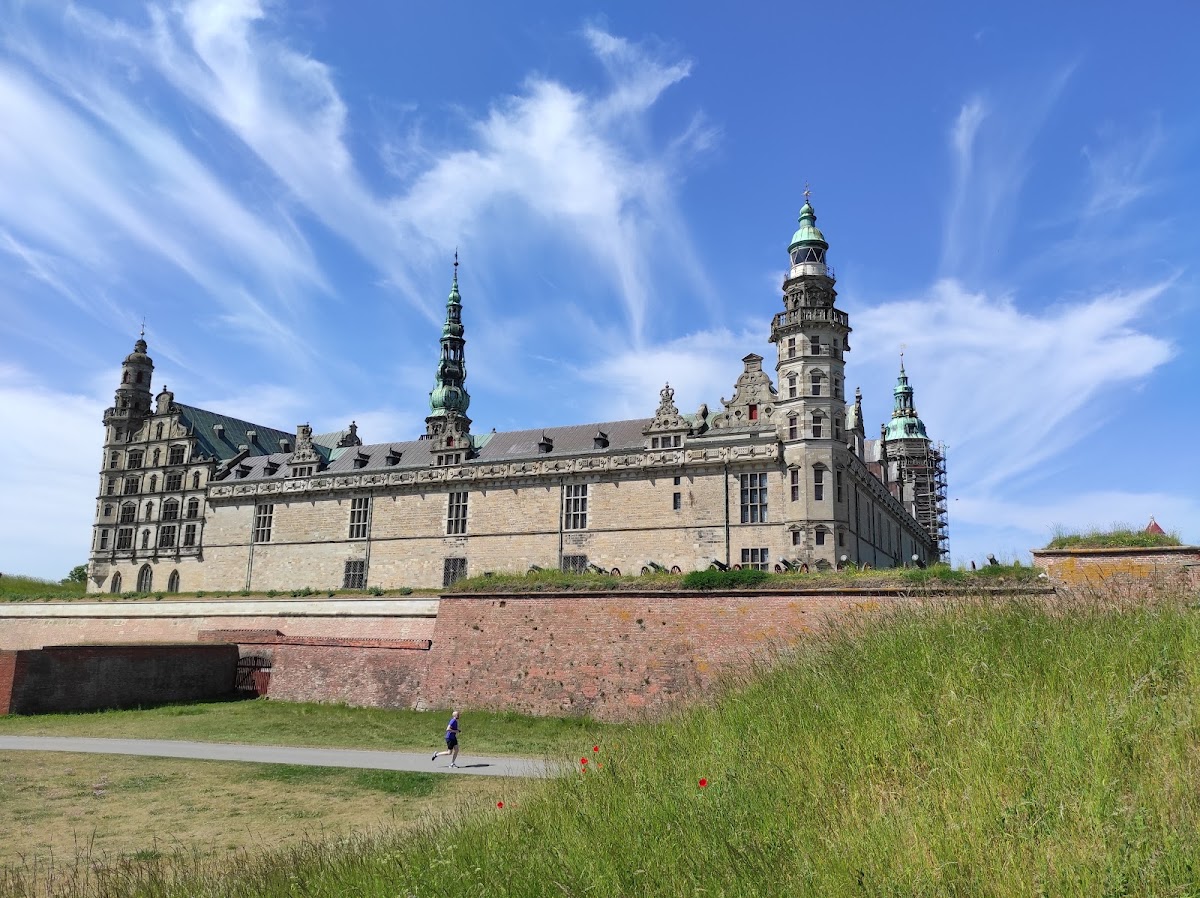
Kronborg Castle is a Danish castle and historical stronghold at Helsingør, Denmark, built and repeatedly transformed by the Danish monarchy from the early fifteenth century onward. Its Renaissance rebuilding between 1574 and 1585 created the courtly castle known today, while its position at the narrowest point of the Øresund gave it control over one of the few maritime entrances to the Baltic Sea. The strait is about 4 kilometres wide at this point, making the site both a royal residence and a major instrument of Danish maritime policy.
Krogen and the Sound Dues
The castle began as Krogen, a fortress generally dated to the 1420s. King Eric of Pomerania built it on a sandy tongue of land extending from Zealand toward Scania to help enforce the Sound Dues, a royal toll charged to ships passing through the Øresund. Captains had to declare the value of their cargo, and the payment was calculated from that declaration. The Danish king could also buy the cargo at the declared price, a rule intended to discourage captains from undervaluing their goods.
Krogen formed part of a wider system controlling navigation through the strait. Together with Helsingborg Castle on the opposite shore and a Danish guard ship, it helped regulate maritime movement between the Baltic Sea and the North Sea. The early fortress had a square curtain wall enclosing stone buildings. Its northeastern building contained the king’s residence, the southwestern building held a large arched banquet hall, and the southeastern building probably served as a chapel.
Fortification and Renaissance Transformation
King Christian III strengthened Krogen in 1558 and 1559 by adding bastions to the corners of its curtain wall. A bastion is a projecting fortification that allows defenders to direct artillery and small arms along the walls and toward approaching forces. After the Northern Seven Years’ War ended in 1570, improved artillery made the medieval defenses inadequate. King Frederick II therefore ordered a major modernization and expansion.
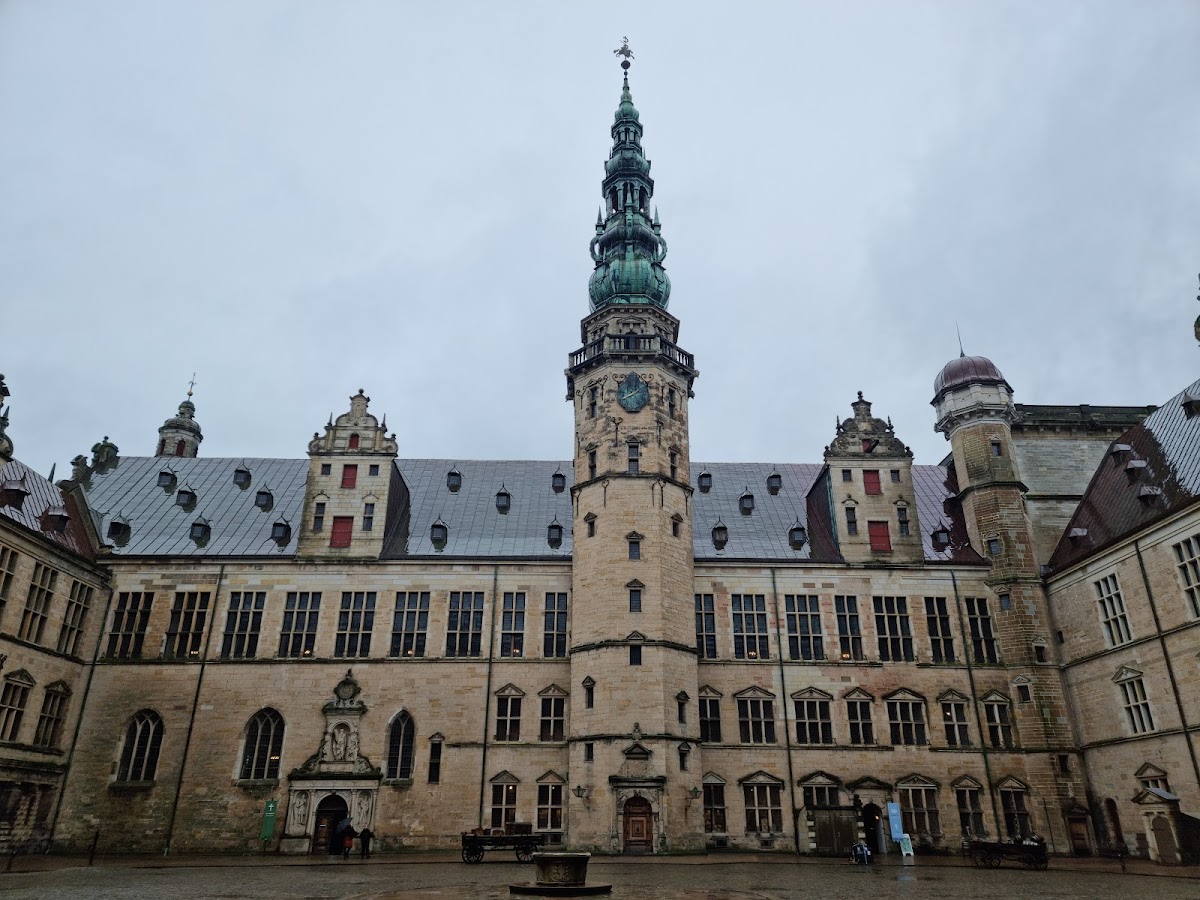
The advanced fortification works, led by Hans Hendrik van Paesschen, were completed in 1577. At that point the castle acquired the name Kronborg, meaning “Crown Castle.” Frederick II also transformed the older fortress into a Renaissance castle between 1574 and 1585. Hans Hendrik van Paesschen was the principal architect, Anthonis van Obbergen became master builder from 1578, and Gert van Groningen coordinated the sculptural work.
The rebuilding joined Krogen’s separate medieval buildings into three coherent wings. Frederick II was a major patron of theatre, and performances took place at Kronborg when he held court there in 1579. In 1590, James VI of Scotland stayed at the castle after marrying Anne of Denmark and gave 2,000 Danish gold dalers to its officers and servants.
Fire and Christian IV’s Restoration
During the night of 24 to 25 September 1629, a fire caused by the carelessness of two workmen destroyed much of Kronborg. King Christian IV ordered its restoration, which began in 1631 under Hans van Steenwinckel the Younger. By 1639 the exterior had been restored without major changes to its form, although the interior did not fully regain its earlier splendour.
Portals, chimneypieces, ceiling paintings, and other decorative elements were renewed in the Baroque style, a seventeenth-century form of decoration known for rich ornament and dramatic movement. The fire and subsequent rebuilding therefore altered the interior character of the Renaissance castle while preserving its principal external arrangement.
Swedish Capture and Military Strengthening
During the Dano-Swedish War of 1658 to 1660, a Swedish army commanded by Carl Gustaf Wrangel besieged, attacked, and captured Kronborg. During the occupation, Queen Hedvig Eleonora of Holstein-Gottorp and Maria Eufrosyne of Pfalz, the sister of the Swedish king, lived at the castle. Charles X of Sweden visited them there, and they received foreign ambassadors. Swedish forces removed many valuable artworks as war booty, including a richly decorated courtyard fountain, Frederick II’s canopy, and large ceiling paintings commissioned by Christian IV for the Ballroom.
The capture demonstrated that Kronborg could be overcome, leading to a substantial strengthening of its defenses. The Crownwork, an advanced defensive line placed beyond the principal castle defenses, was added between 1688 and 1690. A new series of surrounding ramparts followed shortly afterward. Once these works were complete, Kronborg was regarded as the strongest fortress in Europe.
Prison, Barracks, and Public Monument
From 1739 until the beginning of the twentieth century, Kronborg served as a prison. Soldiers stationed at the castle guarded inmates sentenced to forced labour on the fortifications. Prisoners with minor sentences could work outside the walls, while those convicted of serious violence, murder, arson, or similar offences performed hard labour within the ramparts. All prisoners wore chains and spent the nights in cold, damp dungeons.
Queen Caroline Mathilde, the British-born sister of King George III, was imprisoned at Kronborg from 17 January to 30 April 1772 after the scandal surrounding her relationship with Johann Friedrich Struensee, a German-born Danish statesman and royal physician. Kronborg ceased to be a royal residence in 1785 and became army barracks. It remained under military administration from 1785 to 1922, with further renovations carried out during that period.
The Royal Danish Army left in 1923. Extensive renovation followed, and the castle opened to the public in 1938. Kronborg was inscribed on the UNESCO World Heritage List in 2000 under cultural criterion (iv), which recognizes an outstanding building or architectural group illustrating an important stage in human history. The Danish cultural heritage authority also records it as a monument.
Hamlet and Legendary Associations
Kronborg became internationally associated with William Shakespeare’s Hamlet, where it appears as Elsinore, the English form of Helsingør. The play was first staged at the castle in 1816 for the bicentenary of Shakespeare’s death, with soldiers from the garrison performing in the telegraph tower. It has since been performed repeatedly in the courtyard and at other places on the fortifications, including productions involving Laurence Olivier, John Gielgud, Christopher Plummer, Derek Jacobi, David Tennant, and Jude Law.
A separate legend connects the sleeping figure Ogier the Dane, also known as Holger Danske, with a Danish king who rests at Kronborg until his homeland needs saving. The story links him with Avalon and Morgan le Fay in Arthurian tradition. A statue of the sleeping hero stands in the castle’s casemates, vaulted protected chambers within the fortification.
Remains
Setting and Defensive Layout
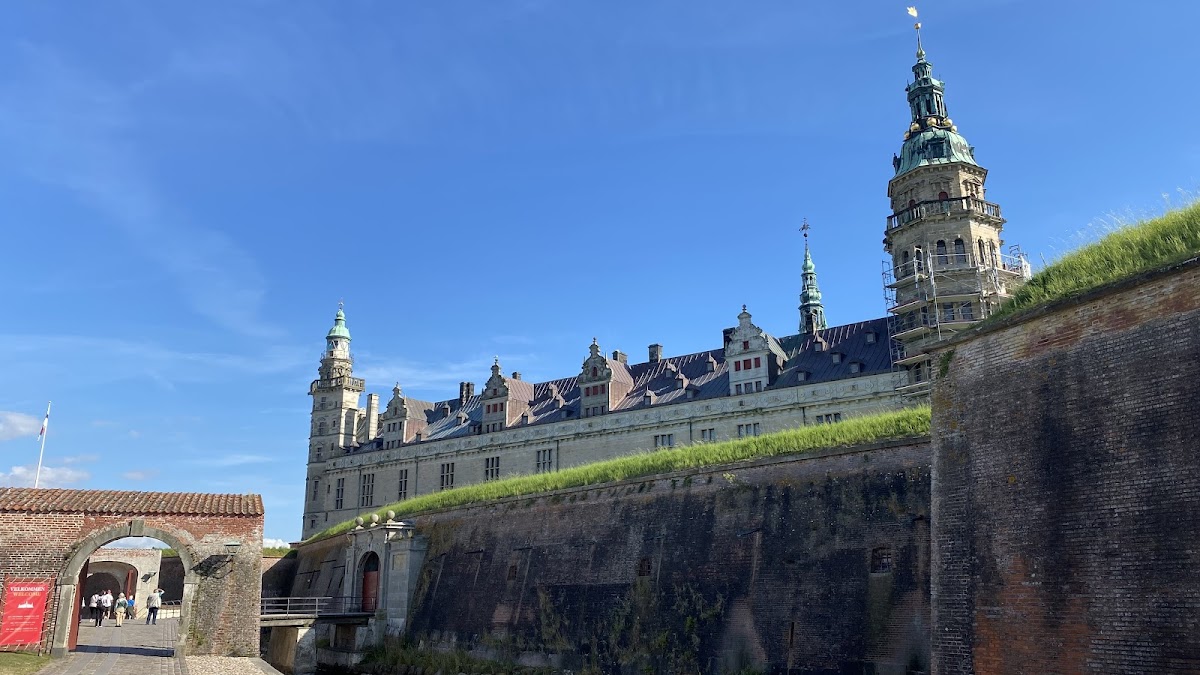
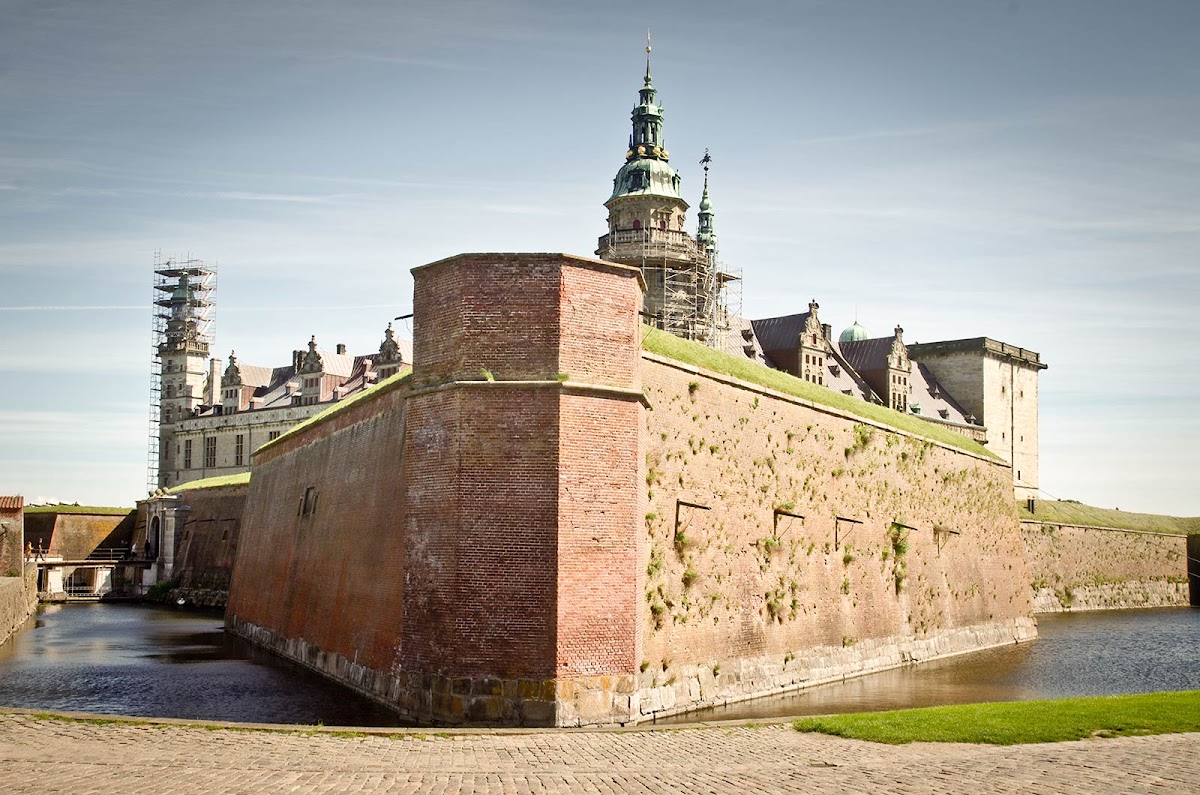
Kronborg stands on a small foreland projecting into the narrowest part of the Øresund, at the extreme northeastern tip of Zealand and northeast of Helsingør’s historic centre. The castle is about 12 metres above sea level. Its approach from the town runs eastward through a sequence of moats and gates before reaching the main complex. The Crownwork and the later surrounding ramparts form the enlarged defensive system that surrounds the castle.
Large portions of Krogen’s medieval walls remain incorporated into the present complex. The original fortress used a square curtain wall, a continuous defensive wall linking fortified points, around stone buildings. Later works preserved this medieval core while extending the site with bastions, moats, gates, ramparts, and the advanced Crownwork.
Royal Wings and Apartments
Frederick II’s rebuilding turned the separate buildings of Krogen into three connected wings. The north wing contained chambers for the king, queen, and the queen’s ladies-in-waiting, as well as the chancellery. The southeastern medieval building was refitted as a chapel within the south wing. The castle was first rebuilt to two storeys, but from 1578 Anthonis van Obbergen added another storey to the south wing, built the large Ballroom above the chapel, and heightened the west and north wings. The east wing received the Queen’s Gallery, a passage linking the queen’s chambers with the Ballroom.
The rebuilt exterior was clad in sandstone from Scania and covered by a copper-sheet roof. The royal apartments occupy the first floor of the north wing. Frederick II furnished them around 1576, while Christian IV refurnished and decorated them after the fire with ceiling paintings, stone portals, and chimneypieces. Their original black-and-white tiled floors were replaced by wooden floorboards in 1760 and 1761, and the walls were covered with gilt leather. The rooms now contain seventeenth-century Netherlandish furniture.
The King’s Chamber has a bay window directly above the main portal. The Queen’s Chamber opens onto a vaulted tower chamber overlooking the Flag Bastion. These rooms preserve the arrangement of the royal apartments and their connection with the castle’s ceremonial and defensive architecture.
Chapel and Ballroom
The chapel occupies the ground floor of the south wing and was inaugurated in 1582. In 1785 the army converted it into a gymnasium and fencing hall, placing its furniture in storage. The original furniture was returned in 1838, and the chapel was reinaugurated in 1843.
Above the chapel is the Ballroom, which measures 62 by 12 metres. When completed in 1582, it was the largest hall in Northern Europe. Its walls display large paintings made between 1618 and 1631 for the Great Hall of Rosenborg Castle in Copenhagen, including works by Francis Cleyn, Reinhold Timm, and Isaac Isaacsz. The present floor and fireplaces date from the rebuilding carried out between 1924 and 1938.
Little Hall Tapestries
The Little Hall contains seven tapestries from a series of forty depicting one hundred Danish kings. The surviving works include representations of Oluf, who reigned from 1376 to 1387, and Knud VI, who reigned from 1182 to 1202. Frederick II commissioned the series around 1580. Seven additional tapestries are held by the National Museum of Denmark, while the rest of the series has been lost.
Casemates and Courtyard Artworks
The castle’s casemates contain the statue of the sleeping Ogier the Dane. These vaulted chambers form part of the protected spaces within Kronborg’s fortifications. The courtyard formerly held a richly decorated fountain, but Swedish forces removed it during the occupation of 1658 to 1660. Other displaced artworks included Frederick II’s canopy and several large ceiling paintings made for the Ballroom on Christian IV’s orders.