Burg Ziegenberg (Ziegenhagen): A Medieval Spur Castle in Germany


Site at a Glance
- Rating
- 3.9
- Popularity
- Very Low
- Country
- Germany
- Primary era
- Medieval
- Eras represented
- Medieval
- Civilizations
- Holy Roman Empire
- Site type
- Military
- Remains
- Castle
On this page9 sections
History
Burg Ziegenberg, also known as Ziegenburg, is a medieval spur castle in Germany above Ziegenhagen, now within Witzenhausen. Probably built in the late eleventh century, it occupied a projecting ridge whose slopes helped protect the fortified site. The castle first appears in written records in 1101 under the name Zygenberch.
The Counts of Ziegenberg
Count Dedo of Ziegenberg was recorded at the castle in 1116. His marriage to a woman from the Dassel family connected the count with another prominent noble lineage. At the beginning of the thirteenth century, the Counts of Ziegenberg divided into three lines led by the brothers Hermann the Black, Hermann the White, and Giso.
Hermann the Black repeatedly accompanied Duke Otto of Brunswick as a member of his retinue and was married to Hildegunde of Lauterberg. He died in 1262. The line associated with him ended when Hermann the White died in 1266. Giso of Ziegenberg was among the co-founders of Mariengarten Monastery, linking the family to the establishment of a religious community.
Hessian control and noble fiefs
Landgrave Otto I of Hesse, a high-ranking territorial ruler in the Holy Roman Empire, conquered the castle in 1320. He subsequently pledged it to the von Berlepsch family. In 1400, Hessian landgrave troops again took Burg Ziegenberg, as well as Burg Berlepsch, during a punitive campaign.
The campaign followed an inheritance dispute at Burg Berlepsch. After the childless death of Hans von Berlepsch in 1392, Thilo von Berlepsch, a castle retainer with a service obligation connected to the fortress, took possession of the castle against the landgrave’s wishes. The seizure of both castles in 1400 followed this defiance.
In 1494, Burg Ziegenberg became a male fief of Georg the Younger von Buttlar, meaning that the holding was normally inherited through the male line. His son Erasmus, also known as Asmus von Buttlar, was the last resident of the castle. He lived there until his death in 1541. Afterward, the castle fell into decay and was partly demolished. Its territory remained part of the Hessian administrative district of Witzenhausen until 1821.
Remains
Setting and layout
The ruins occupy the rocky, wooded northern spur of the Kalbskopf, approximately 270 metres above sea level and east of Ziegenhagen. This ridge lies at the northern edge of the Kaufungen Forest. The castle was arranged as an outer bailey, the lower or more external part of the complex, and a main bailey, its principal enclosed area. Together, the fortifications covered approximately 15 by 30 metres.
Main defensive works
Keep
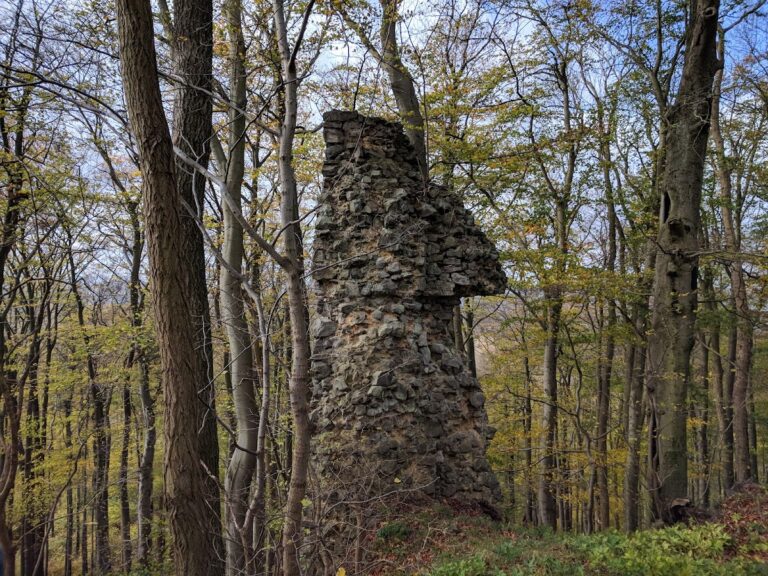
A square keep stood in the main bailey. A keep was the principal defensive tower of a medieval castle and was not necessarily designed as a permanent residence. Only wall remains just under 1.5 metres high survive, although the tower originally had walls approximately 5 metres thick.
Outer defenses
A zwinger, an outer defensive enclosure or passage between fortification walls, adjoined the southern side of the keep. Further wall remains extend along the eastern side of the upper plateau. A second tower still stood on the site into the 1820s, and an elliptical curtain wall enclosed it. These surviving and formerly standing elements belonged to the defensive organization of the castle beyond the square keep.
Valley setting
West of the ruins, the Rautenbach runs through the valley containing Ziegenhagen. It is a southwestern tributary of the Werra. The boundary with the Lower Saxon district of Göttingen lies nearby, placing the castle in a border landscape between the Hessian and Lower Saxon territories.