Krimisa: An Ancient Town and Sanctuary in Magna Graecia
Site at a Glance
- Popularity
- Medium
- Country
- Italy
- Primary era
- Classical
- Eras represented
- Classical
- Civilizations
- Ancient Greek
- Site type
- Religious
- Remains
- Temple
On this page14 sections
History
Krimisa was a small ancient town in Magna Graecia, the name for Greek communities in southern Italy. Its exact location is unknown, but it is associated with the area around the sanctuary of Apollo Aleus at Punta Alice near modern Cirò Marina, Italy. The town probably dates to the seventh century BC, while evidence for an indigenous cult at the sanctuary reaches back to the second half of the eighth century BC.
Early settlement and foundation traditions
Krimisa lay between the spheres of influence of the Greek cities of Sybaris and Kroton. The sanctuary also brought Greek communities into contact with the region’s established indigenous population. In the fourth century BC, it held an important position within the Bruttian Confederation, the political association of the Bruttii, an ancient people of southern Italy.
Greek myth associated the town’s foundation with Philoctetes, a hero of the Trojan War. Traditions linked with Strabo, Pseudo-Apollodorus, Lycophron, and works attributed to Aristotle tell of Philoctetes arriving with Rhodians led by Tlepolemus and founding Krimisa, as well as Petelia and Macalla. They also connected him with the sanctuary of Apollo Aleus, where he was said to have placed the bow and arrows given to him by Heracles. In these stories, Philoctetes later died fighting local people. His tomb was placed either near the Sybaris River or at Macalla, where a temple was said to have been built and sacrifices made in his honor. These accounts are mythological traditions, not established records of the town’s foundation.
Archaic and Classical development
The sanctuary grew from an earlier indigenous cult. During the Archaic period, it acquired monumental buildings in Greek architectural forms. A later phase, from the mid-fifth to the end of the fourth century BC, is represented particularly by fired-clay architectural decoration. A temple to Demeter, the Greek goddess associated with agriculture and fertility, also stood near the Alice crossroads.
Hellenistic decline
During the Hellenistic period, which followed the conquests of Alexander the Great, the rising power of the Bruttii coincided with major changes at the sanctuary. In the first decades of the third century BC, the Archaic temple was demolished. Sacred objects, including the statue of Apollo and a votive offering, were placed within the foundations of a larger temple that incorporated the earlier building. The sanctuary remained renowned until the devastations associated with Pyrrhus, king of Epirus, after which it declined. It was plundered and may have been destroyed by the end of the third century or during the second century BC.
Roman-period use and modern excavations
Use continued on a reduced scale from 202 BC, after the Second Punic War between Rome and Carthage, through the end of the Roman Empire in AD 476. Finds indicate activity in the sacred area during the late Roman Republic and the Empire. The Italian archaeologist Paolo Orsi placed the sanctuary’s destruction between the fourth and sixth centuries AD.
Orsi excavated in the area from 1924 to 1929. Further excavations at the temple took place between 1970 and 1990.
Remains
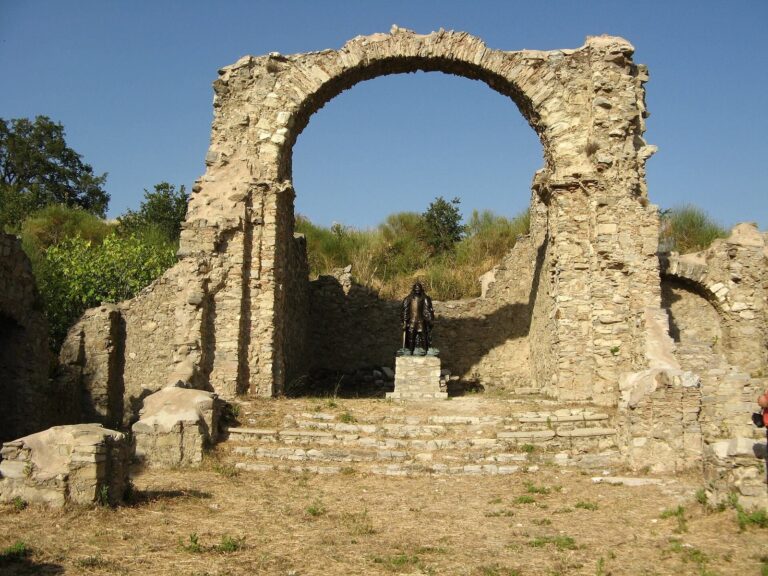
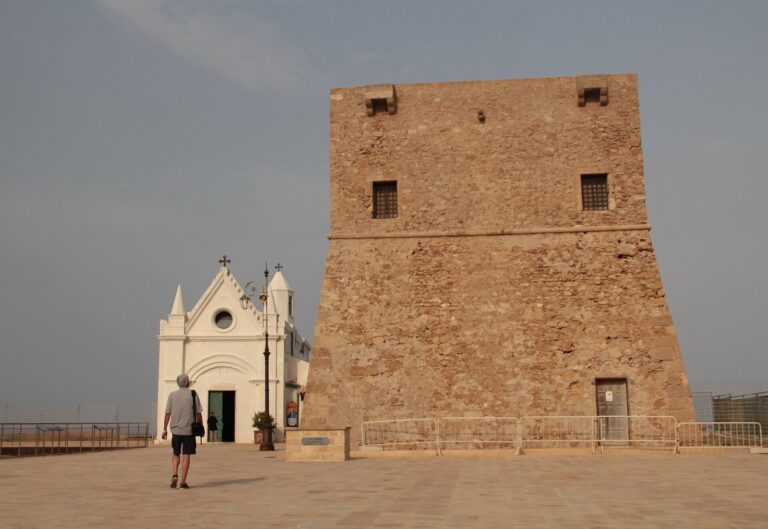
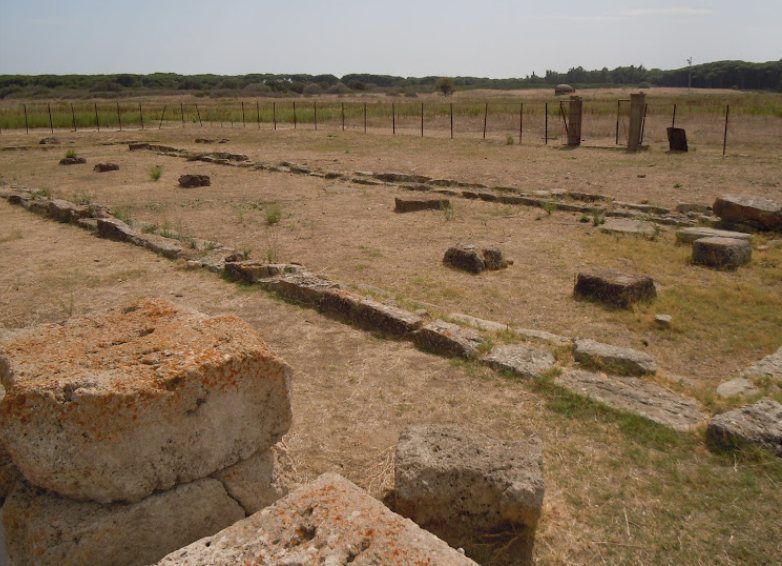
The sanctuary stood in marshy surroundings on a coastal promontory recognizable to navigators. Its principal remains are associated with successive Doric temples, set within a sacred area that developed over several periods.
Temple remains
Earlier temple phases
The earliest sanctuary may have used timber construction. A later temple phase had an elongated plan, with a platform, or stylobate, measuring 16.15 by 38.10 metres and a colonnade arranged in seven by fifteen columns. The surviving remains include the base of the cella, the main inner chamber, bases for the central colonnade, and pillars within the adyton, a restricted inner part of the sanctuary. Its light foundations consisted of two rows of roughly worked limestone blocks held with clay and limestone chips. The walls were probably built of mud brick and wood.
Hellenistic temple
The later temple was built of limestone in the Doric order. It was peripteral, meaning that columns surrounded the building, with eight columns along each short side and nineteen along each long side. Its foundations incorporated the earlier temple.
Roof decoration
Fired-clay architectural elements include antefixes, ornaments along a roof’s edge, dated to about 350–300 BC. Other finds from the sanctuary include Doric capitals and architectural fragments, providing evidence of the temple’s construction and decoration.
Finds held in museums
Cirò Marina Archaeological Museum
The museum at Cirò Marina holds a capital and other architectural elements from the sanctuary, alongside a terracotta mask and a pedestal. Its collection also includes fragments of a bronze statue and bronze wig, bronze coins, and figurines.
National Archaeological Museum of Crotone
The Crotone collection includes Doric capitals, votive terracottas, a mold for an antefix, and fragments of an Archaic limestone statuette of a young man. One antefix bears a Gorgon image on a disc and came from decoration at the temple roof’s peak or corner.
National Museum of Magna Graecia
The museum in Reggio Calabria preserves the marble head, hands, and feet of an acrolith of Apollo, a statue combining marble parts with a body made from other materials. The body was probably wooden or formed around a framework. The head dates to about 440 BC and shows the influence of the sculptor Pheidias. Holes around its forehead held a bronze wig or metal crown. The museum also holds a small gold figurine that Orsi believed represented Apollo.