Kreuzkirche: A Late Gothic Cemetery Church in Munich
Site at a Glance
- Rating
- 4.7
- Popularity
- Very Low
- Country
- Germany
- Primary era
- Medieval
- External website
- Open
- Eras represented
- Medieval, Early Modern, Modern
- Civilizations
- Duchy of Bavaria, Electorate of Bavaria, German, Holy Roman Empire
- Site type
- Religious
- Remains
- Church
On this page7 sections
History
Kreuzkirche is a late Gothic Roman Catholic branch church in Munich, Germany, built between 1478 and 1485 as the cemetery church of the parish of St. Peter. Designed and supervised by the Munich architect Jörg von Halsbach, also known as Ganghofer, it was consecrated in 1485 as the Church of All Saints at the Cross. Its name referred to the crossing of four roads, while its foundation reflected the growth of Munich and the resulting pressure on the cemeteries around St. Peter and the Frauenkirche.
Foundation and late Gothic construction
In 1478, St. Peter’s cemetery was moved to the Hackenviertel, still within Munich’s city walls, because the older cemetery had become insufficient. A new cemetery church was planned there, and Halsbach oversaw its construction. The church was oriented toward the south, an unusual arrangement before the nineteenth century. Churches, especially cemetery churches, were generally directed eastward because Christian belief associated the expected return of Christ with the east and the rising sun.
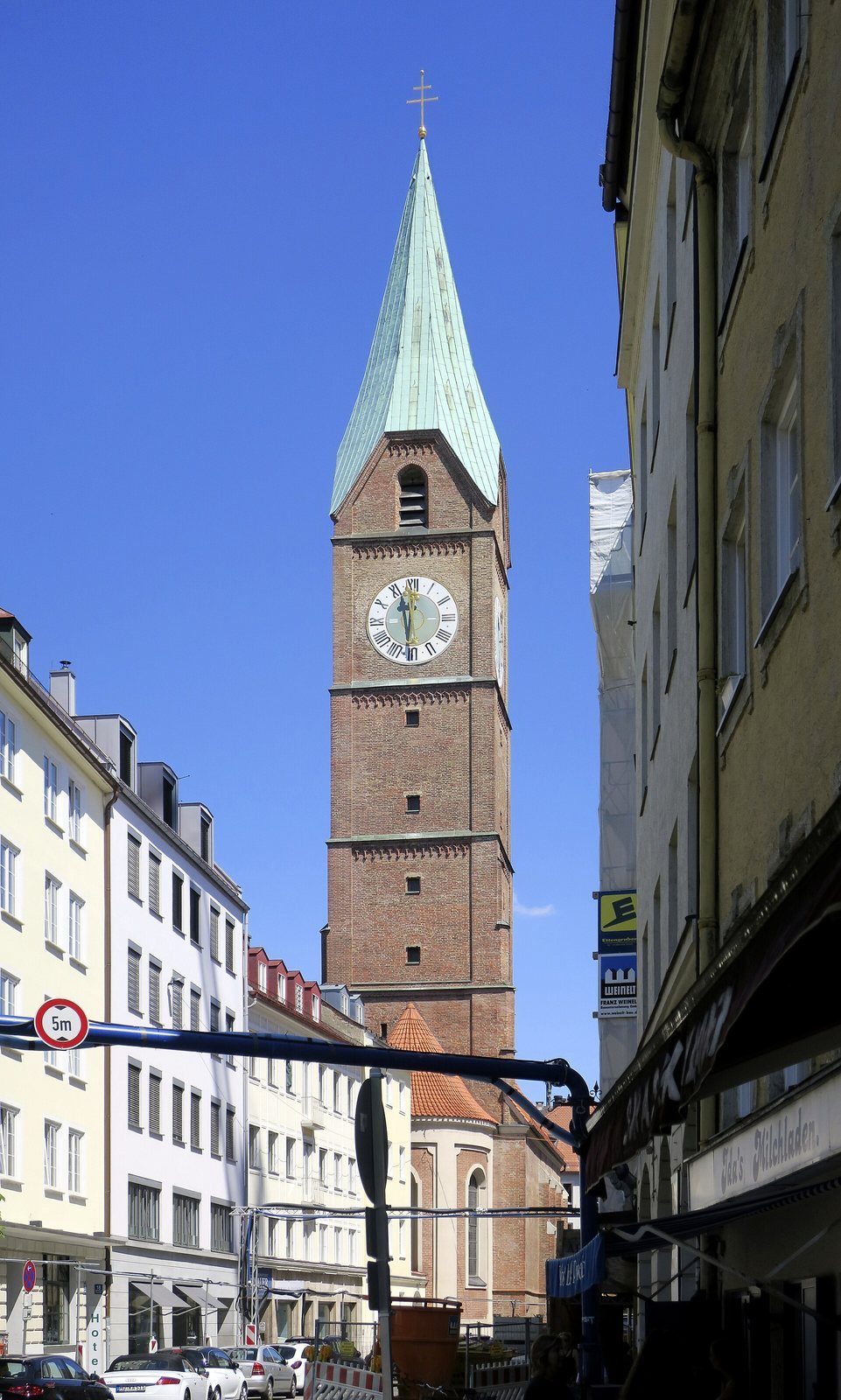
After 1493, the church received a chancel tower, meaning a tower incorporated into or rising above the chancel. The tower was heightened after 1506. Further additions and changes took place during the seventeenth and eighteenth centuries, including a Baroque remodeling in 1620. Galleries were installed between 1722 and 1726.
Historicist and postwar changes
In 1814, the church was regothicized, or remodeled in a revival of medieval Gothic forms, during the nineteenth-century movement known as Historicism. Its interior was renewed in 1936. Damage during the Second World War led to rebuilding in reduced forms between 1947 and 1949.
Kreuzkirche remains a subsidiary church of St. Peter, known as the “Old Peter,” and belongs to the Roman Catholic Archdiocese of Munich and Freising. It is currently operated by the Priestly Fraternity of Saint Peter, a traditionalist Catholic clerical society devoted to the Latin Mass and pastoral administration. The building is protected as an architectural monument and appears in the Bavarian monument list under number D-1-62-000-3639.
Remains
Kreuzkirche stands in Munich’s Hackenviertel near the former fortifications at Sendlinger Tor. It is a three-bay, single-nave church, with each bay forming a structural division along the building’s length. Plain exposed brickwork, a tall tower with a spire or tower helmet, and four truncated gables define its exterior. The building faces south. A north portal was added during the 1814 remodeling, while the side entrances were bricked up.
Nave and choir
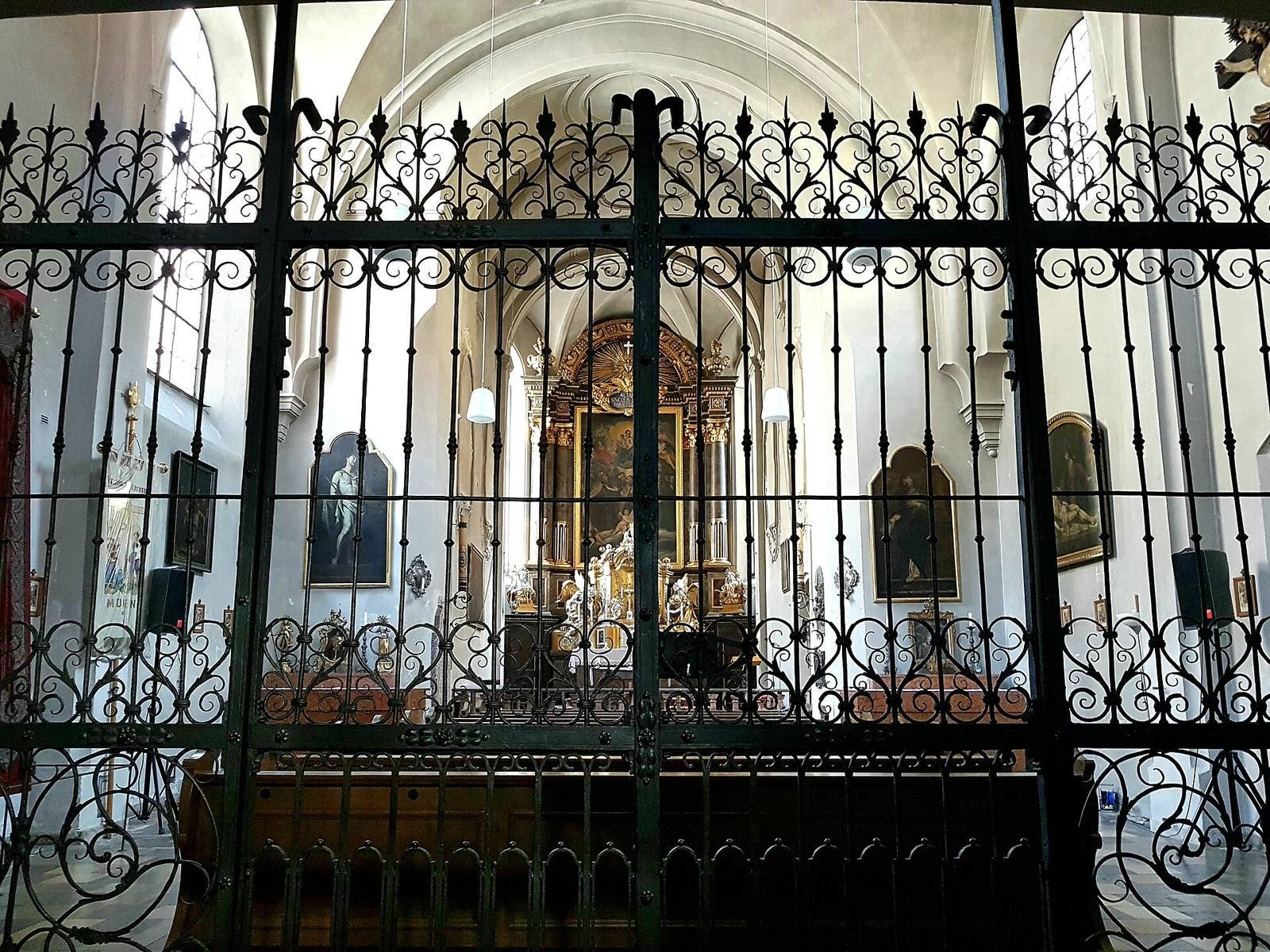
The nave retains a Gothic net-rib vault, whose ribs form a network pattern, supported by stepped buttresses. In the lower part of the tower, the choir has a Baroque barrel vault with lunettes, or curved openings set into the vault. The galleries added between 1722 and 1726 remain part of the interior arrangement.
Tower and bells
The tower contains two historic bells. Anton Ihm cast one in Munich in 1814. It measures 935 millimeters in diameter, weighs 426 kilograms, and sounds the note A-flat. Joseph Ignaz Daller cast the second bell in Munich in 1787; it has a diameter of 790 millimeters. Both bells can be rung by hand or struck by the electric clock mechanism. The present organ was built in 1961 by the Munich firm Carl Schuster & Son. It has six stops divided between one manual and a pedal, with mechanical action for both the keys and the stops.
Paintings, sculpture, and inscriptions
The high-altarpiece painting The Virgin Appears to Saint Augustine, made by Johannes Rottenhammer the Younger in the first half of the seventeenth century, came from the former Augustinian church. A tabernacle by Johann Baptist Straub came from the Carmelite church. Above the bricked-up east portal, fragments of Gothic frescoes show Christ within a mandorla, an almond-shaped halo used around sacred figures.
Late Baroque paintings of Ecce Homo and Mater Dolorosa, made around 1700 by Andreas Wolff, hang above the side altars. A wooden crucifix dating from around 1520 stands at the west portal and is attributed to Hans Leinberger. Beneath the gallery is a Pieta dated 1626, together with an epitaph for the banker Goetz made by Hans Krumpper in 1627.