Amazuka Kofun: A Late Kofun-Period Keyhole Burial Mound in Kyoto


Site at a Glance
- Rating
- 3.9
- Popularity
- Very Low
- Country
- Japan
- Primary era
- Medieval
- External website
- Open
- Eras represented
- Medieval
- Civilizations
- Yamato
- Site type
- Burial
- Remains
- Burial Mound
On this page8 sections
History
Amazuka Kofun is a sixth-century keyhole-shaped burial mound in Japan, located in the Sagano-Uzumasa area of Kyoto. Built during the first half of the sixth century, in the late Kofun period, it reflects the development of large elite burial mounds in ancient Japan. The Kofun period, conventionally dated from about the third through the seventh centuries, is known for such monumental tombs. Amazuka was an important burial mound in the Sagano area and is the second-largest known keyhole mound there after Hebizuka Kofun.
The Hata clan and the Sagano tombs
Amazuka Kofun is thought to have been associated with members of the Hata clan, an immigrant lineage traditionally linked with the development of the Sagano-Uzumasa area. Several other large tombs in the region have also been considered possible Hata clan burials, including Hebizuka Kofun, Taruyama Kofun, and Shimizuyama Kofun.
Shimizuyama Kofun, northeast of Amazuka, was regarded as an earlier chief’s tomb than Amazuka. It was an approximately 60-metre-long keyhole mound with a horizontal-entry stone chamber, probably built between the end of the fifth century and the beginning of the sixth. The mound was destroyed in 1973.
Finds, investigation, and protection
Grave goods were unearthed at Amazuka in 1887. In 1900, the objects were deposited with the Kyoto Imperial Museum, now the Kyoto National Museum, and they are currently held by the Kyoto University General Museum. The finds include horse equipment, iron swords, arrowheads, Sue ware pottery, bronze mirrors, and many other burial objects. Sue ware was a high-fired gray stoneware made in ancient Japan. Their original placement between the two burial chambers remains uncertain, although one interpretation associates them with the chamber opening at the junction of the mound’s front and rear sections.
Hamada Kōsaku surveyed the condition of the site in 1900, and Umehara Sueji prepared a report during the Taisho period, from 1912 to 1926. The Kyoto University Archaeological Society published an overview of Amazuka and Shimizuyama kofun in 1966. Sewer construction monitoring in fiscal year 1984 confirmed part of Amazuka’s surrounding moat and recovered fragments of haniwa, unglazed clay objects placed on and around burial mounds. The results were reported in 1985. The kofun area became a National Historic Site of Japan on March 3, 1978.
Remains
Mound and surrounding features
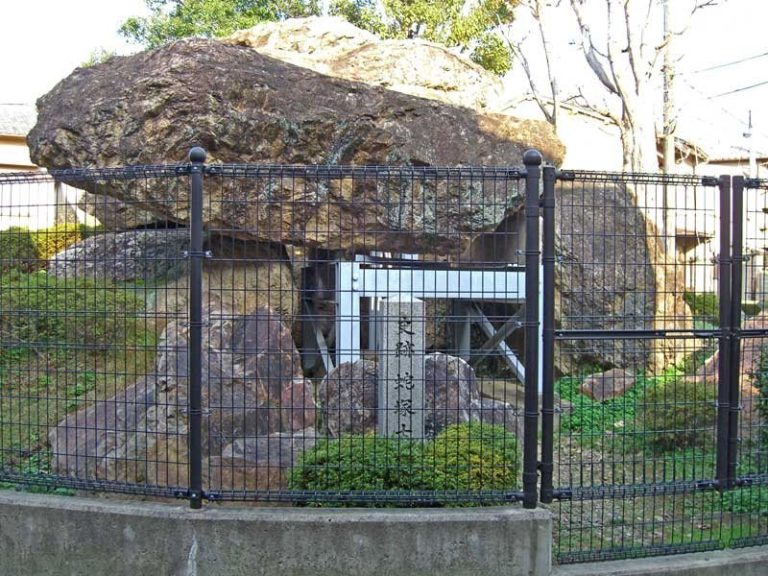
Amazuka Kofun has the form of a keyhole mound, combining a rectangular front section facing south with a circular rear section. The mound is approximately 73 metres long and was built in two tiers. Its circular rear portion measures about 40 metres in diameter and rises approximately 9 metres high, while the rectangular front is about 50 metres wide and also reaches roughly 9 metres in height.
A moat once encircled the mound and exceeded 20 metres in width in places. Cylindrical haniwa fragments have been found around the exterior. A circular mound northwest of Amazuka is thought to be a subsidiary burial mound, adding another feature to the cemetery landscape.
Stone burial chambers
Western-opening chamber
Two horizontal-entry stone chambers were constructed in the circular rear portion, set perpendicular to one another. One opens from the western side of the rear section toward the northwest. It is approximately 10 metres long, about 2 metres wide at its centre, and 1.1 metres wide at the entrance. The chamber reaches approximately 2 metres in height at the centre. Its side walls consist of irregularly stacked rough stone blocks, and an Inari shrine is now enshrined near the rear wall. Inari is a Shinto deity especially associated with rice, food, and prosperity.
Junction-opening chamber
The second chamber opens from the constricted junction between the rectangular front and circular rear sections, toward the southwest. It is a single-sleeved chamber, meaning that a projecting stone partition marks the junction between the burial room and its passage. Its estimated total length is 7.7 metres. The burial chamber itself is 4.7 metres long, 1.7 metres wide at the centre, and approximately 2 metres high. Its passage is about 3 metres long, 1.2 metres wide, and 1.5 metres high. The walls are made from irregularly stacked rough stone blocks, and a second Inari shrine stands near the rear wall.