Bergen Cathedral: A Medieval Church and Lutheran Episcopal Seat in Norway


Site at a Glance
- Rating
- 4.2
- Popularity
- Low
- Country
- Norway
- Primary era
- Medieval
- External website
- Open
- Eras represented
- Medieval, Early Modern, Modern
- Civilizations
- Denmark–Norway, Norwegian
- Site type
- Religious
- Remains
- Cathedral
On this page13 sections
History
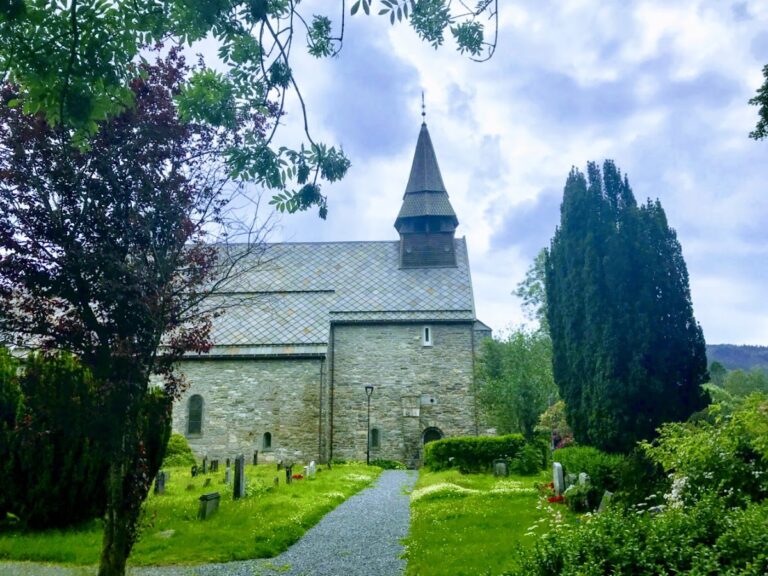
Bergen Cathedral is a stone church in Bergen, Norway, whose first church was probably built around 1150 in the Romanesque style and dedicated to Saint Olaf. Saint Olaf, or Olaf II Haraldsson, was a Norwegian king later canonized as Norway’s patron saint. Today, the cathedral is an active parish church of the Church of Norway, the country’s Evangelical Lutheran church, and the episcopal seat of the Lutheran Diocese of Bjørgvin, the diocese centered on Bergen. It also serves as the seat of Bergen arch-deanery.
Foundation and medieval rebuilding
The first recorded reference to the church dates from 1181, when men pursued by King Sverre took refuge there. It was probably an ordinary parish church at that time. During the reign of King Haakon IV of Norway, the church was taken over, probably by Franciscan friars, members of a Catholic mendicant order founded by Saint Francis of Assisi. A friary was established beside it, south of the church. The medieval cathedral of Bergen was instead Christ Church at Bergenhus Fortress.
The original church burned in the city-wide fire of 1248. A new stone church rose on the same site and incorporated part of the earlier building’s north wall. Another fire in 1270 led to repairs financed by Magnus VI of Norway. The church was rebuilt again around 1301, and Magnus VI was buried there.
From parish church to cathedral
A further fire in 1463 left the church without a full reconstruction until the 1550s. After the Reformation, the movement that established Lutheran churches in place of Catholic structures across much of northern Europe, the building became the cathedral of the diocese in the 1530s. It replaced the former cathedral at Holmen, which was demolished in 1531. Bishop Gjeble Pederssøn arranged for the rebuilding to be completed before his death in 1557.
Fire, civic events, and restoration
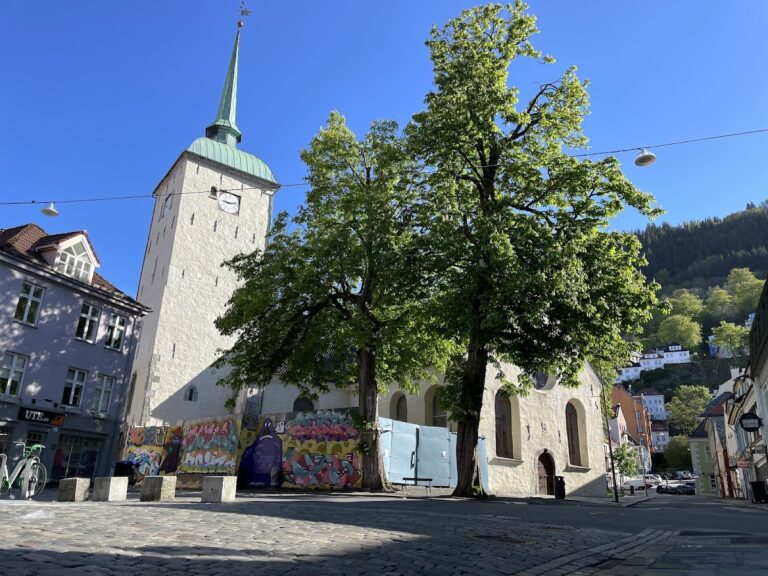
Fires in 1623 and 1640 gave Bergen Cathedral much of its present general appearance. The earlier steeple over the nave was removed and replaced by a tower at the west end. A major renovation and restoration followed the city-wide fire of 1702.
The cathedral also bears physical evidence of the Battle of Vågen in 1665, a confrontation between English and Dutch fleets in Bergen’s main harbor. A cannonball fired during the battle remains embedded in the exterior wall.
In 1814, the church served as an election church and polling station during the process that selected representatives to Norway’s Constituent Assembly, which drafted the country’s Constitution. A comprehensive restoration followed in the 1880s under Christian Christie and Peter Andreas Blix. The work aimed to recover a medieval appearance inside the church and included the removal or alteration of later Rococo treatments.
Bergen Cathedral is an automatically protected Norwegian cultural-heritage site, listed as site ID 83876. Its present organ, built in 1997 by the Austrian firm Rieger Orgelbau, belongs to a succession of cathedral organs whose history is documented from 1549 onward. Concerts are regularly held in the cathedral.
Remains
Overall form
The present building is a stone long church measuring approximately 60.5 metres in length and 20.5 metres in width. Its two-aisled nave leads to a Gothic choir ending in a polygonal east end. The cathedral accommodates approximately 600 seated people. The current arrangement reflects several periods of construction and alteration, including the addition of a side aisle during the nineteenth-century restoration to a church that had previously been single-aisled.
Medieval features
West portal and windows
Gothic elements from the thirteenth century remain in the west portal and in the tracery windows. Tracery is the stone framework that divides and supports the upper parts of Gothic windows, allowing more elaborate openings than those associated with the earlier Romanesque style.
North chapel
A chapel stands north of the choir. Built in the late thirteenth century, it also served as the sacristy, the room used to store liturgical objects and prepare clergy and assistants for worship.
Later additions and interior furnishings
West-end tower
The square tower dates from the seventeenth century. It occupies the west end, where it replaced the earlier steeple over the nave after the fires of 1623 and 1640.
Altar, pulpit, and font
The 1880s restoration introduced a side aisle and reshaped elements of the interior. Christian Christie designed an altar installed in 1884, based on the form of a medieval reliquary shrine, a container or devotional structure made to hold or commemorate religious relics. The pulpit and baptismal font date from 1883.
Organ
The present organ was installed in the case of an earlier instrument built by Albert Hollenbach in 1891. Rieger Orgelbau constructed the 1997 organ with 61 stops on three manuals and pedal. It has mechanical key action and electric stop action, together with couplers, a register crescendo, and an electronic setter system.
Nearby sites