Koma Shrine: A Shinto Shrine Honoring Ko Yakgwang in Japan


Site at a Glance
- Rating
- 4.3
- Popularity
- Medium
- Country
- Japan
- Primary era
- Early Modern
- External website
- Open
- Eras represented
- Early Modern
- Civilizations
- Tokugawa
- Site type
- Religious
- Remains
- Sanctuary
On this page9 sections
History
Goguryeo immigrants and Koma County
Koma Shrine is a Shinto shrine in Hidaka, Saitama, Japan, associated with the establishment of Koma County in Musashi Province in 716. Its principal kami, or sacred being and chief object of worship, is the deified Prince Ko Yakgwang, also known as Koma no Ō Jakko. Sarutahiko no Mikoto and Takenouchi no Sukune are also enshrined there.
Goguryeo, an ancient kingdom that occupied parts of the Korean Peninsula and Manchuria, fell in 668 after conflict involving Tang China and Silla. Goguryeo immigrants were subsequently relocated to Japan. Ko Yakgwang later settled in Koma County with 1,799 Goguryeo refugees, many of whom came from Suruga Province. The county covered present-day Hidaka and Tsurugashima, as well as parts of Hannō, Kawagoe, Iruma, and Sayama. Its territory expanded from the Kamakura period onward.
Ko Yakgwang is traditionally said to have received the surname 王 from the imperial court in 703. He may have been a member of the Goguryeo royal family if he was the same person as Genbu Jakko, an identification that remains uncertain. Koma Shrine is believed to have been founded around the creation of Koma County to enshrine him.
Religious administration and Tokugawa patronage
During the period when Buddhist and Shinto institutions operated together, the Koma family served as the shrine’s hereditary religious officials. Members of the family also practiced mountain asceticism as shugenja, practitioners of mountain-based religious discipline. A bettō, a religious official who administered a shrine or temple, was associated with this wider religious system.
After Tokugawa Ieyasu entered the Kantō region in 1590, the Tokugawa house granted the shrine three koku of land income in Koma County in 1592. A koku was a historical measure of rice commonly used to express land income or institutional stipends. The shrine was formerly known as Koma Ōmiya Daimyōjin, Ōmiya Daimyōjin, and Shirahige Daimyōjin. It adopted the name Koma Shrine after the Meiji period.
State Shinto and colonial-era interpretations
Following the Meiji Restoration and the creation of State Shinto, the system of government-supported Shinto institutions and practices developed before 1945, Koma Shrine was classified as a prefectural shrine. This was a rank within the former state-sponsored shrine classification system.
During Japan’s colonial expansion in Korea, beginning with the establishment of a Japanese protectorate over Korea in 1905, Japanese officials used Koma Shrine to promote the assimilation and unity of Korean and Japanese people. Jirō Minami, who served as Governor-General of Korea, was among the officials associated with this interpretation. In 1934, the Koma Jinja Hosan-kai was established under the leadership of Hideo Kodama, the minister responsible for colonial affairs, to preserve and restore the shrine.
Postwar memory and continuing associations
Koma Shrine retained cultural importance after the Second World War and was discussed by Japanese writers including Eiji Yoshikawa and Ango Sakaguchi. More recent interpretations have presented it as a symbol of Japanese-South Korean friendship, and South Korea’s Ministry of Foreign Affairs has endorsed that understanding.
Six politicians associated with worship at the shrine later became prime ministers: Makoto Saitō, Reijirō Wakatsuki, Osachi Hamaguchi, Kiichirō Hiranuma, Kuniaki Koiso, and Ichirō Hatoyama. Their association contributed to the shrine’s popular epithet, “Shusse Myōjin,” meaning “Deity of Advancement.” Emperor Akihito and the Empress visited during a private trip to Saitama on September 20 and 21, 2017. Akihito’s worship was described as the first imperial worship at the shrine since its foundation.
The former prefectural status forms part of the shrine’s modern historical background. The Koma family residence was designated a National Important Cultural Property in 1971. The shrine also possesses the Great Prajnaparamita Sutra, a medieval collection of Mahayana Buddhist scriptures concerning the perfection of wisdom. The manuscript was copied between 1211 and 1218 by Keiben of Ashikaga Keisokuji.
Remains
Shrine precinct
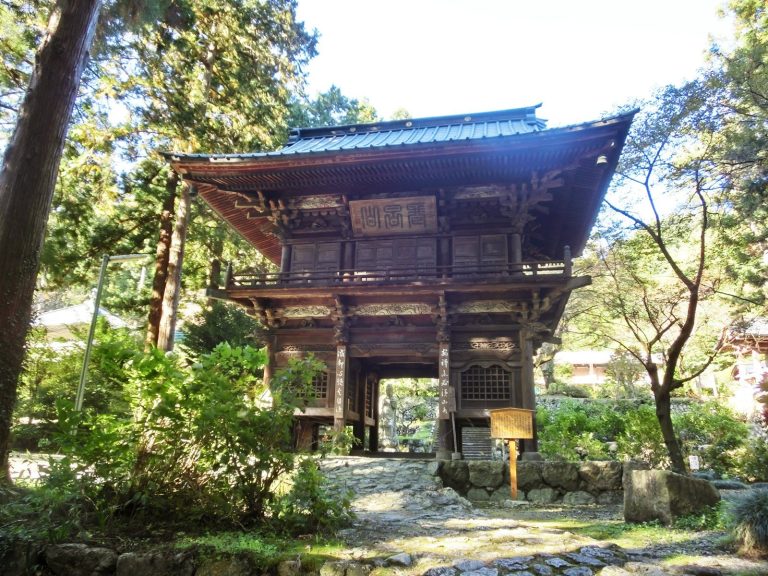
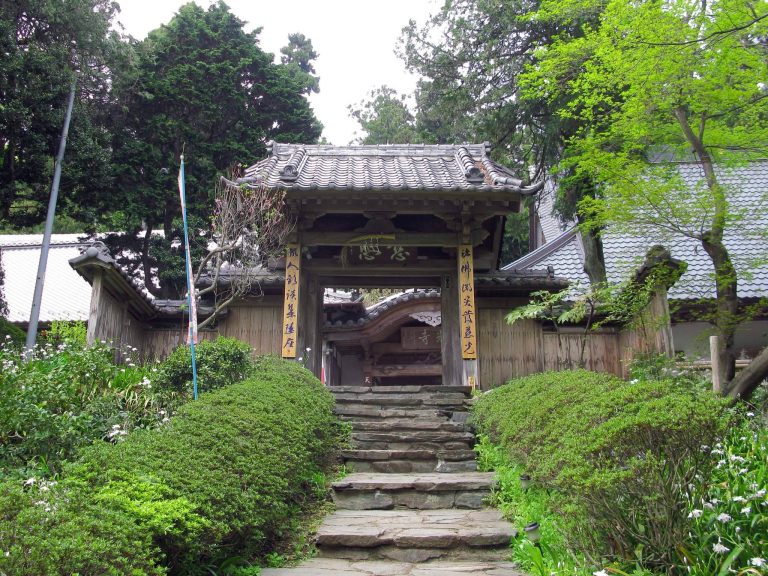
The shrine entrance includes a Shinmon gate. At the entrance stands a granite Shōgun marker installation bearing the inscriptions “Tenka Taishōgun” and “Chika Jo Shōgun.” Mindan, the Korean Residents Union in Japan, donated the installation on October 23, 2005, to mark the fortieth anniversary of the normalization of Japan-South Korea relations. It replaced wooden markers installed in 1992 that had become damaged and decayed.
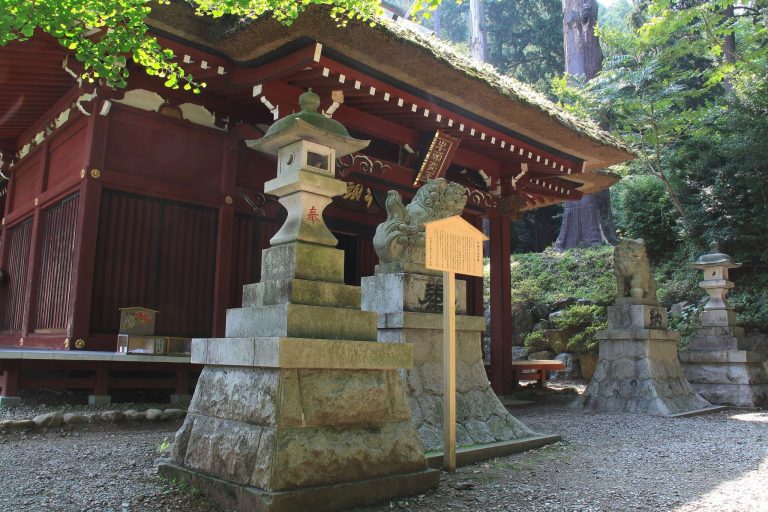
The precinct has no auxiliary shrine formally classified as a sessha, meaning a shrine associated with a principal shrine. Suitengū, a subsidiary shrine, stands outside the precinct on a mountaintop.
Koma family residence
The Koma family residence stands beside and behind the shrine precinct. Built during the early Edo period for the hereditary Koma family, it is a thatched building in the irimoya style, a traditional Japanese hip-and-gable roof form. The residence is set against a mountain and faces east.
Medieval manuscript
The Great Prajnaparamita Sutra is a surviving medieval manuscript associated with the shrine. It was copied between 1211 and 1218 by Keiben of Ashikaga Keisokuji and represents the shrine’s continuing connection with the Buddhist religious traditions that once operated alongside Shinto institutions.