Shōbō-ji Temple: A Kannon Pilgrimage Temple in Japan


Site at a Glance
- Rating
- 4.4
- Popularity
- Low
- Country
- Japan
- Primary era
- Early Modern
- External website
- Open
- Eras represented
- Early Modern
- Civilizations
- Later Hōjō, Tokugawa
- Site type
- Religious
- Remains
- Sanctuary
On this page13 sections
History
Shōbō-ji Temple is a Buddhist temple in Higashimatsuyama, Japan, belonging to the Chisan branch of Shingon Buddhism, an esoteric Japanese tradition centred on ritual, sacred texts, and visionary practice. Its traditional origin dates to 718, when the Shugendō mountain ascetic Etsumi carved an image of Senjū Kannon, the Thousand-Armed Kannon associated with compassion and protection, and established a hermitage called Shōbō-an on Mount Iwadono. The temple is also known as Iwadono Kannon, and it is the tenth temple on the Bandō Thirty-Three Kannon pilgrimage circuit in the Kantō region. It is also associated with the Seven Kannon pilgrimage.
Origins and medieval restoration
The early history of Shōbō-ji combines uncertain foundation details with traditions preserved by the temple. One tradition tells how the general Sakanoue no Tamuramaro defeated an evil dragon that had troubled villagers on Mount Iwadono with the help of Kannon. After returning to Kyoto, he is said to have reported the event to Emperor Kanmu, who ordered the hermitage enlarged into a temple in 796.
Shōbō-ji later declined into ruin. During the Kamakura period, the shogun Minamoto no Yoritomo ordered its restoration, entrusting the work to Hiki Yoshikazu. By the Muromachi period, the temple had developed into a large institution with 66 hermitages. Its fortunes changed during the Sengoku period, an era of prolonged civil warfare in Japan. Repeated fighting damaged the complex and eventually left much of it destroyed.
Warfare and revival
In 1563, Shōbō-ji was burned during the Siege of Musashi-Matsuyama, a military campaign attributed to Hōjō Ujiyasu. The Senjū Kannon image narrowly survived the destruction. The monk Eishun revived the temple in 1574, beginning a further phase of religious and institutional recovery.
A later tradition connects another surviving object with the conflicts of the period. Toyotomi Hideyoshi’s forces are said to have dragged the temple bell through the mountains during the 1590 Battle of Matsuyama Castle, leaving the scratches that cover its exterior. In 1591, Tokugawa Ieyasu granted Shōbō-ji a fief assessed at 25 koku, a historical measure of agricultural yield conventionally based on rice, through a formal red-seal authorization. During the Tokugawa period, the temple also received estates for its upkeep and exemptions from taxation, helping it become a popular pilgrimage destination.
Meiji-period disruption
The Meiji Restoration brought severe difficulties through the Haibutsu-kishaku movement, a nineteenth-century campaign against Buddhism during which Buddhist institutions, landholdings, and religious objects were widely attacked or confiscated. Shōbō-ji lost much of its land and revenue. After the former Kannon Hall was destroyed by fire in 1871, the present hall was transferred from a small temple near Hanno.
The eastern approach still retains traces of the former temple gate town. Traditional shop names and remnants of buildings connected with the prosperous settlement reflect the commercial and religious activity that once developed outside the temple precinct.
Several surviving features carry formal cultural-property status. The bronze bell is registered as a tangible cultural property of Saitama Prefecture, the six-faced memorial pillar is a prefectural historic site, and the belfry is designated as a cultural property of Higashimatsuyama City.
Remains
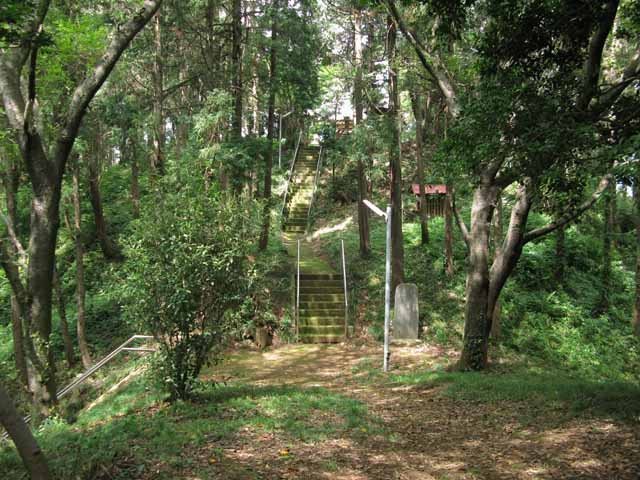
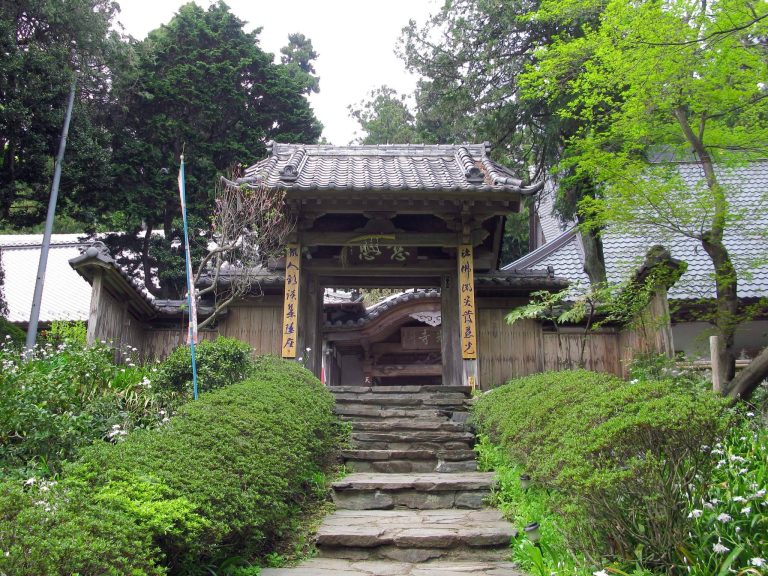
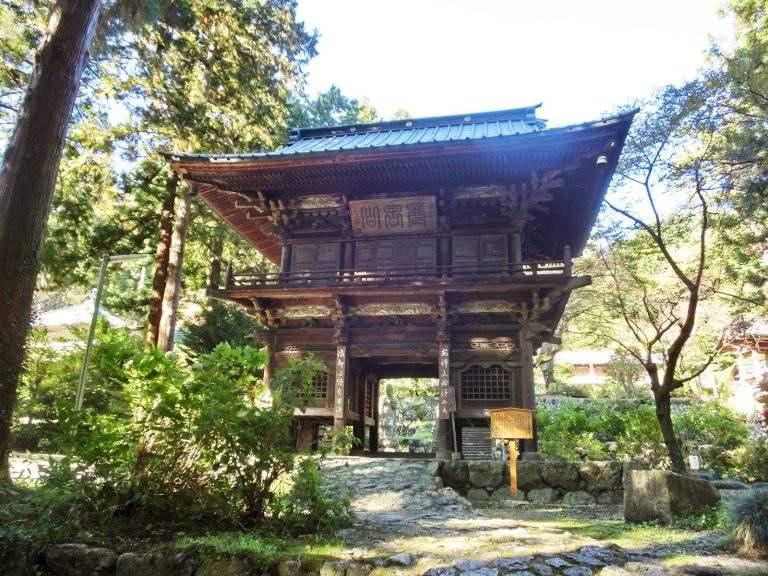
Shōbō-ji occupies a steep, wooded slope at the eastern edge of the Iwadono Hills, beside a nearby mountain. The precinct appears to have been cut into the hillside and opens chiefly toward the east. From that direction, the approach passes through the Niō Gate and continues up a long flight of steps into the temple grounds. The buildings and features are arranged within this sloping landscape, with rock walls surrounding the Kannon Hall.
Approach and halls
Niō Gate
The Niō Gate marks the approach to the precinct. A Niō Gate is a Buddhist temple entrance flanked by paired guardian figures, and the two protectors stand on either side of the passage here. A sign gives the temple’s name, while a second inscription reads Semui, meaning “freedom from fear,” a quality particularly associated with Kannon.
Kannon Hall
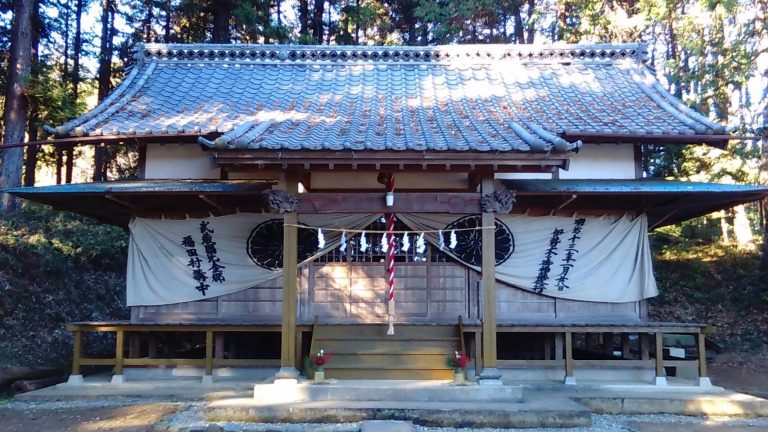
The Kannon Hall is enclosed by rock walls and houses 88 small Buddha figures, corresponding to the 88 temples of the Shikoku pilgrimage associated with the monk Kūkai and the Shingon tradition. Its principal image is Senjū Kannon Bosatsu. The principal image in the main hall is Amida Nyorai, the Buddha associated with the Pure Land tradition.
Supporting halls
Other buildings in the precinct include the small Hall of One Hundred Jizō, the Yakushi Hall, and an Ema Hall. Jizō is associated especially with the protection of children, travellers, and the dead, while Yakushi is the Buddha of healing and medicine. The Ema Hall is used for hanging wooden votive plaques.
Bell and memorial monument
Belfry and bronze bell
The belfry was built in 1702 and is identified as the oldest structure in Higashimatsuyama. It houses a bronze bell cast in 1322. The bell has a double-dragon head, measuring 32 centimetres in height at the head, 113 centimetres in the bell body, and 106 centimetres in diameter. Its lower band is 7 centimetres thick. Numerous scratches on the exterior are traditionally linked to the bell’s reported transport through the mountains by Hideyoshi’s forces during the 1590 Battle of Matsuyama Castle.
Six-faced memorial pillar
The six-faced memorial pillar consists of chlorite-schist slabs, a foliated metamorphic stone that can be split into sheets, topped by a hexagonal capstone. It stands 107 centimetres high. Each slab is 36 centimetres wide and 101 centimetres high, while the capstone measures 128 centimetres across. Flying clouds are carved around the capstone, and its reverse carries elaborate images of a dragon, a treasure ball, a lion, and hōsōge, a stylized floral motif used in East Asian Buddhist art. An inscription states that the monk Dōshō of Mount Iwadono erected the pillar in February 1582 for a memorial service for Eishun and his disciples.
Living landscape
A ginkgo tree in the precinct has a trunk circumference of 11 metres and is estimated to be about 700 years old. Its presence forms part of the surviving physical landscape of the temple, alongside the hillside setting, rock walls, halls, gate, and historic belfry.