Kita-in Temple: A Tendai Buddhist Temple in Kawagoe, Japan


Site at a Glance
- Rating
- 4.2
- Popularity
- Medium
- Country
- Japan
- Primary era
- Early Modern
- External website
- Open
- Eras represented
- Early Modern, Modern
- Civilizations
- Tokugawa
- Site type
- Religious
- Remains
- Monastery
On this page18 sections
History
Kita-in Temple is a Tendai Buddhist temple in Kawagoe, Japan, traditionally founded in 830 by the monk Ennin at the command of Emperor Junna. Tendai is a Japanese Buddhist school based on the teachings of the Chinese Tiantai tradition. The temple was originally called Muryōjuji, a name associated with Amitabha Buddha, and its principal image is Amida Nyorai, or Amitabha Buddha of the Western Pure Land. It is also known informally as Kawagoe Daishi.
Foundation and medieval revival
Ennin, also known as Jikaku Daishi, established the institution to spread Tendai teachings in eastern Japan. The temple was traditionally associated with Amida Nyorai, Fudō Myōō, a guardian deity linked with immovable wisdom, and Bishamonten, a protective Buddhist deity. The original institution developed into three temples: Kita-in, Naka-in, and Minami-in. Naka-in later became independent, while Minami-in was abolished at the beginning of the Meiji period. Stone funerary monuments remain in the area identified with Minami-in.
Kita-in declined during conflicts that included the wars between the Hōjō and Ogigayatsu Uesugi families. In 1296, under Emperor Fushimi, the monk Sonkai revived the temple. Sonkai was associated with Senpukuji at Kawadaya. In 1300 or 1301, Emperor Go-Fushimi granted Kita-in the status of head temple for more than 580 Tendai temples in the Kantō region. A head temple was the senior institution exercising authority or influence over affiliated temples.
Sonkai first rebuilt Butsuji-in, later known as Naka-in, with assistance from the Narita family. He subsequently established Butsuzō-in, or Kita-in, and Tamon-in, or Minami-in. Emperor Go-Nara later granted the temple the mountain-name plaque “Seiya-san.” These developments confirmed the institution’s position within the regional Tendai network.
Warfare and the Tokugawa restoration
Kita-in again suffered during approximately a decade of warfare between the Later Hōjō and Ogigayatsu Uesugi families. The Battle of Kawagoe formed part of these conflicts, and the temple burned in 1537.
In 1599, Tenkai became Kita-in’s twenty-seventh abbot and changed its name to Kita-in. Tenkai was a prominent Tendai monk and religious adviser to the Tokugawa regime. Sakai Tadatoshi, a senior official who became lord of Kawagoe Domain, supported the temple’s revival. Under Tenkai and the patronage of Tokugawa Ieyasu, Tokugawa Hidetada, Tokugawa Iemitsu, and the lords of Kawagoe Domain, Kita-in entered a period of renewed prosperity.
In 1613, regulations issued under Tokugawa Hidetada confirmed Kita-in as the chief Tendai temple of the Kantō region and granted it temple lands yielding 500 koku, a historical measure of agricultural revenue. Its mountain name became Tōei-zan, meaning “Hieizan of the East.” The name was later transferred to Kan’eiji in Ueno. Tokugawa Ietsuna subsequently increased Kita-in’s holdings by 200 koku>, bringing the total to 750 koku and giving the temple a precinct of approximately 48,000 tsubo.
Fire, rebuilding, and later development
In 1633, Semba Tōshōgū was built on the former site of Naka-in, prompting Naka-in to move approximately 200 metres south. The Great Kawagoe Fire of 1638 destroyed nearly all of the Kita-in complex, while the Sanmon and sutra repository survived. Semba Tōshōgū was also destroyed in the fire and rebuilt in 1640 by order of Tokugawa Iemitsu.
In 1639, Iemitsu ordered the transfer of buildings from the Momijiyama compound of Edo Castle to Kita-in. Commissioner Hotta Masamori assisted Tenkai with the reconstruction of Kita-in and Semba Tōshōgū. The movement of the buildings also led to the opening of boat transport on the Shingashi River. The transferred structures are regarded as the only surviving buildings of the original Edo Castle after the castle’s destruction in the Great Kantō Earthquake of 1923. In 1879, the former main hall of Kan’eiji was removed from Kita-in and transferred to the site of a former Kan’eiji subtemple.
The Five Hundred Rakan ensemble was created between 1782 and 1825. Kita-in is also associated with the Kawagoe Daishi identity, the twenty-eighth stop on the Kantō Thirty-Six Fudō pilgrimage, and the third stop on the Koedo Kawagoe Seven Lucky Gods pilgrimage, where Daikokuten is enshrined.
Memorials and protected heritage
A mausoleum for five Kawagoe lords of the Matsudaira Yamato house was established for rulers who died in Kawagoe between 1767 and 1866. The five members include Asanori, Naotsune, Naoharu, and Naokata. Kita-in and the Matsudaira Yamato family mausoleum were designated historic sites by Kawagoe City in 1958. Major buildings also hold national Important Cultural Property status, while the Jie Hall, Tahōtō, and guardhouse have prefectural protection, and the temple site and Matsudaira mausoleum have municipal designation.
Remains
Kita-in stands in the former Kosenba settlement at the eastern edge of the Musashino Plateau, south of Kawagoe Castle. Its extensive precinct forms a landscape enclosed by ponds and moats. Surviving gates, halls, religious monuments, memorials, and transferred Edo Castle buildings preserve the site’s principal historical layers.
Buildings transferred from Edo Castle
Reception Hall
The Reception Hall was built in 1638 as part of Edo Castle and later transferred to Kita-in. Its interior contains two rooms measuring 12.5 tatami mats, two rooms of 17.5 tatami mats, and two rooms of 10 tatami mats, as well as a bathhouse and toilet. The ceiling is decorated with 81 polychrome floral panels. One 12.5-tatami room is an upper room with a tokonoma, a recessed ornamental alcove, and staggered shelves. It is traditionally called the Birth Room of Tokugawa Iemitsu because Iemitsu is believed to have been born there while the building stood at Edo Castle. The castle toilet was said to have been used to examine the shogun’s stools each day as part of health monitoring.
Study Hall
The Study Hall was built in 1639 as another Momijiyama building from Edo Castle and transferred to Kita-in. It contains two eight-tatami rooms and two twelve-tatami rooms, with part of the building forming a mezzanine level. Its rooms are traditionally identified as the private quarters of Kasuga no Tsubone, a senior female official and wet nurse in Iemitsu’s household. The building is therefore known as the Makeup Room of Kasuga no Tsubone.
Priest’s Quarters
The Priest’s Quarters was built in 1638 and transferred from the Momijiyama compound of Edo Castle. Together with the Reception Hall and Study Hall, it is an Important Cultural Property. These three buildings form the principal surviving group associated with the Edo Castle transfer.
Gates, halls, and shrine buildings
Sanmon and Bell Tower Gate
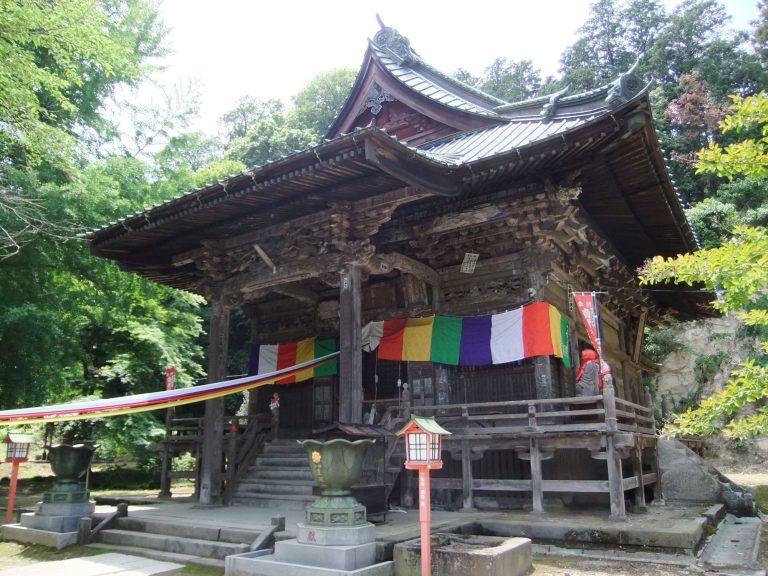
The Sanmon, the temple’s main gate, was built by Tenkai in 1632 and is the oldest surviving building at Kita-in. It stood through the Great Kawagoe Fire of 1638, as did the sutra repository. The Bell Tower Gate and its bronze bell date from 1702, and the structure is an Important Cultural Property.
Jigen-dō and Jie Hall
Jigen-dō was built in 1645 and enshrines Tenkai. A wooden seated image of the monk is kept inside a shrine cabinet. The Jie Hall contains an image of Jie Daishi at its center, with images of Fudō Myōō on either side. It is a prefecturally designated tangible cultural property and is also called Chōon-den. A tradition holds that the sound of waves can be heard when a person sits quietly inside and listens.
Semba Tōshōgū and Tahōtō
Semba Tōshōgū enshrines the spirit of Tokugawa Ieyasu. Its 1640 rebuilding closely resembles Nikkō Tōshōgū, and the structure is an Important Cultural Property. A Tahōtō, a Buddhist pagoda with a square lower section and cylindrical upper section beneath a pyramidal roof, also stands within the precinct. It is a prefecturally designated tangible cultural property.
Sculpture, memorials, and associated objects
Five Hundred Rakan
The Five Hundred Rakan is an ensemble of approximately 540 stone statues of Buddhist disciples, although it is also counted as 538 figures. The statues were carved between 1782 and 1825, over roughly half a century. Each figure has a distinct facial expression, pose, or activity. A local tradition says that one statue becomes warm when touched at night and resembles the face of a deceased parent.
Matsudaira Yamato mausoleum
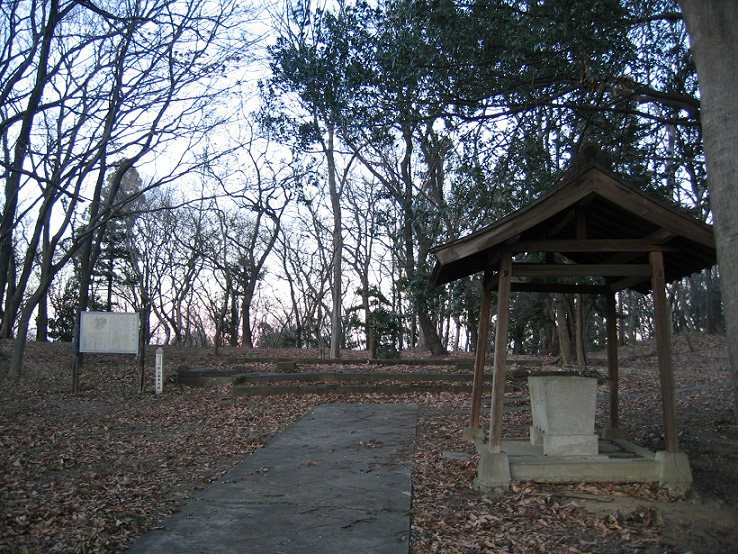
Behind the Jie Hall, the Matsudaira Yamato family mausoleum is enclosed by a stone fence. It contains large gorintō, five-element stone funerary monuments whose parts symbolize earth, water, fire, wind, and space. The five burials belong to Kawagoe lords who died in Kawagoe. Entry is prohibited because the gravestones may collapse.
Other monuments and cultural property
The precinct includes a guardhouse, an old stele dated to the Ryakuō period, and an Enbun-period stone monument. The temple’s associated cultural property also includes a painting set showing twenty-four scenes of artisans at work. Kano Masanobu, founder of the Kano school of painting, produced the set in the early seventeenth century, and it is designated an Important Cultural Property.