St. Emmeram’s Basilica: A Benedictine Monastery Church in Regensburg


Site at a Glance
- Rating
- 4.9
- Popularity
- Low
- Country
- Germany
- Primary era
- Medieval
- External website
- Open
- Eras represented
- Medieval, Early Modern
- Civilizations
- Carolingian, Holy Roman Empire
- Site type
- Religious
- Remains
- Church
On this page21 sections
History
St. Emmeram’s Basilica is a Catholic church in Regensburg, Germany, founded around 780 as the principal church of the Benedictine monastery of St. Emmeram. Its core was built during the Carolingian period, the era of the Frankish dynasty associated with Charlemagne and his successors, under Bishop-Abbot Sintpert, who held office from 768 to 791. The church became an important center of the medieval cult of Saint Emmeram, a seventh-century Christian cleric traditionally venerated as a martyr, and was enlarged and altered through successive medieval phases.
Emmeram and the Carolingian foundation
According to a longstanding tradition, Emmeram was first buried at Aschheim near Munich after his martyrdom. Forty days later, around 690, his body was transferred to Regensburg. His first Regensburg grave was situated in front of the southern apse of the present church. An earlier Church of St. George stood on the site, but its exact location and form are unknown.
The church founded around 780 was later expanded under Abbot Ramwold. Around 980, he added an eastern outer crypt, a chamber associated with burials or relics, beyond the main apse. Evidence indicates that the church was then rebuilt as a three-aisled basilica. Parts of its nave piers and upper clerestory wall survived in the eastern section. Ramwold was buried in a southern extension in 1000 or 1001. His tomb continued to attract devotion, including an eighteenth-century pilgrimage by women experiencing difficult childbirth.
The eleventh-century expansion
Around 1050, the church received a large western transept, the cross-arm crossing the nave, together with a hall crypt. The new complex was intended to house relics associated with Saints Dionysius and Wolfgang of Regensburg. The western choir was dedicated to Dionysius after bones said to belong to the saint were discovered there. Documents claiming to confirm that Arnulf of Carinthia had transferred the relics were later falsified.
Wolfgang, Bishop of Regensburg, was buried at St. Emmeram and canonized there in 1052 by Pope Leo IX, a reforming eleventh-century pope. Emperor Henry III was present at the ceremony. The western choir was dedicated to Dionysius, while the crypt beneath it was dedicated to Wolfgang, establishing two closely connected centers of veneration within the expanded church.
Medieval fires and rebuilding
Fires in the eleventh and twelfth centuries brought repeated rebuilding. A particularly destructive fire in 1166 led to a major transformation of the nave. The interior was then redecorated with paintings representing the four world empires described in the Book of Daniel, Babylonian, Persian, Greek, and Roman. A cross dominated the space above the nave.
St. Emmeram also had an organ by at least 1166. Abbot Johann II Tergernbeck installed an elaborate instrument in 1474. Christoph Egedacher built another organ in 1669, and its case survives. Johann Konrad Brandenstein rebuilt the instrument in 1731, followed by alterations by Johann Heinssen in 1846 and repairs by Anton Breil in 1880.
Fire, Baroque transformation, and secularization
In 1642, fire destroyed the nave roof, interior furnishings, paintings, and seven bells. The church was rebuilt, while much of the twelfth-century spatial arrangement remained. Between 1731 and 1733, the Bavarian Baroque artists Cosmas Damian Asam and Egid Quirin Asam redesigned the interior with an integrated program of architecture, frescoes, and decoration.
The monastery was elevated to a prince-abbey in 1731. A prince-abbey was an ecclesiastical territory whose abbot held the rank and political privileges of a prince within the Holy Roman Empire. In 1810, the monastery was secularized and transferred to the Thurn und Taxis family, whose representatives converted the monastic complex into a palace. The former abbey church remained in religious use and became a parish church, taking over this role from the neighboring Church of St. Rupert.
Burials and civic memory
The church contains 83 funerary monuments. Many commemorate members of the court of the princes of Thurn und Taxis, or delegates, secretaries, and relatives connected with the Perpetual Imperial Diet at Regensburg. This assembly was the permanently convened parliament of the Holy Roman Empire, held in Regensburg from 1663 until the empire was dissolved in 1806. More than 50 of the people commemorated are identified by name. Thirty-five monuments were moved to the northern adjoining garden after the Rupert Cemetery closed in 1806, while 48 remain in the church, in some cases with their graves.
Burials associated with St. Emmeram include Saint Emmeram, Blessed Abbot Ramwold, the hermit Aurelia, Bishops Wolflek, Gaubald, and Tuto, Arnulf of Carinthia, his son Louis the Child, the Bavarian dukes Arnulf the Bad and Henry the Wrangler, and the Bavarian historian Johannes Aventinus. The church also contains the remains of the catacomb saints Maximianus and Calcidonius in glass shrines.
A five-metre-high epitaph was erected in 1777 for Alexander Ferdinand von Thurn und Taxis, who died in 1773 and was buried in the Wolfgang Crypt. He had served as the emperor’s principal commissioner at the Perpetual Imperial Diet. Another monument commemorates Ernst Reichsgraf von Metternich, the Prussian delegate to the assembly. A Calvinist, Metternich converted to Catholicism two days before his death on 27 December 1727. He was laid in state at St. Emmeram and buried there after three days of bell ringing. His conversion and the explicitly Catholic message of his epitaph provoked a public and political reaction in Regensburg.
Modern status and musical history
Pope Paul VI elevated the church to a minor basilica on 5 March 1964 through the apostolic letter Terra sacra. A basilica minor is an honorary papal designation for a church of particular historical, religious, or pastoral importance. Since 2006, St. Emmeram has formed part of the UNESCO World Heritage property “Old Town of Regensburg with Stadtamhof.”
Binder and Siemann replaced the earlier instrument within the surviving Egedacher case in 1900. Their organ had two manuals and 30 stops. Eduard Hirnschrodt installed a new organ in 1959 with four manuals, pedal, and 68 speaking stops, reusing many pipes from the preceding instrument. The present arrangement divides the instrument between a main organ and a west organ so that sound can serve the large interior from both areas. A separate four-stop chest organ by Sandtner has been available for portable use and basso continuo, the bass-and-chordal accompaniment used in Baroque music, since 1997.
Remains
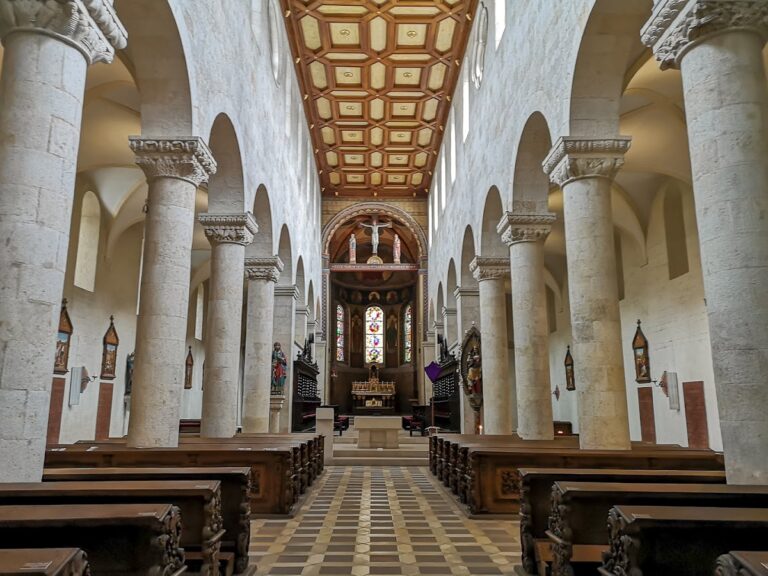
St. Emmeram’s Basilica is approximately 100 metres long. Its nave is about 29 metres wide, and the western transept measures about 35 metres across. The church is a three-aisled basilica without an eastern transept. It has a long presbytery, lateral apses, nearly 20 altars, and three crypts. The surviving building combines a medieval spatial framework with eighteenth-century Baroque decoration.
Eastern sanctuary and crypts
Carolingian ring crypt
The earliest known core was a flat-roofed church with at least one eastern apse. An outer vaulted ring crypt, which encircles the central sanctuary or grave, surrounded the apse. A confessio, a feature providing visual or physical access to a saint’s tomb, allowed views from the crypt toward Emmeram’s newly created grave beneath the high altar. The eighth-century crypt still surrounds the grave, and fragments of Carolingian decoration and wall paintings survive on its walls. Because the interior has not been fully excavated, the original number of aisles and the extent of the Carolingian church to the west remain uncertain.
Ramwold’s outer crypt
The rectangular eastern outer crypt was added around 980 under Abbot Ramwold. It lies beyond the main apse and is reached by a passage leading eastward. It was originally vaulted on two supports and was remodeled during the Baroque period. Excavated remains associated with the rebuilding around 980 to 1000 include large-block piers. Parts of the nave piers and clerestory wall from this phase survive in the eastern part of the church.
Wolfgang Crypt
The western transept and choir date from the middle of the eleventh century. Beneath the choir is the Romanesque Wolfgang Crypt, the burial place of Bishop Wolfgang. Romanesque architecture is a medieval tradition characterized by massive masonry, rounded arches, and crypt-centered church plans. Wolfgang’s shrine occupies an illuminated niche beneath the crypt altar. Three altars were installed there in 1613.
Wolfgang’s relics were successively placed in a crystal shrine and a tin sarcophagus. After their elevation in 1839, they were transferred to a gold tumba, a tomb-shaped reliquary, and in 1877 Bishop Ignatius von Senestrey placed them in a Neo-Romanesque reliquary.
Western complex and medieval sculpture
Western transept and choir
The western transept later received a wooden ceiling painted with a representation of Benedict of Nursia. Baroque organs divide the western part of the church from the nave. Beside the western complex stands the small Romanesque Chapel of St. Magdalene, whose interior contains twelfth-century frescoes.
Northern portal reliefs
Three medieval stone reliefs at the northern portal were created around 1052. They show Jesus Christ enthroned with Saints Emmeram and Dionysius and are described as the earliest reliefs of their type in Germany.
Baroque interior and entrances
Nave and presbytery decoration
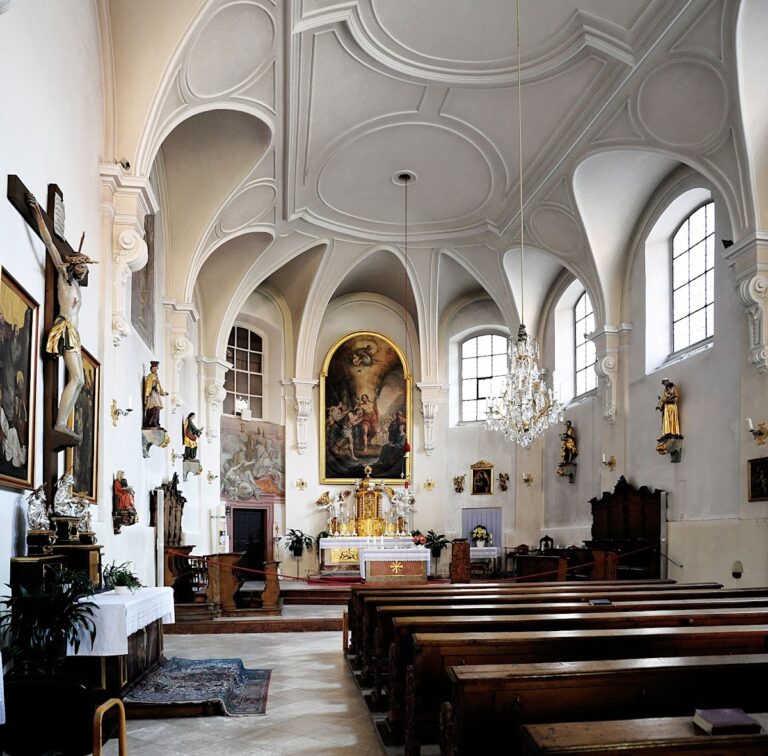
The interior retains the spatial character of the twelfth-century rebuilding beneath the Baroque decoration created by Cosmas Damian Asam and Egid Quirin Asam between 1731 and 1733. Their nave frescoes depict the life of Saint Emmeram, following the Vita Sancti Emmerami written by Bishop Arbeo. The large ceiling fresco presents Emmeram in heavenly glory. Other vault paintings show Benedictine missionary activity in the presbytery and the martyrdom of Christians in the nave.
The high altar is a Baroque work from 1669 and depicts the martyrdom of Saint Emmeram. The entrance to the church is formed by a Gothic gateway with two portals, a garden, and a portico. Separate doors in the portico lead to the western transept and northern aisle. A richly ornamented southern portal opens onto the former monastic cloisters.
Funerary monuments
A thirteenth-century epitaph commemorating Queen Hemma, the ninth-century wife of Louis the German, is set into the wall beside the Dionysius altar in the northern aisle. Other funerary features include a sculpted recumbent figure of Wolfgang in the southern aisle, the burial place of Ramwold, a gisant of the hermit Aurelia, and the grave slab of Johannes Aventinus.
The large southern epitaph of Alexander Ferdinand von Thurn und Taxis stands in the western transept beside the southern exit of the Wolfgang Crypt. Its black-marble inscription tablet is flanked by allegorical figures of Justice and Prudence. Above them, beneath a canopy, stands a figure of the Church holding a cross, chalice, and Host. Nearby, on the southern wall, is the epitaph of Ernst Reichsgraf von Metternich. Its upper female figure represents the Catholic Church, and its inscription urges visitors to follow Metternich’s example and convert.
Bell tower and organs
Renaissance bell tower
The freestanding bell tower was built between 1575 and 1579 to replace an older dilapidated tower. It is a major Renaissance structure in Regensburg and was originally constructed using remains from Roman buildings. Six bells cast by Regensburg bell founders in different centuries hang within it. The largest is reserved for major feasts, while the others mark the Angelus, commemorate the dead, and sound the quarter-hour and hour.
Organ installations
The organ case from Christoph Egedacher’s 1669 instrument survives. The 1959 organ had electro-pneumatic action, four manuals and pedal, 68 speaking stops, an auxiliary pneumatic console, couplers, combination controls, swell pedals, and other playing aids. Its divided main and western sections remain part of the church’s documented musical arrangement. The four-stop Sandtner chest organ installed in 1997 provides a separate instrument for portable musical use and basso continuo.
Nearby sites