Novalesa Abbey: A Benedictine Monastery in Italy’s Susa Valley


Site at a Glance
- Rating
- 4.5
- Popularity
- Low
- Country
- Italy
- Primary era
- Early Modern
- External website
- Open
- Eras represented
- Medieval, Early Modern
- Civilizations
- Carolingian, Duchy of Savoy, Holy Roman Empire
- Site type
- Religious
- Remains
- Monastery
On this page20 sections
History
Novalesa Abbey is a Benedictine monastery in Italy, founded by the Frankish lord Abbo on 30 January 726 near the route to the Mont Cenis Pass. Dedicated to Saints Peter and Andrew, it was established in the Alpine Susa Valley for both religious and strategic purposes. Its foundation belonged to the expansion of Frankish authority across the Alps, while its location placed a monastery close to an important route between northern Europe and Italy.
Frankish Foundation
Abbo was the Frankish rector and lord of Susa and Maurienne, with authority in the Alpine and southeastern territories of the Frankish realm. His charter founded the monastery in a position commanding the pass and called for prayers for his soul, the stability of the Frankish kingdom, and the Christian people. Monasteries served Frankish rulers as religious institutions, centres of learning, landholders, and bases of influence near Alpine routes.
Novalesa was an unusually ambitious foundation because it stood within the Alps, close to what was probably the upper limit of permanent human settlement. Most of its lands lay in Alpine valleys. The founding monks are thought to have come from the Grenoble region, and Abbo appointed Godone as the first abbot. An abbot named Asinarius later attended the synodal council of Attigny, convened between 760 and 765 by Pepin the Short.
Abbo’s charter of 30 January 726 provides the earliest foundation record, while his testament of 5 May 739 survives in a later copy. The charter is the oldest document preserved in the State Archives of Turin. The eleventh-century Chronicon Novalicense, a medieval chronicle combining historical traditions, legends, miracles, and political interpretation, helped reinforce the abbey’s prestige after its destruction and later revival.
Carolingian Expansion
Under Pepin the Short, Charlemagne, and Louis the Pious, Novalesa received privileges that included the free election of its abbot and full ownership of its property in relation to secular and ecclesiastical authorities. Charlemagne stayed at the abbey. Its possessions eventually stretched from the Susa Valley through lower Piedmont to the western Ligurian hinterland.
By 817 the community followed the Benedictine rule, the monastic code associated with Saint Benedict of Nursia and centred on communal prayer, work, study, and obedience under an abbot. Novalesa became a major Carolingian monastery and cultural centre, housing more than 500 monks. Its greatest flourishing came under Abbot Eldrado, who governed from 820 to 845 and was later canonized as Saint Eldrado. The abbey’s territory eventually formed an autonomous ecclesiastical district comprising Novalesa, Venaus, and Ferrera.
Destruction and Rebuilding
In 906, Saracen raiders from Provence sacked, burned, and destroyed the abbey. Abbot Donnivertus and most of the monks fled to Turin, taking the library’s manuscripts with them. Other monks later moved to Lomellina, where they founded the monastery of Breme under the protection of Adalbert I, margrave of Ivrea. Two monks captured and killed at Oulx, Giusto and Flaviano, came to be venerated as martyrs.
Some of the displaced monks first settled at the monastery of Saint Andrew Outside the Walls in Turin before moving to Breme. Novalesa became a dependency, or priory, of Breme, while a smaller community remained connected with the original site. During the first half of the eleventh century, Gezo, abbot of Breme, initiated the rebuilding of Novalesa. Benedictine monks directed by the monk-architect Bruningo carried out the work. Gezo and Bruningo were also connected with the rebuilding of Turin’s church of Saint Andrew, now the Sanctuary of the Consolata.
Later Religious Communities
Benedictine monks were replaced by Cistercians in 1646. The Cistercians were a reform branch of Western monasticism that followed the Benedictine tradition with particular emphasis on discipline and austerity. They remained at Novalesa until the late eighteenth century, when the provisional Piedmontese government expelled them.
In 1802, Napoleon entrusted Abbot Antonio Gabet and Trappist monks from Tamié in Savoy with the hospice at the Mont Cenis Pass, where they assisted French troops travelling through the area. After Napoleon’s fall, the monks moved to Novalesa and refounded the abbey. In 1821 they joined the Italian Cassinese Congregation. They were expelled again in 1855, following the Piedmontese suppression of contemplative orders.
Suppression and Renewal
After the 1855 suppression, the monastic buildings were auctioned and reused for secular purposes, including a thermal establishment and hotel. The library was given to a seminary, while the manuscripts were transferred to the State Archives of Turin. The Province of Turin acquired the deteriorated complex as public property in 1972. Benedictine monks returned in 1972–73, and the community remains active.
Archaeological excavation, restoration, and conservation campaigns recovered and studied different parts of the complex. Their cooperation among public heritage authorities, academic institutions, the Diocese of Susa, and the Benedictine community supported the creation of the Novalesa Abbey Archaeological Museum in 2009. In 2010, the abbey received international Herity heritage-management certification, which assessed its recognized significance, communication, services, and conservation.
Remains
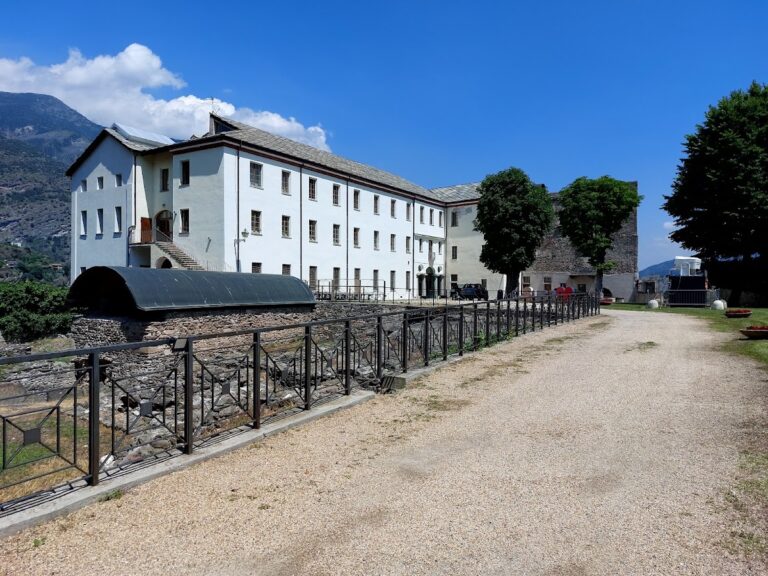
Novalesa Abbey stands at approximately 824 metres above sea level on the slopes of the Cenischia Valley, near the Mont Cenis massif. The complex consists of the abbey church and monastic buildings positioned near routes used by pilgrims, merchants, and other travellers. The buildings preserve traces of earlier structures alongside later additions, while four medieval chapels stand near the monastery.
Monastic Buildings and Cloister
Entrance Courtyard
The monastic buildings lie to the right of the church and retain traces of earlier construction. An entrance portal opens into a first courtyard, where a three-bay portico is covered by groin vaults. A groin vault is formed by the intersection of two barrel vaults. Above the portico is a loggia, an open gallery or passage articulated by arches or columns.
Sixteenth-Century Cloister
The buildings are arranged around a central courtyard containing two surviving wings of a sixteenth-century cloister. One wing has five round arches and the other has seven. The arches rest on squat cylindrical brick columns without capitals. A bell tower rises at the junction of the two wings. Built between 1725 and 1730, it reaches 22.50 metres in height.
Abbey Church
Baroque Structure
The present church was built in the eighteenth century in the Baroque style on the site of an eleventh-century Romanesque church. It has a single long nave covered by a barrel vault with lunettes, two chapels on each side, and a presbytery occupying approximately half of the nave. The presbytery is the area around the high altar reserved for the clergy. The church ends in a semicircular apse, and contains a modern marble high altar surmounted by a wooden crucifix, together with the monks’ choir.
Medieval and Gothic Paintings
Parts of the earlier Romanesque church survive through wall paintings, including a Stoning of Saint Stephen. Other paintings from the late Gothic period depict Benedictine saints and prophets and are attributed to Antoine de Lonhy, a fifteenth-century painter active in the western Alpine region. Taken together, the wall paintings preserved across the abbey range from the eighth to the fifteenth century and reflect the monastery’s long artistic and cultural activity.
Pipe Organ
The church’s counterfaçade contains a pipe organ built by the Italian organ builder Cesare Catarinozzi in 1725 and later modified. It has entirely mechanical action, a single 50-note manual, and an 18-note lectern pedalboard permanently coupled to the manual.
Medieval Chapels
Chapel of Mary
The Chapel of Mary dates from the eighth century and was remodeled in the eleventh century. Its early origin places it among the surviving structures that preserve the monastery’s medieval development beyond the main church.
Chapel of the Holy Saviour
The Chapel of the Holy Saviour dates from the middle of the eleventh century. It belongs to the group of medieval chapels standing near the monastery and associated with the abbey’s rebuilt medieval complex.
Chapel of Saint Michael
The Chapel of Saint Michael dates from the eighth or ninth century. Its date places it close to the abbey’s Carolingian period, when Novalesa developed into a large monastic and cultural centre.
Chapel of Saint Eldrado and Saint Nicholas
The Chapel of Saint Eldrado and Saint Nicholas was built in the eleventh century over a ninth-century predecessor. Its late-eleventh-century frescoes contain two cycles, one showing the life of Saint Eldrado and the other the life of Saint Nicholas of Bari, the Christian bishop of Myra whose cult spread widely in Western Europe. These cycles are among the earliest known Western or continental European fresco programs devoted to Saint Nicholas.
Archaeological and Movable Remains
Archaeological investigations in several parts of the complex uncovered the burial of a man probably passing through the abbey after a pilgrimage to Santiago de Compostela. A characteristic pilgrim’s shell was found with the remains, connecting the burial with the long-distance religious journeys that used routes through the Alpine region.
Following the nineteenth-century suppression, the twelfth-century reliquary chest of Saint Eldrado and other goldsmith’s work and sacred-art objects were transferred to the parish church. They are currently visitable through the Diocesan Museum of Sacred Art. The large wooden choir was sold to the parish church of Bardonecchia, where it remains installed with adaptations.
Nearby sites