Princely Abbey of Corvey: A Carolingian Monastery and Imperial Abbey in Germany


Site at a Glance
- Rating
- 4.6
- Popularity
- Low
- Country
- Germany
- Primary era
- Medieval
- External website
- Open
- Eras represented
- Medieval, Early Modern
- Civilizations
- Carolingian, Holy Roman Empire
- Site type
- Religious
- Remains
- Monastery
On this page20 sections
History
The Princely Abbey of Corvey is a former Benedictine abbey and ecclesiastical principality in Germany, founded by the Carolingian dynasty at its present site in 822. Its medieval name, Nova Corbeia, meaning “new Corbie,” reflected its foundation from Corbie Abbey in Picardy. Built beside the Weser and the Hellweg crossing, Corvey became a royal monastery, a centre of Christian missions and learning, and later an imperial abbey whose abbot held the rank of a prince.
Foundation at Hethis and the Weser
Charlemagne intended to establish an imperial monastery to support the Christianization of Saxony, the region incorporated into the Frankish realm through his conquests. After his death, his cousin Wala and Adalhard, abbot of Corbie, founded Nova Corbeia at a place called Hethis with the approval of Emperor Louis the Pious in 815 or 816. Hethis has not been securely identified. Proposed locations include areas near Neuhaus in the Solling, near Silberborn, near the Externsteine, and at Heiden in Lippe.
The first settlement stood on infertile land, creating shortages of food and clothing. The community maintained its monastic life and established a school, but severe material difficulties eventually divided it into three groups under priors. The search for a more suitable location led the monks to the Weser.
In 822 the community moved to the present site beside the Hellweg crossing and near the royal estate of Huxori, later Höxter. The bishop of Paderborn consecrated the building site and laid its foundation stone on 25 August 822. Monks from Fulda joined the relocation and increased the community by about half.
Two charters issued by Louis the Pious on 27 July 823 established Corvey as a royal monastery. The emperor granted it Höxter, the Saxon possessions of Corbie, earlier donations, free election of its abbot, and royal protection and immunity. Corvey thereby became independent of Corbie, although it remained linked to its mother house in a personal union until 826 or, according to another dating, 833.
Royal monastery and missionary centre
Corvey’s connection with the Carolingian monarchy was reflected in the confinement there of Hilduin of Saint-Denis after his disgrace. In 836, the relics of Saint Vitus were transferred from Saint-Denis to Corvey. Vitus became the tribal saint of the Saxons, and Corvey developed as a pilgrimage destination dedicated to Saints Stephen and Vitus. The transfer was described in the Translatio sancti Viti martyris.
The monastery also became an early base for Christian missions to Scandinavia. In 823, Corbie sent Ansgar, later bishop of Hamburg-Bremen and known as the Apostle of Scandinavia, to Corvey as a teacher and preacher. His work connected the Weser monastery with the first missionary efforts north of the Frankish realm.
Corvey’s monks came from the high nobility of Franconia and Saxony, rather than from the lower social orders. During the Hirsau reform, a movement seeking stronger monastic discipline and organization, lay brothers called conversi were admitted to perform physical work while living outside the monastic community.
By about 900, Corvey’s landed estate probably included several thousand hides, numerous churches and tithe rights, and at least 3,000 liable farmsteads. Its possessions extended between the North Sea, the Elbe, the Rhine, the Moselle, the Lahn, and the lower Werra, with major concentrations around the upper Weser, the lower Ems, Marsberg, the middle Leine, and eastern Saxony. Royal grants and donations from Saxon aristocrats made Corvey one of the wealthiest monasteries in the German lands.
Louis the Pious transferred Höxter, Eresburg, and Meppen to Corvey. Louis the German added Hemeln, Hemmendorf, Visbek, tithe rights in the diocese of Osnabrück, and vineyards near Litzig, while Lothar I donated Rügen and its surrounding territory. Some later claims rested on forged documents and could not be enforced. Corvey’s dependent institutions included the provostries of Gröningen, Obermarsberg, Nienkerken, and tom Roden, the former missionary church at Meppen, and the monasteries of Schaaken, Werbe, and Kemnade. By the fourteenth century, about 60 churches were under its control.
In 833, Corvey received the right to mint coins for its market settlement, the first privilege of this kind in the East Frankish kingdom. Minting later took place at Marsberg, Meppen, Volkmarsen, and Höxter. Silver, copper, and gold coins were produced, with the last recorded copper issues dating from 1787.
Cultural flowering in the ninth and tenth centuries
Corvey became a major centre of Christian culture in north-western Europe during the ninth and tenth centuries. Its school and library transmitted West Frankish culture into Saxony, while its liturgy and monastic offices influenced other religious communities. Twenty-three bishops emerged from Corvey during its first four centuries, including Ansgar and four of his successors at Hamburg and Bremen.
The monastery reached a cultural peak under Abbots Bovo I and Bovo II between 879 and 916. The poet Agius and the historian Poeta Saxo worked there, and Corvey produced saints’ lives, the Annales Corbeienses, and the Translatio sancti Viti martyris. Bovo II wrote a commentary on Boethius, and two Corvey monks produced the Heliand manuscript.
Corvey later became a centre of the Ottonian Renaissance. Bovo III was one of its important representatives, while Widukind of Corvey worked at the monastery from 942 to 973 and composed his history of the Saxons. Royal visits turned Corvey into a monastic palace. Twenty-three visits by kings are known through 1203, beginning with Conrad I in 913, although the royal presence also placed a heavy burden on the monastery’s economy.
Reform, conflict, and territorial power
Monastic discipline declined during the eleventh century. In 1015, Emperor Henry II, influenced by Meinwerk, bishop of Paderborn, removed Abbot Walo and installed Druthmar of Lorsch, who was associated with the Gorze reform. Strong resistance followed, and only nine monks remained after many others left.
Under Abbot Markward, Corvey adopted elements of the Hirsau reform without becoming subordinate to Hirsau. The two monasteries instead formed a confraternity. Corvey became a centre of monastic reform in Westphalia and sent monks and abbots to six Saxon monasteries. It also contributed to the renewal of women’s religious houses.
Vitus and Stephen confraternities developed at Corvey and in places where the abbey held property or rights. Between 1081 and 1138, the names of 1,350 members were recorded. These associations supported the poor, commemorated the dead, prayed for the monks, and supplied financial and political support during the Investiture Controversy, the eleventh- and twelfth-century struggle between emperors and popes over the appointment of bishops and abbots.
During that conflict, Corvey gradually moved away from the Salian royal house and toward the Gregorian reform party. In 1118, Theoger of Sankt Georgen was consecrated bishop of Metz at Corvey by the papal legate Kuno of Praeneste. Theoger then consecrated Corvey’s Saint George’s Church, an altar of Saint Andrew, and the crypt of the abbey church.
Royal and imperial intervention continued to affect the abbey. In 1065, Corvey was temporarily transferred to Adalbert of Bremen and lost parish tithes in the diocese of Osnabrück. In 1102, Abbot Markward was forcibly expelled by Günther of Hersfeld, an adherent of Henry IV, with the support of Corvey vassals and imperial troops. Markward returned after Günther’s death, but Henry V later appointed Erkenbert despite Corvey’s right to elect its own abbot.
Corvey experienced a final medieval flourishing under Wibald of Stablo, abbot from 1146 to 1158. He strengthened monastic discipline, reaffirmed possessions and exemptions, defended the abbey against attacks, and oversaw the conversion of the Westwork into its twin-towered form. The Liber vitae, a medieval book of remembrance listing Corvey’s monks, abbots, and 76 associated religious communities, belongs to this period.
Corvey became a princely imperial abbey in 1220. An imperial abbey, or Reichsabtei, was directly subject to the Holy Roman Emperor rather than to a regional prince. As a princely imperial abbey, Corvey’s abbot also held the rank and political privileges of a prince. Although the abbey lost extensive possessions and tithes, it retained a territory of about 275 square kilometres, bounded by the Weser to the east and by the territory of the prince-bishop of Paderborn to the west and south. At the end of the Holy Roman Empire, this territory contained Höxter, 16 villages, and about 10,000 inhabitants.
After Wibald’s death, Corvey declined politically, economically, and intellectually. A fire in 1242 and the policies of later abbots contributed to debt and worsening relations with Rome. As Hohenstaufen royal protection weakened, the abbots sought to consolidate a compact territory and constructed or controlled fortifications including Brunsburg, Landegge, Kugelsburg, Wildburg, and Lichtenfels.
Corvey’s settlement also became an economic rival to Höxter. Its surrounding community supported non-agricultural production, including knives and tongs. In 1150, King Conrad III granted Corvey the right to prospect and mine gold, silver, copper, lead, and tin at Eresburg. In 1192, Emperor Henry VI extended mining rights throughout the monastic territory and granted the associated tithes. Mining and metalworking remained important around Marsberg.
On 15 July 1265, Bishop Simon of Paderborn, the citizens of Höxter, and Corvey ministerials attacked and devastated the town of Corvey. An earlier promise of support from the Brunswick dukes had proved ineffective. The attack eliminated the developing competitor to Höxter, and the settlement subsequently declined.
Reformation and the Thirty Years’ War
In 1500, Corvey joined the Lower Rhenish-Westphalian Imperial Circle. Its abbot held an individual seat and vote in the Imperial Council of Princes rather than a collective vote with other imperial abbots. Around 1522, Corvey was required to provide two horsemen, nine foot soldiers, and 120 gulden for the imperial army.
Around 1500, Abbot Franz von Ketteler affiliated Corvey with the Bursfeld Congregation and began an internal renewal. The Reformation entered the territory from 1533 and became permanently established in Höxter, Amelunxen, and Bruchhausen. Counter-Reformation efforts began around 1590 under Abbot Dietrich von Beringhausen, and Catholic restoration was largely complete in the territory by 1624, except in Höxter.
The Thirty Years’ War, a European conflict from 1618 to 1648 that combined religious and dynastic struggles, brought occupation, heavy contributions, and extensive destruction. A major fire in 1635, attributed to marauding Brunswick, Brandenburg, and Swedish Protestant troops, destroyed large parts of the monastery library and left Corvey close to collapse.
In 1665, Christoph Bernhard von Galen, bishop of Münster, became administrator after the monks declined to elect an abbot from their own community. He founded the baroque abbey church, restored an aristocratic convent, and re-established Corvey’s territorial authority over Höxter. Abbatial election was later restored.
From prince-bishopric to private ownership
The dwindling number of eligible noble monks drove Corvey’s final political and religious transformation. In 1779, Corvey became an exempt abbey, freeing its inhabitants from the jurisdiction of the bishop of Paderborn in ecclesiastical matters, although Paderborn retained the right to ordain bishops. The convent contained only 13 members in 1786, when a seminary opened and its students helped maintain the liturgical schedule.
At Corvey’s request, Pope Pius VI dissolved the monastery in 1792, elevated Prince-Abbot Theodor von Brabeck to prince-bishop, and transformed the former abbey territory into a small prince-bishopric of ten parishes. The prior became dean of the cathedral chapter, the monks became canons, and the abbey church became a cathedral. Ferdinand von Lüninck succeeded Brabeck as prince-bishop in 1794.
The Reich Deputation Act of 1803 abolished Corvey’s territorial independence and incorporated it into the Principality of Nassau-Orange-Fulda. Corvey became part of the Kingdom of Westphalia in 1807 and a Prussian royal domain in 1815. The bishopric survived until Lüninck’s death in 1825 and was then incorporated into the diocese of Paderborn.
In 1820, Landgrave Viktor Amadeus of Hesse-Rotenburg received Corvey and Ratibor as compensation for territories lost after the Congress of Vienna. His non-Hessian possessions passed by testament to his nephew Victor of Hohenlohe-Schillingsfürst. In 1840, Victor received the titles Duke of Ratibor and Prince of Corvey from King Frederick William IV of Prussia. Corvey has remained in the family’s ownership.
Modern preservation and World Heritage
The princely family’s administration moved to Corvey in 1945 after the family fled its Silesian residence at Rauden. Extensive post-war renovation renewed or repaired roofs, facades, windows, doors, and other parts of the buildings. The abbey church was donated to the diocese of Paderborn in 1977 and later transferred to the parish of Saint Stephen and Saint Vitus.
From autumn 1944 to spring 1945, staff of Albert Speer’s working group for rebuilding bomb-damaged cities used Corvey as an alternate headquarters. In cooperation with Rudolf Wolters, the group prepared plans and models for Hitler’s proposed “World Capital Germania.” About 800 photographs were rediscovered at Corvey after the war, and around 150 were displayed in a 1997 exhibition. The photographed models remain missing.
Corvey was placed on Germany’s UNESCO Tentative List in 1999. On 21 June 2014, UNESCO inscribed the “Carolingian Westwork and Civitas Corvey” as a World Heritage property under criteria ii, iii, and iv. The property covers 12 hectares and has a 69-hectare buffer zone. The inscription recognizes the Westwork and the archaeological remains of the medieval Civitas, an urban or quasi-urban settlement associated with an important ecclesiastical or political centre. The former lay settlement outside the monastery precinct lies within the buffer zone.
Archaeological investigations, conservation planning, and management have involved the Ducal House of Ratibor, the parish of Saint Stephen and Saint Vitus, the city and district of Höxter, and the Kulturkreis Höxter-Corvey. Fieldwalking, geophysical and aerial prospection, and ground-penetrating radar have examined the monastery, castle grounds, and abandoned town. Corvey’s 1200th-anniversary celebrations opened on 25 September 2022, while augmented reality during the 2023 Landesgartenschau presented archaeological knowledge about the former town.
Remains
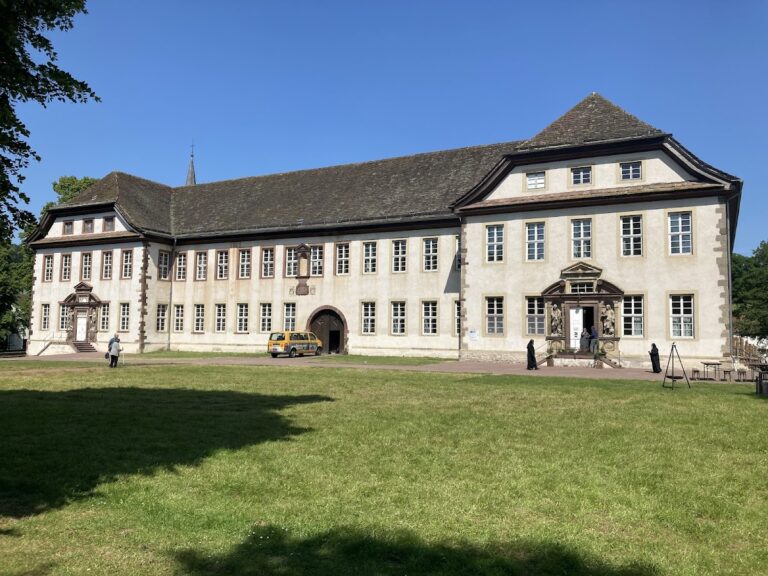
The present complex occupies about 80,000 square metres on the lower terrace of the western Weser bank. Its setting at the meeting point of the east-west Hellweg and the river helped determine the monastery’s location. The complex combines the medieval Westwork, the former abbey church, baroque former abbey buildings, and economic structures now incorporated into Schloss Corvey. The baroque rebuilding took place mainly between 1699 and 1721, with further work continuing during the eighteenth century.
The Carolingian church and Westwork
The first church was begun in 822. Its nave was consecrated in 844, the transepts and choir in 867, and the Westwork between 873 and 885. The original church was a three-aisled basilica with narrow side aisles, an approximately square choir, an eastern apse and crypt, later transepts, extended eastern passages, and an additional eastern chapel. The medieval church was demolished in 1665, except for the Westwork.
Twin-towered Westwork
The Westwork is the oldest preserved major component of Corvey and one of the earliest surviving monumental western church buildings of its form. A Westwork is a western entrance block attached to a medieval church, often containing towers, galleries, chapels, and representational rooms. Corvey’s original structure had three towers, with two facade towers and a central square tower, and drew partly on the Palatine Chapel at Aachen.
Between 1145 and 1159, under Wibald of Stablo, the central tower was removed and the two facade towers were raised, giving the building its present twin-towered form. The separate construction phases remain visible in the differing masonry. The tower gables and roofs were repaired or renewed between 1585 and 1616, and the roofs of the central block and towers date from the late sixteenth century. The former western atrium, once the principal entrance, was demolished between 1617 and 1624.
Entrance hall and upper rooms
The tall western facade consists of two flank towers and a central block with a projecting central bay. Its lower walls use irregular rubble masonry, interrupted by plain round-headed windows and narrow light slits. The central bell house has four two-part openings in its lower row from the original construction and six two-part openings in its upper row from the twelfth-century alterations. Paired double-arched windows appear in the upper tower stages.
Three arcades lead into the Carolingian entrance hall, a five-aisled square room arranged around a smaller inner square. Four columns with Corinthianizing foliage capitals and high ornamented impost blocks mark the inner space. The two three-bay side aisles formerly had flat roofs, while the eastern portion connected the Westwork to the church and was vaulted around 1600.
Stairways at the western corners lead to the two-storey central room known as the Johannischor. The high square room has a sixteenth-century beam ceiling, adjoining subsidiary rooms, and a gallery. Above it is an upper gallery zone with a large western arch opening. The central area originally carried the third Carolingian tower.
Paintings, stucco, and inscription
Carolingian wall paintings survive across the Westwork. They include ornamental bands, acanthus vines, geometric patterns, painted architectural elements, and figural scenes. Evidence of red, green, blue, yellow, and pink colouring remains on walls, pillars, capitals, arcades, and vaults.
The western room contains fragments showing Odysseus fighting the sea monster Scylla. The scene transforms ancient mythology into an early Christian image, with Odysseus representing the virtuous Christian and Scylla the dangers of the sinful world. Other paintings show a long-haired bird siren with a harp-like instrument, sea creatures, fantastic animals, a reddish frieze, and a dolphin rider.
Figural stucco fragments were found in rubble beneath the quadrum floor in 1960. In 1992, oxidized-red preliminary drawings, called sinopias, were discovered on the Carolingian masonry. These drawings, used as guides for fresco or stucco decoration, allowed the fragments to be associated with life-sized stucco figures. Oak wedges held the figures in place, and one fragment was returned to its original position using its masonry impression and wedge holes.
The stucco figures were applied in seven layers. Traces of colour support a reconstruction with green tunics and oxidized-red cloaks. The group probably comprised two women and four men, although their identities remain uncertain because attributes and inscriptions are absent. Interpretations have included rulers, archangels, Corvey saints, and representatives of martyrs and holy virgins.
Baroque church and furnishings
Saint Stephen and Saint Vitus Church
Between 1667 and 1671, Niklas Dentell built the present church interior in a Gothicizing style. Its baroque furnishings were largely completed by 1675, and the church was consecrated in 1681. Saint Stephen and Saint Vitus Church is a three-bay hall church with a recessed three-bay choir ending in a 5/12 polygonal termination. The eastern Benedictus Chapel is a two-bay annex with a three-sided termination.
Tall two- and three-light pointed-arch windows illuminate the church, whose cross-ribbed vault has no transverse arches. The furnishings include the high altar, two seventeenth-century side altars, and four alabaster epitaphs of prince-bishops. Andreas Schneider of Höxter built the organ in 1681. The tower contains a four-part peal, including three historic bells.
Baroque monastery and princely residence
Monastery buildings and grounds
The baroque monastery was rebuilt after the Thirty Years’ War. Florenz von dem Velde began the work in 1699, and Maximilian von Horrich completed the east wings by 1715. Later prince-abbots added guard, residential, and carriage buildings, two towers, and the wings of the economic court. The Benedictus Chapel dates from 1727, the garden house from 1741, the southern Marien Chapel from 1790, and the Dreizehnlindenhaus outside the main precinct from 1794.
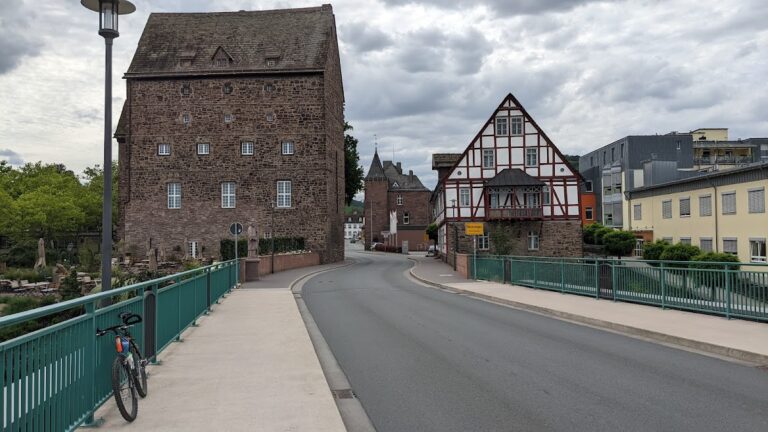
A stone bridge leads to the entrance gate. Two figures resembling oriental warriors decorate its front, while two landsknechts appear on the rear. Former carriage and stable buildings stand north of the gate, and former servants’ housing stood to the south. The west front of the former abbey buildings is 112 metres long, has three storeys and 32 window axes, and is divided by two large and three small portals. The north front measures 90 metres, while the east wing is 112 metres long.
The Schelpe stream crosses the former monastery grounds, passes beneath the west wing, supplied a fishpond used during fast days, and flows into the Weser behind the castle. The former monastery complex is bounded to the south by the church and Westwork. Nineteenth-century cemeteries lie north and south of the church.
Historic interiors
The Abbot’s Gallery occupies the former monastic residential wing in the east tract. Florenz von dem Velde commissioned its 65 portraits, which Tobias Querfurt completed by 1714, with two later additions. Only the latest portraits are considered realistic, while the earlier images were invented by the painter.
The Geweihgang connects the former convent residence in the east with the abbot’s tract in the west. The ducal family furnished it with hunting trophies during the second half of the nineteenth century. Its walls imitate marble, and its wall-mounted candelabra are in the Historicist style.
The princely salons occupy the west wing and were arranged for Landgrave Viktor Amadeus after rooms in the north wing remained occupied by Bishop Ferdinand von Lüninck. Their furniture represents late-classical and Biedermeier styles. The Blue Salon retains its original early nineteenth-century French wallpaper.
The Kaisersaal extends across the west wing and retains its baroque furnishings. Twenty portraits of emperors and kings decorate the walls, including full-length portraits of Charlemagne and Louis the Pious on the end walls. A large ceiling medallion depicts the Wedding at Cana, surrounded by smaller biblical scenes concerning hospitality. The wall and ceiling stucco is probably by the Italian artist Giacomo Perinetti.
Princely library and commemorative remains
The princely library is a secular collection formed by the landgraves of Hesse-Rotenburg rather than a continuation of the medieval monastery libraries. About 36,000 volumes were moved from Rotenburg an der Fulda to Corvey between 1825 and 1833, and the collection later grew to approximately 74,000 volumes. It occupies 15 rooms with stucco ceilings, about 200 wooden bookcases, and French wallpaper.
The medieval monastery library was dispersed after the secularization of 1803. About 2,500 volumes remained as the Corvey parish library and were later deposited in the Archiepiscopal Academic Library in Paderborn. The famous Tacitus manuscript left Corvey in the early sixteenth century.
August Heinrich Hoffmann von Fallersleben, poet of the German national anthem and librarian of the princely library from 1860, is buried in the cemetery beside the abbey church. His grave has two marble plaques and a larger monument unveiled in 1911.
Buried Civitas Corvey
The archaeological remains of the medieval Civitas Corvey lie beneath the present castle complex as a buried archaeological monument. Foundations of the Carolingian monastery town and church survive below ground. Much of the former medieval town lies in the Weser bend south of the complex, where its remains are not generally visible above ground.
Archaeological work has investigated the monastery, castle grounds, and abandoned town through fieldwalking, geophysical and aerial prospection, and ground-penetrating radar. Conservation planning has addressed the Westwork’s masonry, towers, foundations, plaster, wall paintings, stairs, doors, and access points, as well as the church, castle buildings, historic interiors, library, grounds, ponds, ditches, and the archaeological park associated with the former town.
Nearby sites