Dominican Monastery in Jablonné v Podještědí: A Baroque Pilgrimage Complex

Site at a Glance
- Rating
- 4.8
- Popularity
- Very Low
- Country
- Czechia
- Primary era
- Early Modern
- External website
- Open
- Eras represented
- Early Modern
- Civilizations
- Habsburg, Holy Roman Empire, Kingdom of Bohemia
- Site type
- Religious
- Remains
- Monastery
On this page8 sections
History
The Dominican monastery in Jablonné v Podještědí is a Dominican complex in Czechia, founded around 1250 by the Bohemian nobleman Havel of Lemberk and his wife, Zdislava of Lemberk. It developed into a centre of Dominican religious and pastoral life and a pilgrimage destination associated with Zdislava, whose remains are kept in the Church of St Lawrence.
Foundation and medieval development
The first friars probably arrived from Brno or Cologne. Construction of the monastic buildings was under way by 1252, when the Dominican cardinal and papal subdelegate Gerhard of Vrorzheim granted indulgences, a remission of temporal punishment associated with sin in Catholic theology, to people who contributed to the cloister and other necessary facilities. The convent was probably complete by about 1269, when it hosted the provincial chapter of the Bohemian-Polish Dominican province. A provincial chapter was the formal governing assembly of a regional Dominican province.
Zdislava was buried in the Church of St Lawrence, where her bodily remains were preserved. The monastery received continuing endowments from the Lords of Vartenberk. In 1402 it acquired the Janov Forest, which later became the subject of a dispute. In 1415 Henry Berka of Dubá at Houska granted the convent an annual income of 13 kop of groschen. A kop was a historical monetary unit equal to 60 groschen.
Destruction, rebuilding, and the Reformation
The Hussite Wars, fifteenth-century religious and political conflicts in the Bohemian lands associated with the reform movement inspired by Jan Hus, brought destruction to Jablonné and its monastery. In 1425 the Hussites attacked and destroyed both. Some Dominicans escaped and soon returned. Jarek of Pecka then endowed an annual income of 20 kop in 1430 to help repair the buildings and provide clothing for the friars. The Lords of Dubá, the monastery’s patrons, continued their support, and valuables hidden in Zittau were returned in November 1431.
In 1508 the convent purchased three farms on the Lemberk estate. The convent and Church of St Lawrence were rebuilt in 1510 on a modest scale, apparently with wood and clay. Devotion to Zdislava grew around her tomb in the church crypt, drawing pilgrims and strengthening the monastery’s religious role. The convent also took responsibility for pastoral administration in Jablonné.
The monastery survived the Reformation despite the ambivalent position of the Berka branch that controlled Jablonné. In 1579, however, it lost administration of the town parish, and Catholic worship was thereafter largely confined to the monastic church. A visitation in 1594 found the monastery in poor moral and economic condition, following the marriage of Prior Pavel Landtmann in Česká Lípa. The institution nevertheless endured. Devotion to Zdislava spread more widely through the Bohemian lands in the late sixteenth century through the work of Berthold Pontanus of Most, a canon of St Vitus Cathedral and a poet.
Baroque renewal and the pilgrimage church
A major rebuilding campaign began in 1683. The Dominicans were a mendicant order, one that relied substantially on alms and donations rather than extensive landed wealth, so financial difficulties repeatedly interrupted the work. The convent was gradually rebuilt almost completely between 1683 and 1696. Evidence of devotion to Zdislava was recorded by the parish priest in 1677, and petitions for her beatification increased afterward.
František Antonín Berka, the last member of the Berka of Dubá family, commissioned plans for a new Church of St Lawrence from Johann Lucas von Hildebrandt. The design was modeled on St Peter’s Basilica in Rome. After Berka’s death, construction was first led by Petr Bianco of Litoměřice and then by the stonemason Domenico Perini, who modified the original dome design. The church was consecrated in 1729.
A fire damaged the monastery and church in 1710, but construction continued with support from Berka’s sister, Františka Rozálie, who had married into the Kinský family. The popularity of the pilgrimage site helped sustain a sizeable Dominican community. In 1773 the convent contained 11 priests and two lay brothers.
Dissolution and modern Dominican return
Emperor Joseph II, whose late-eighteenth-century reforms included dissolving many religious houses in the Habsburg monarchy, ordered the monastery dissolved in 1785. After a fire in Jablonné in 1788, the monastic Church of St Lawrence became the parish church. Dominicans continued pastoral work in the town until 1810.
Zdislava was beatified in 1907. The Dominican Order continued to seek the monastery’s restoration because her bodily remains were preserved there and she had belonged to the Dominican Third Order, an affiliated form of religious life for lay members. The monastery was briefly restored in 1945, but the communist Czechoslovak state forcibly closed it in 1950 during Action K, an operation that dissolved male religious houses and removed their communities. Pastoral administration then passed to diocesan priests of the Litoměřice Diocese.
During the political liberalization of 1968, a semi-clandestine Dominican community formed in Jablonné under the central influence of Father Jindřich Gajzler. After 1989 the Dominicans returned and re-established a community at the monastery. In 2014 it consisted of three members, who also administered nearby parishes and provided Catholic pastoral care at a prison and at a former parish house serving a community of former drug users.
Pope John Paul II canonized Zdislava on 21 May 1995 and proclaimed her the principal patron of the Litoměřice Diocese on 24 October 2000. The monastery continues to host Dominican tertiaries, religious education, and the Saint Zdislava Centre, which accommodates families undertaking spiritual stays. Its church is the Basilica Minor of St Lawrence and St Zdislava, a papal honorary designation for a church of particular religious or historical importance.
Remains
Baroque monastery and basilica
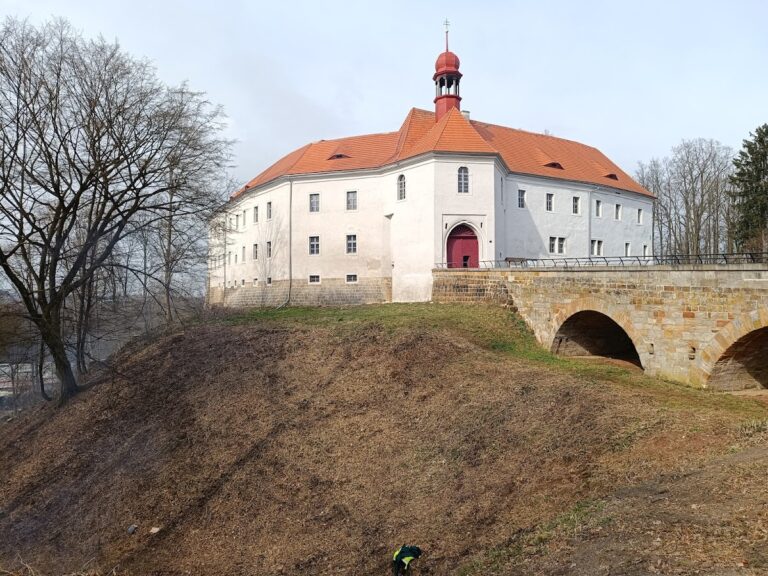
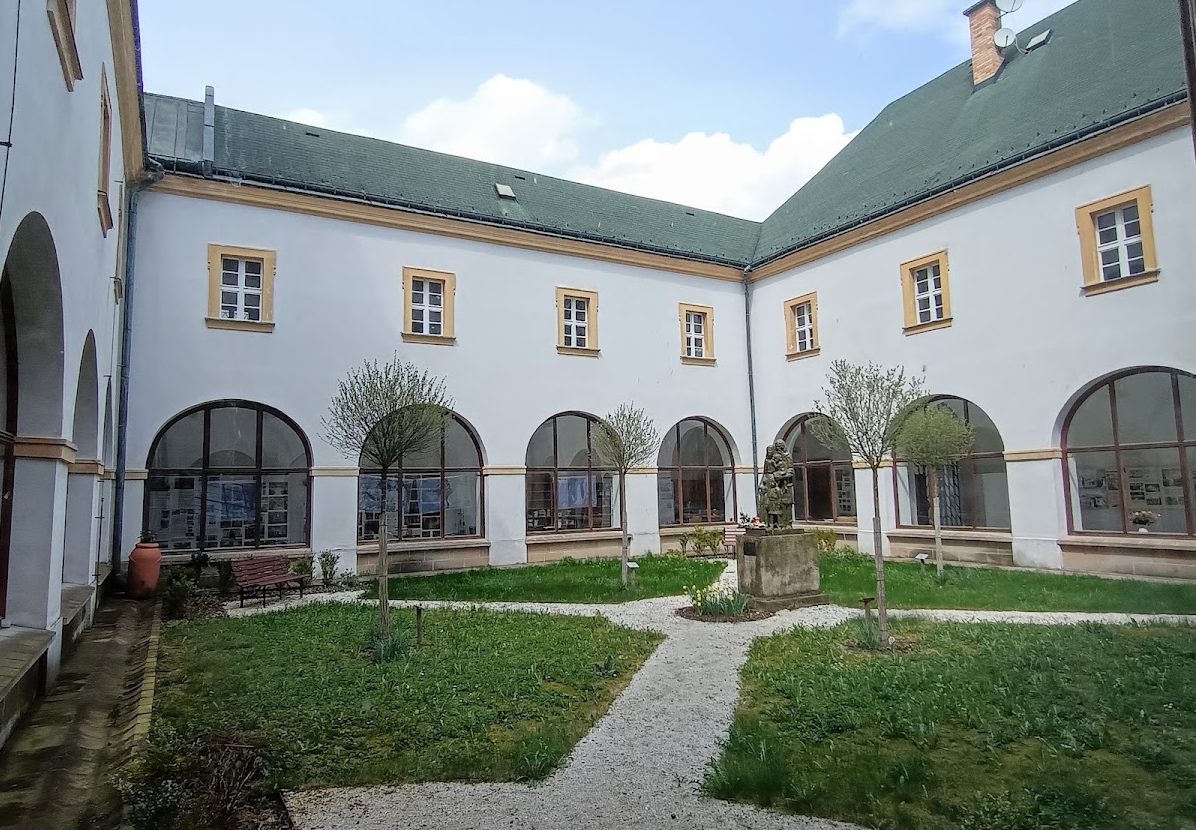
The complex is a Baroque monastery centred on the pilgrimage Basilica Minor of St Lawrence and St Zdislava. The convent was substantially rebuilt between 1683 and 1696, while the church designed by Johann Lucas von Hildebrandt was constructed under the direction of Petr Bianco and later altered by Domenico Perini. Its form was modeled on St Peter’s Basilica in Rome, and the church was consecrated in 1729. The earlier church had contained a devotional image of the Virgin Mary that attracted numerous pilgrims. The convent and church rebuilt in 1510 had used wood and clay, and Zdislava’s tomb was altered in 1596 and enclosed with an iron grille.
Catacombs and crypts
Beneath the basilica lies an underground system known as the catacombs, made up of crypts and passageways. It probably has three levels reaching approximately 39 metres below ground, although only the first level can be entered because the way into the two lower levels is unknown. The accessible level contains the crypt of Saint Zdislava, the coffin of František Antonín Berka of Dubá, the main patron of the church’s construction, and the crypt of the Pacht family of Rájov. It also holds the remains of workers who died during construction, a small coffin associated with a wireworker, and a Dominican crypt that is not ordinarily accessible out of respect.
In 1981 Czechoslovakia’s State Security service, the secret police, investigated the catacombs because it suspected that a Nazi archive from the Second World War had been hidden there. The search found nothing, while drilling reached groundwater and substantially damaged the underground spaces. The catacombs are now opened only on exceptional occasions.