Franciscan Monastery in Braniewo: A Medieval Religious Complex in Poland


Site at a Glance
- Rating
- 4.6
- Popularity
- Low
- Country
- Poland
- Primary era
- Medieval
- External website
- Open
- Eras represented
- Medieval
- Civilizations
- Teutonic Order
- Site type
- Religious
- Remains
- Monastery
On this page10 sections
History
The Franciscan Monastery in Braniewo, Poland, was a Catholic religious house founded in 1296 by Bishop Henry I Fleming of Warmia for the Franciscans, a mendicant order founded by St. Francis of Assisi. The friars initially belonged to the order’s Saxon Province, a regional administrative jurisdiction. The monastery passed through several locations, became a Jesuit institution in the sixteenth century, and remained associated with religious, educational, and burial activities until the destruction of its church in 1809.
Foundation and relocation
The position of the first Franciscan residence is unknown. A dispute later developed between the friars and Braniewo’s townspeople, who relied on a town-foundation privilege from 1280 that prohibited monasteries within the town without the citizens’ consent. Eberhard of Nysa, Braniewo’s long-serving parish priest, supported the townspeople.
An agreement reached at Braniewo Castle on 28 April 1301 ended the dispute. The Franciscans surrendered their urban plot and abandoned their claims to it. In return, the town granted them land north of Braniewo beside the Pasłęka River. The monastery building inside the town was demolished, and the new riverside site was most directly approached through the Monks’ Gate. Its position close to the fortifications also exposed the friars to attack and made the site a possible enemy bridgehead against Braniewo.
The arrangement did not last. In 1330, the town council assigned the Franciscans a plot within the walls, and the convent moved back into Braniewo. This third location became permanent. Pope Clement V had already issued a bull on 19 June 1310 rebuking both the Franciscan order and the townspeople over the circumstances surrounding the monastery.
Medieval support and decline
The monastery received financial assistance from the Teutonic grand master. Between 1399 and 1409, payments normally arrived in installments of two marks and provided an annual income of twelve marks. Similar subsidies probably existed before this period, while the continuation of such payments after the Teutonic Order’s financial collapse following its wars with the Polish-Lithuanian state remains uncertain.
The Reformation brought a sharp decline in the number of friars during the fifteenth and sixteenth centuries. The monastery therefore faced the possibility of complete abandonment. On 8 January 1565, Stanislaus Hosius, Bishop of Warmia and a Catholic cardinal, installed Jesuits, members of the Society of Jesus, in the Franciscan monastery. The Jesuits were strongly involved in education and Counter-Reformation activity.
The Jesuit period
Only two Franciscans remained at the transfer in 1565. Father Simon Neumeister was moved to the monastery at Lubawa, while the Jesuits retained the eighty-year-old Brother Bernard because he was believed to know the location of the monastic treasury. He died two years later after being treated well and disclosed a walled-up hiding place containing 1,330 marks.
The Jesuits assumed control of the Franciscan church, monastery buildings, movable property, and library. The collection contained 300 volumes, including valuable incunabula, books printed in Europe during the earliest period of movable-type printing, and medieval manuscript books. It also included part of the collection associated with the bequest made to Braniewo by the Warmian canon Thomas Werner, who died in 1498.
The former Franciscan church became the religious center of the Jesuit community. Many townspeople also attended services there, even though the parish church of St. Catherine stood nearby. Elaborate vocal and instrumental music drew worshippers, and in 1603 the church hosted spectacular performances involving live cannon charges and fiery wheels. The provincial superior later prohibited such displays.
Burials and destruction
The church crypts were used for burials. On 21 January 1613, Regina Protmann, founder of the Congregation of the Sisters of St. Catherine the Virgin and Martyr and later known as Blessed Regina Protmann, was buried there. The Jesuits otherwise used the crypts for members of their order and distinguished benefactors of their college. Protmann’s remains stayed in the church until its demolition in 1809.
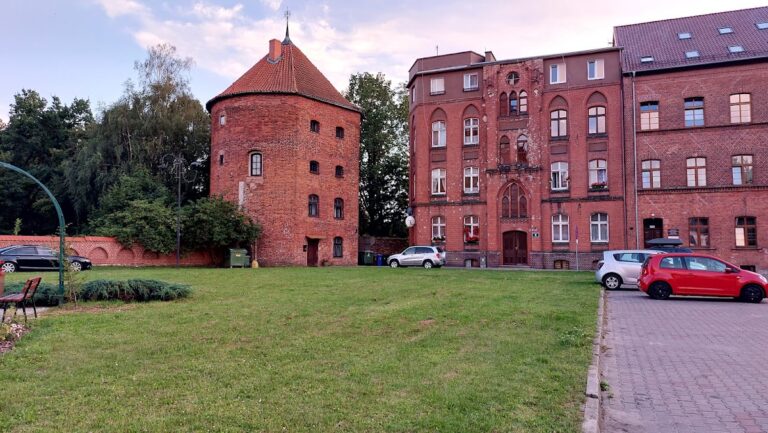
Visitors passing through Braniewo included Peter the Great, Tsar of Russia, who came in 1697, and Charles XII, King of Sweden. In 1743, the monastery buildings were demolished except for the Church of the Blessed Virgin Mary and the Cleric’s Tower. A new Jesuit college building was erected on the former monastery site.
The church survived until 1809, when rising groundwater damaged its floor and walls after a well near the old college had been filled. On 23 February 1809, the royal government ordered demolition. The work was administered by Cornelius Burgund, a Prussian official and former cleric. Johann Schmülling, director of the gymnasium, a secondary school, described the destruction of the beautiful and potentially salvageable church as vandalism in a letter to Minister Johann Heinrich Schmedding.
The church furnishings were distributed to other parishes in Warmia. Father Andrew Rehaag, dean of Elbląg, bought the organ, while Father Joachim Scholler, dean of Olsztyn, acquired the backs of the choir stalls. Those choir-stall backs survive in St. James’s Church in Olsztyn.
Later buildings and archaeological investigation
A much smaller gymnasium church was built on the site of the medieval Franciscan church between 1861 and 1863. It was damaged during the Red Army offensive and bombing of Braniewo, which began on 5 February 1945. Although its walls survived, neglect led to its deterioration, and the building was demolished in the 1960s. A typical postwar residential block used as a school boarding facility was later constructed there.
On 23 and 24 June 2019, non-invasive geophysical investigations examined the courtyard and parking area occupying the former church site. Ground-penetrating radar indicated the remains of two structures and identified two locations where crypts probably survive. The former Franciscan site now belongs to the Braniewo Vocational Schools complex.
Remains
The Franciscan complex consisted of three interconnected houses and a Gothic church. The monastery contained fifty cells and communal rooms, including a refectory, or shared dining hall, and a library. The church and monastery occupied a site that later became the location of the smaller nineteenth-century school church, followed by the present courtyard and parking area.
Church of the Blessed Virgin Mary
The Church of the Blessed Virgin Mary, also called St. Mary’s Church, was first mentioned in 1311 and was completed at the end of the fourteenth or the beginning of the fifteenth century. It was a Gothic building 67 metres long, including a 24.5-metre choir, and 12.5 metres wide. The interior was divided into three aisles, longitudinal passages alongside the central part of the church.
Nine long Gothic windows and an equal number of projecting wall buttresses shaped the exterior. Instead of a conventional church tower, the building had a tall, slender turret containing a small bell. Extensive underground crypts belonged to the church from its earliest period. The crypts served as burial chambers for Regina Protmann, members of the Jesuit order, and distinguished college benefactors.
Interior furnishings and communal use
Eight altars were recorded in the church. They included the altar of St. Stanislaus Kostka, dated 1644; the altar of the Blessed Virgin Mary, dated 1646; and the altars of St. Ignatius and the Three Kings, both dated 1652. The altar of St. Sebastian and the altar of the Holy Cross dated from 1653, the altar of St. Francis Xavier from 1668, and the altar of St. Francis of Assisi from 1742.
The church also contained separate seating areas for the guilds of bakers, coopers, and fishermen. Its organ was transferred to a Warmian parish after the demolition, while the backs of its choir stalls were moved to St. James’s Church in Olsztyn. The library associated with the monastery contained 300 volumes, including incunabula, medieval manuscript books, and part of the collection connected with Thomas Werner’s bequest.
Later structures and subsurface remains
The gymnasium church built in 1861–1863 was oriented transversely to the former Franciscan church and ran along the town’s defensive walls. Its surviving walls were damaged in 1945, and the building was eventually demolished in the 1960s. The later residential block used as a school boarding facility changed the appearance and use of the site.
Today, the former church area is a courtyard and parking space within the Braniewo Vocational Schools complex. The ground-penetrating-radar survey carried out in 2019 identified probable subsurface remains of two structures and two likely crypt locations. These findings indicate that elements of the former complex remain beneath the later surface, even though the Franciscan church itself no longer stands.