Frauenalb Monastery: A Former Benedictine Convent in Germany


Site at a Glance
- Rating
- 4.5
- Popularity
- Medium
- Country
- Germany
- Primary era
- Early Modern
- External website
- Open
- Eras represented
- Medieval, Early Modern
- Civilizations
- Holy Roman Empire
- Site type
- Religious
- Remains
- Monastery
On this page14 sections
History
Frauenalb Monastery is a former Benedictine convent for women from noble families in Germany, located in Marxzell in the upper Alb valley near Bad Herrenalb. The convent was founded around 1180–1185 within the historical sphere of the County of Eberstein and later belonged to the Archdiocese of Freiburg im Breisgau. Its history includes medieval territorial conflict, destruction by fire and war, dissolution during the Reformation, and secularization in the early nineteenth century.
Legend and foundation
A foundation tradition recorded in the Zimmern Chronicle of 1566 connected Frauenalb with Count Berthold of Eberstein. According to the story, Albrecht of Zimmern witnessed a hunting apparition in 1134 and vowed to build a church. Berthold was then said to have founded a women’s monastery at the site. The tradition placed the foundation around 1135 and was accepted locally until the end of the nineteenth century, although historians had questioned it earlier.
The foundation generally accepted as historical took place around 1180–1185. Eberhard III of Eberstein founded the convent together with Uta. By 1193, its possessions included Schielberg, Metzlinschwand, and Muggensturm. An earlier foundation from the beginning of the twelfth century, associated with the name Cella Sancta Maria, has also been linked with Frauenalb, but the relationship between the two foundations and the precise date remain uncertain.
Medieval growth and political autonomy
Frauenalb admitted only women from noble families and housed as many as about 30 members. Many entered while still young. Donations from new members and other benefactors enabled the convent to acquire extensive property in the northern Black Forest and on both sides of the Rhine.
During the fourteenth century, the margraves of Baden acquired the monastery’s bailiwick, or right of protection. In 1403, King Rupert granted Frauenalb imperial immediacy, a status within the Holy Roman Empire that placed the institution directly under the emperor rather than beneath a territorial lord. The resulting dispute was associated with Margrave Bernard of Baden’s burning of the earlier Romanesque monastery buildings.
Fire, war, and renewed prosperity
A fire in 1508, caused by the carelessness of a lay sister, destroyed the abbey and convent buildings, including the dormitory and refectory. The reconstructed monastery was plundered during the German Peasants’ War in 1525. Despite this damage, Frauenalb soon regained its former prosperity through its extensive estates.
By the sixteenth century, the convent derived income from 38 villages east of the Rhine and 10 west of it. In 1598, wine income alone, particularly from Ersingen, amounted to approximately 39,000 litres. The Reformation reached Frauenalb during the late sixteenth century, and Margrave Ernst Friedrich of Baden-Durlach dissolved the convent in 1598. The last canoness, a woman belonging to the religious community, left in 1605.
After an abbatial vacancy from 1629 to 1631, Benedictine nuns from Urspring Abbey occupied Frauenalb during the Thirty Years’ War. This major European conflict, fought from 1618 to 1648 amid religious and dynastic struggles, caused widespread disruption in the German lands. The nuns fled to Lichtental in 1634 and returned to Frauenalb in 1645.
Baroque rebuilding
The old convent building was demolished in 1696, and a new structure was erected between 1696 and 1704. The building was designed by Franz Beer, an architect of the Vorarlberg school, and constructed by Johann Jakob Rischer. Under Abbess Gertrudis von Ichtrazheim, a new monastery church was built and completed in 1751.
Secularization and later uses
After the Peace of Lunéville in 1802, the former noblewomen’s convent passed to Baden. Secularization, the transfer of ecclesiastical property and institutions into secular ownership or administration, ended Frauenalb’s institutional existence in 1803. The property served as a military hospital from 1813 to 1815 and was auctioned to private purchasers in 1819.
Factories subsequently occupied the buildings, but the ventures failed. A fire in 1853 left the monastery complex as burned ruins. Lambert Heinrich von Babo later acquired the abbey buildings and lived there for periods. From 1936 to 1945, an adjoining former hotel housed the Baden district leadership school of the Nazi Party, where party officials attended courses lasting several weeks.
The Frauenalb Foundation was established in 1960. It acquired the surviving building remains and undertook their preservation.
Remains
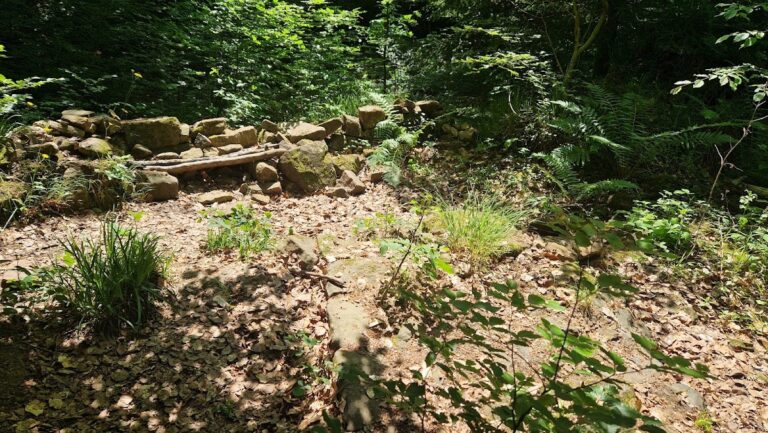
Frauenalb is a monastery ruin surrounded by a small settlement in the upper Alb valley. The surviving complex combines intact buildings with burned and deteriorated sections. The ruins and remaining structures stand near the Alb stream, while a historical boundary between Baden and Württemberg lies close to the monastery ruins along the path toward Bad Herrenalb.
Main monastery buildings
Monastery church
The church rebuilt between 1404 and 1406 survived the fire of 1508. It was later replaced or supplemented in the monastery complex by a Baroque church with two towers, completed in 1751 under Abbess Gertrudis von Ichtrazheim. The church forms part of the surviving architectural history of Frauenalb, where medieval and eighteenth-century building phases belong to the same monastic site.
Baroque convent building
The convent building erected between 1696 and 1704 was a three-storey structure with a gabled facade facing the mountains. Franz Beer designed it, and Johann Jakob Rischer carried out the construction. The building belongs to the rebuilding of Frauenalb after the destruction of the older convent structure and survives within the site in a combination of intact and ruined sections.
Domestic and working buildings
The former convent complex included dormitory and refectory buildings, an infirmary, weaving rooms for lay sisters, stables, a monastery mill, an inn, and a brickworks. A water mill stood on the Alb stream. The grounds also contained pigsties and guest accommodation. Bathing rooms were provided for the members of the convent, although the order’s rules permitted the canonesses to use them only two or three times a year.
Buildings outside the main convent
Former monastery inn
The former monastery inn, Zum Straussen, was built in 1793 by Freifrau von Wrede. The old monastery smithy was incorporated into the building and later additions doubled the length of the original structure. It now houses the Gasthof König von Preußen.
Former abbess’s house
The coat of arms of the von Babo family remains above the outer gate of the former abbess’s house. It reflects the later phase in which Lambert Heinrich von Babo acquired the abbey buildings and lived at Frauenalb for periods.