Archcathedral Basilica of the Assumption of the Blessed Virgin Mary and Saint Andrew in Frombork: Cathedral of Warmia


Site at a Glance
- Rating
- 4.6
- Popularity
- Low
- Country
- Poland
- Primary era
- Medieval
- External website
- Open
- Eras represented
- Medieval, Early Modern
- Civilizations
- Crusader, Kingdom of Poland, Polish–Lithuanian Commonwealth, Teutonic Order
- Site type
- Religious
- Remains
- Cathedral
On this page12 sections
History
The Archcathedral Basilica of the Assumption of the Blessed Virgin Mary and Saint Andrew in Frombork, Poland, is a Roman Catholic brick Gothic hall church built between 1329 and 1388 on a fortified hill now known as Cathedral Hill. It replaced a wooden cathedral built on the site in 1288 and became the principal church of the Diocese of Warmia. Today it is the archcathedral of the Archdiocese of Warmia, the principal church of that archdiocese and the seat of its archbishop.
Foundation and Gothic construction
After Warmia’s economic situation stabilized following the upheavals of the conquest period before 1280, the cathedral chapter began developing a fortified castle complex and a new cathedral. The church was constructed according to a unified plan in three principal stages. The straight-ended choir was built from 1329 to 1342, the nave approximately from 1355 to 1380, and the western porch approximately from 1380 to 1388.
Damage and later additions
The cathedral was plundered by Polish forces in the fifteenth century and by Swedish forces in the seventeenth century. Its interior later acquired a predominantly Baroque character. A tall Renaissance bell turret was added toward the end of the sixteenth century, and a church clock was installed in 1638. The Gothic Saint George’s Chapel was added to the south elevation around the turn of the sixteenth century. From 1639 until the nineteenth century, services for the Polish-speaking population were held there on the orders of Bishop Mikołaj Szyszkowski.
Warmia Bishop Christoph Szembek founded the Salvator Chapel, also called the Chapel of the Holy Relics. Construction began in 1732, and the chapel was consecrated in 1735. The present main altar was created between 1747 and 1752 through the efforts of Bishop Adam Grabowski. A thorough interior renovation followed in 1887–1891, producing the cathedral’s present interior appearance. Justus Bornowski of Elbląg created the new painted architectural and sculptural decoration, while fragments of a Late Gothic painting of the Church Fathers and the coat of arms of Bishop Nicholas Tungen were retained in the choir.
Copernicus and the modern cathedral
Nicolaus Copernicus, the Renaissance astronomer and canon of the Warmia cathedral chapter known for formulating a heliocentric model of the universe, was buried in the cathedral in 1543. Human remains discovered there were attributed to him after several scientific examinations and were reburied in the cathedral on 22 May 2010. The church remains a Roman Catholic parish church. Pope Paul VI granted it the title of minor basilica, a special honorary title awarded by the pope, on 18 September 1965.
The cathedral was declared a Polish historical monument in 1994 and is protected as part of Poland’s cultural heritage. It continues to host editions of the International Organ Music Festival in Frombork. A cult of the Blessed Dorothea of Montau is also associated with the church.
Remains
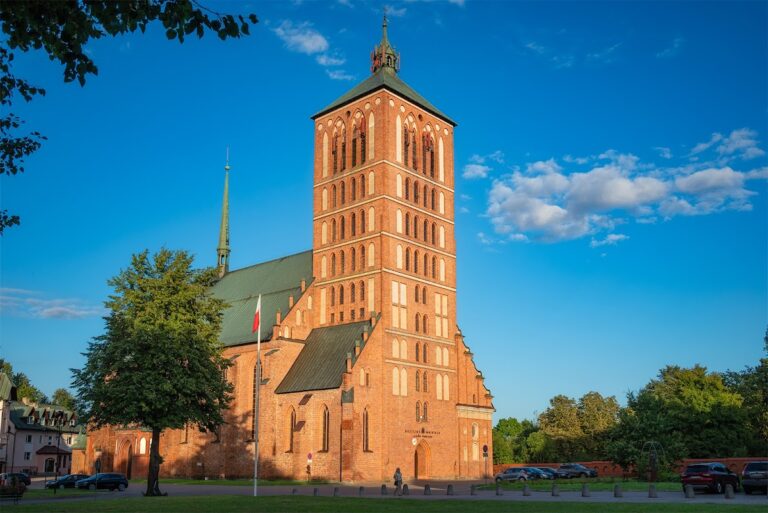
The surviving cathedral is an approximately 100-metre-long brick Gothic hall church with three naves, a straight-ended elongated choir, and a height of 16.5 metres. In a hall church, the central nave and side aisles are approximately equal in height, creating a broad interior space rather than a dominant upper nave. Much of the building remains close to its original architectural form.
Choir and nave
The choir, built from 1329 to 1342, uses forms derived from the late thirteenth century. Its early four-pointed star vaults are visually supported from the floor by clustered wall shafts. The three-aisled nave, constructed approximately from 1355 to 1380, has wall shafts resting on consoles. Its richer eight-pointed star vaults rise directly from capital zones above massive octagonal piers.
Western porch and exterior features
The western porch, built approximately from 1380 to 1388, contains a large portal made of Gotland limestone and artificial stone. Its archivolts, bands of ornament following the curve of an arch, contain figures of saints. The cathedral has no large central tower. Four narrow turrets mark its corners, while a monumental rising arcade gallery decorates the west gable. This gallery is described as unusual north of the Alps and has a comparable form at the transepts of Tournai Cathedral.
South-side chapels
The Gothic Saint George’s Chapel on the south elevation dates from around the turn of the sixteenth century and is crowned by an attic-like superstructure. The Baroque Salvator Chapel is the only post-Gothic extension identified in the architectural description. Its dome carries illusionistic frescoes by Matthias Johann Meyer, and its wrought-iron gate was made by Jan Schwartz of Reszel.
Altars and choir furnishings
The present main altar combines black and pink marble elements made by Dębnik stonemasons to a design by Franciszek Placidi. Its central field contains Stefan Torelli’s paintings of the Assumption of the Virgin Mary and the Martyrdom of Saint Andrew. The Frombork Polyptych, a multi-panel altarpiece, includes a Late Gothic sculpture of the Madonna and Child. Figures of the Church Fathers stand beside it, while its wings preserve partly surviving reliefs of Marian scenes and paintings of the Passion of Christ.
The former high altar was carved and painted in Toruń in 1504 for Bishop Lucas Watzenrode. Its central scene shows Mary with the Christ Child against a golden solar background, with the Church Fathers at the sides. It now stands in the northern nave. Sixteen seventeenth-century side altars contain valuable paintings. The late Baroque choir stalls, decorated with marquetry and a canopy, were made from 1734 to 1738 by Krzysztof Sanda after a design by K. Peucker.
Memorials and stained glass
The painted round-form epitaph of cathedral canon Bartholomew Boreschow, who died in 1426, is the oldest identified furnishing. It exemplifies the International Gothic, also called the Beautiful Style, under Bohemian influence. The cathedral also contains tomb slabs of Warmia bishops and a 1735 epitaph to Nicolaus Copernicus.
A hailstorm destroyed the cathedral’s windows in 1867. New stained-glass windows were produced between 1868 and 1911 by workshops associated with Adolf Seiler of Breslau, Heinrich Oidtmann of Linnich, Adalbert Redner of Breslau, and Joseph Maria Machhausen of Koblenz. Nearly all the windows were heavily damaged during the Second World War. Their restoration has proceeded in stages since 1995, and selected examples are displayed in the Copernicus Museum in Frombork.
Organs
The main organ is housed in a Baroque case dating from 1685. The original instrument had been taken away by Swedish forces during the Polish-Swedish war, so the Warmia cathedral chapter commissioned Daniel Nitrowski of Gdańsk to build a replacement in 1683. The contract was completed in 1684, and painted Baroque decoration was added in 1685. After numerous alterations, E. Kemper built a new electropneumatic instrument in 1934 while retaining the case. That instrument was destroyed during the Second World War.
In 1946, Salesian priests assumed responsibility for the cathedral, and in 1960 the Salesian priest Józef Sianko restored its two instruments to working order. In the late 1970s, under the direction and design of Professor Jan Jargon of Kraków, the Kamiński firm reorganized the main organ, replaced several stops, added a seven-stop Brustwerk and tubular bells, and enlarged the choir organ from 13 to 16 stops. The resulting instruments had a combined 66-stop disposition. The main organ now has 50 registers, four manuals, and a pedal, while the 1935 choir organ has 16 registers, two manuals, and a pedal. An organ stop is an independently controlled set of pipes or equivalent sound-producing elements; a manual is played by the hands, and a pedal by the feet. The two instruments can be played from a common console, and the pedal keyboard and adjustable bench were renewed in 2013.
Oak beside the cathedral
A large pedunculate oak called Mikołaj grows beside the cathedral. In 2011 its circumference was 734 centimetres, and it was estimated to be about 500 years old. At that time, the tree was reported to be in poor health.
Nearby sites