Hikawa Shrine: Kawagoe’s Shinto Guardian Shrine in Japan


Site at a Glance
- Rating
- 4.3
- Popularity
- High
- Country
- Japan
- Primary era
- Early Modern
- External website
- Open
- Eras represented
- Early Modern, Modern
- Civilizations
- Japanese, Tokugawa
- Site type
- Religious
- Remains
- Sanctuary
On this page10 sections
History
Hikawa Shrine is a Shinto shrine in Kawagoe, Japan, traditionally founded in 541 during the reign of Emperor Kinmei. Its present main hall belongs to the Edo period and has an irimoya roof, a form combining a central gable with hipped sections. The shrine is also called Kawagoe Hikawa Shrine to distinguish it from Hikawa Shrine in Omiya Ward, Saitama City. It has long been regarded as Kawagoe’s principal guardian shrine.
Origins and early traditions
The shrine’s foundation is traditionally placed in the sixth century. One tradition links its origin to mysterious lights that repeatedly appeared over the Iruma River and were understood as the divine radiance of the Hikawa deity. Archaeological discoveries made in 1948 provide an earlier setting for ritual activity. They indicate that a settlement existed on the site during the Kofun period, particularly around the fifth century, and a stone sword-like object believed to have served a ritual purpose was excavated from the grounds.
Five deities are enshrined at Hikawa Shrine: Susanoo-no-Mikoto, Kushinadahime-no-Mikoto, Onamuchi-no-Mikoto, Ashinaduchi-no-Mikoto, and Tenaduchi-no-Mikoto. Susanoo, a Shinto deity associated with storms and protection, is regarded as Kushinadahime’s husband. Ashinaduchi and Tenaduchi are regarded as her parents, while Onamuchi, also identified with Okuninushi, is associated with land formation, relationships, and social order. These family relationships have given the shrine a longstanding association with marital harmony and good relationships.
Medieval patronage and domain rule
The shrine’s place in Kawagoe’s civic and religious life was strengthened during the fifteenth century. Ota Dokan, a warrior and military strategist credited with constructing or developing Kawagoe Castle, visited the shrine after completing the castle in 1457 and left a waka, a traditional Japanese poem. From that time, Hikawa Shrine was regarded as Kawagoe’s principal guardian shrine.
Successive lords of the Kawagoe Domain supported the shrine and sponsored construction. Among them were Sakai Tadakatsu, Hotta Masamori, and Matsudaira Naritsune. Matsudaira Naritsune donated the present main hall, completed in 1849. The shrine formerly held the status of a prefectural shrine and is now a Beppyo Shrine, meaning that it belongs to the Association of Shinto Shrines’ special list of notable shrines.
The Kawagoe Hikawa Festival
The Kawagoe Hikawa Festival began in 1652, during the tenure of Matsudaira Nobutsuna, a Tokugawa official and lord of the Kawagoe Domain. Its central October observance consists of the Reitaisai, the shrine’s principal annual festival, on October 14, followed by the Shinko Festival and the float procession that forms the Kawagoe Festival. The festival formerly took place on October 14 and 15, but in 1997 the dates were moved to the third Saturday and Sunday of October.
The festival has 29 floats, with approximately 15 paraded in alternating years. Its cultural importance is recognized through designation as a National Important Intangible Folk Cultural Property and inclusion in UNESCO’s listing of the “Yama, Hoko, Yatai, Float Festivals in Japan” as intangible cultural heritage. The festival tradition is also represented by the Kawagoe Hikawa Festival Picture Scroll by Kono Baisetsu and the Kawagoe Hikawa Festival Votive Plaque by Hasegawa Sekkei.
Ritual life and modern development
A long-standing custom holds that taking white gravel from the shrine grounds home brings good relationships. In response to this tradition, the shrine distributes 20 purified “Marriage Stones” each morning at 8:00. Shrine maidens gather gravel before the main hall, place it in hemp nets, and priests perform purification rites.
Regular and seasonal observances include a monthly good-match prayer at 8:08 on the eighth day and the fourth Saturday, the December 28 bedding-replacement rite, and Great Purification rites on July 31 and December 31. During the bedding-replacement rite, red-and-white silk is offered inside the main hall. The shrine’s marriage ceremony includes the Yui-himo-no-gi, a wedding rite identified as unique to Kawagoe Hikawa Shrine and registered as a trademark.
The Wind-Chime Festival began in 2014 and runs from early July into September. Its summer program includes more than 2,000 Edo-style wind chimes bearing paper strips with written wishes. The summer Love Lanterns event and its special good-match prayer began in 2017. In 2020, the COVID-19 pandemic reduced the wind-chime display, cancelled its associated activities, and led to the cancellation of the October Kawagoe Festival.
Hikawa Kaikan, a wedding venue on the shrine grounds, was established in 1963 after the former Kawagoe Kaikan was moved there. The earlier building had been constructed in 1902 as the office and meeting hall of the Kawagoe Chamber of Commerce and Industry. It was demolished in 1985 during an expansion of Hikawa Kaikan, which was rebuilt in 2023 as part of the Hikawa Grove Initiative. The Kawagoe Hikawa Festival has cultural-property recognition, while the main hall and Yasaka Shrine building have prefectural cultural-property status. The main hall has also been recommended for designation as a National Important Cultural Property, subject to formal notification in the official gazette.
Remains
Main hall
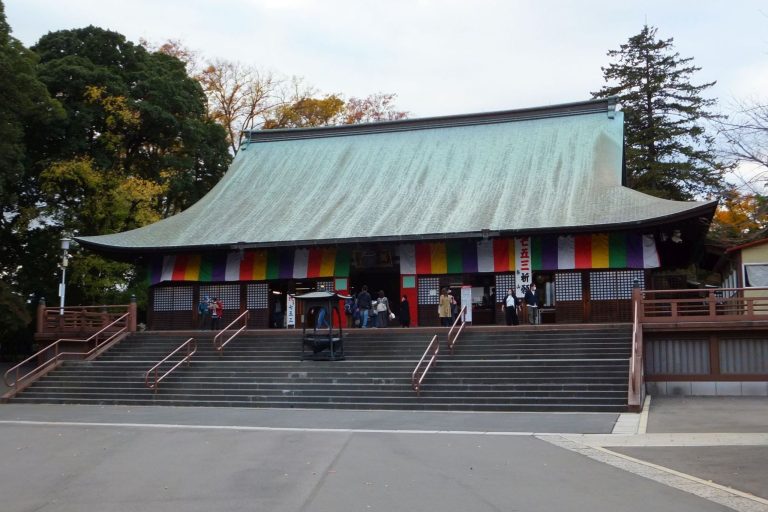
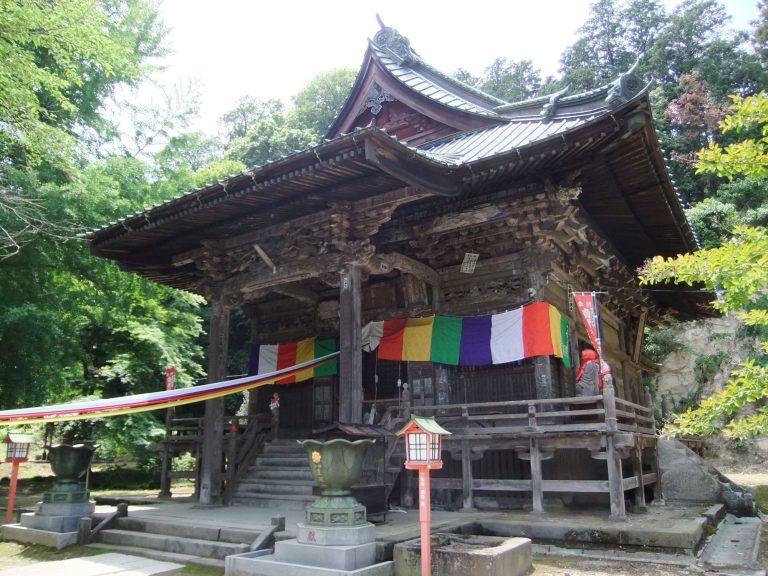
The main hall, completed in 1849 through the donation of Matsudaira Naritsune, has an irimoya roof covered with copper sheets and an attached kohai, or projecting worship porch. Its elaborate Edo-style carvings were made by the sculptors Shimamura Genzo and Iida Ganjiro. The copper roof has a blue-green surface, while the carvings provide the hall with its most detailed decorative treatment.
Yasaka Shrine
The Yasaka Shrine building has a long history of relocation. Tokugawa Iemitsu, the third shogun of the Tokugawa shogunate, originally built it in 1637 as a Toshogu shrine in the Ninomaru of Edo Castle. In 1656 it was transferred to Kawagoe Castle, where it served as the outer shrine of Miyoshino Shrine. After Kawagoe Castle was abolished, the building was moved to the present shrine grounds in 1872. It was formerly associated with the Gozu Tenno tradition, which linked a deity with protection from disease and calamity.
Other shrine buildings and precinct features
The grounds include Kakimoto no Hitomaro Shrine, Inari Shrine, and Gokoku Shrine. Gokoku Shrine enshrines 2,970 war dead from Kawagoe who died after the Seinan War. Its building was rebuilt in 1935, when Yamamoto Isoroku attended the ceremony.
The main torii is a wooden structure approximately 15 meters high. Its name plaque bears calligraphy by Katsu Kaishu, a nineteenth-century statesman and naval official. The dance hall, built in 1704, is used for festival music and other religious or dedicatory performing arts.
A small stream known as the River of Purification runs through the grounds, where paper figures are released during hitogata purification rites. Other precinct features include a rock resembling a dog’s head, a sacred tree, and an ema tunnel installed in 2003. An ema is a wooden votive plaque on which worshippers write prayers or wishes.
Festival installations
The Wind-Chime Corridor forms a seasonal installation throughout the grounds. It contains more than 2,000 Edo-style wind chimes, each accompanied by a paper strip bearing a written wish. The special lanterns distributed during the Love Lanterns event use LED bulbs whose colors can be changed.