Nassau Church: A Protestant Village Church in Germany
Site at a Glance
- Popularity
- Very Low
- Country
- Germany
- Primary era
- Early Modern
- Eras represented
- Early Modern, Modern
- Civilizations
- Electorate of Saxony, Holy Roman Empire, Kingdom of Saxony
- Site type
- Religious
- Remains
- Church
On this page10 sections
History
Nassau Church is a Protestant village church in Nassau, Germany, built around 1526. It serves the Nassau congregation within the Evangelical Lutheran Church of Saxony.
Construction and later changes
The church was remodelled between 1855 and 1858. Restoration took place in 1974, with further work beginning in 1993 and continuing thereafter.
The organ
Gottfried Silbermann, a prominent German organ builder, made the church’s organ in 1748. In the aftermath of the Second Silesian War, fought between Prussia and Austria in 1744–1745 as part of the War of the Austrian Succession, the congregation struggled to raise the funds for the instrument. Repairs are noted from the late nineteenth century onward. In 1929, an employee of the Johannes Jahn organ-building firm inspected and tuned it; the Jehmlich firm has maintained it since 1939. In 1960, experts recommended reducing its wind pressure to 70 millimetres of water column, a measure of the air pressure supplied to the organ. Instability in the wind supply soon led to an increase to 76 millimetres, and a pedal coupler was added. The organ was restored according to heritage-conservation principles in 1998.
A bell from Kleinpösna
On 21 February 1921, the congregation acquired one of its bells from Marienkirche Kleinpösna.
Remains
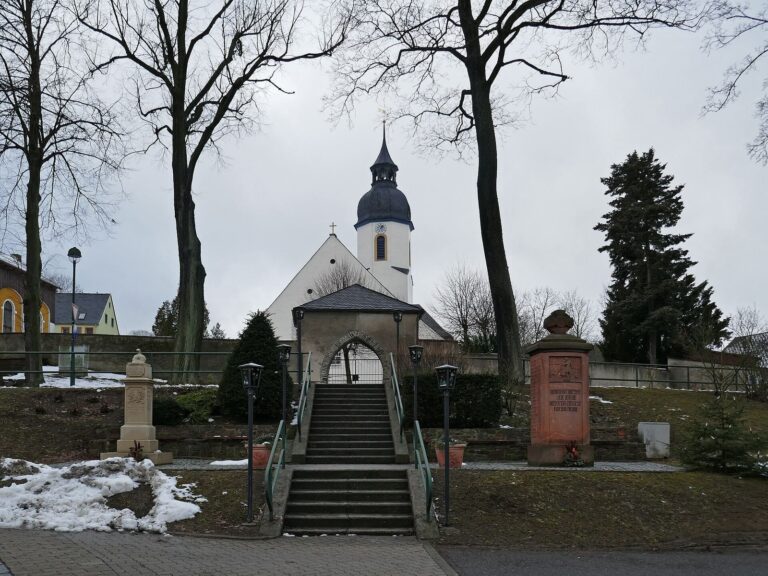
The surviving group includes the church, its associated parsonage, and nearby outbuildings. The church is arranged as a hall with a recessed choir and a porch on its west side.
Church exterior
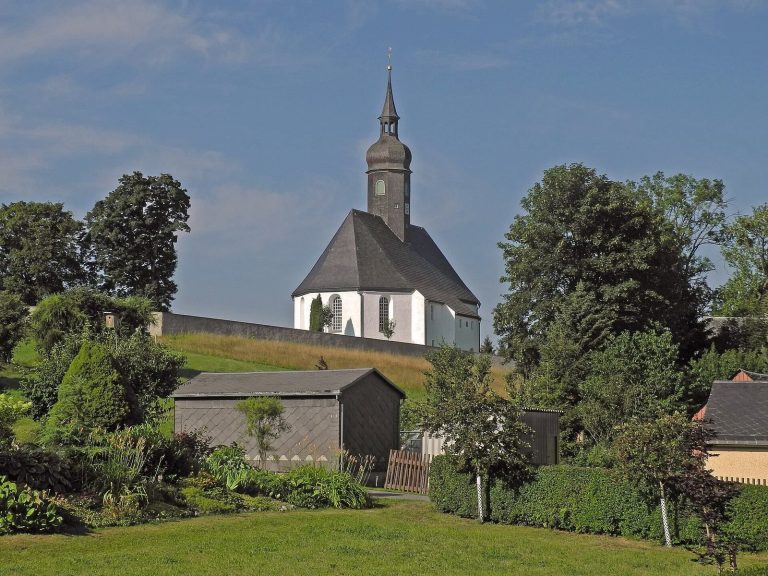
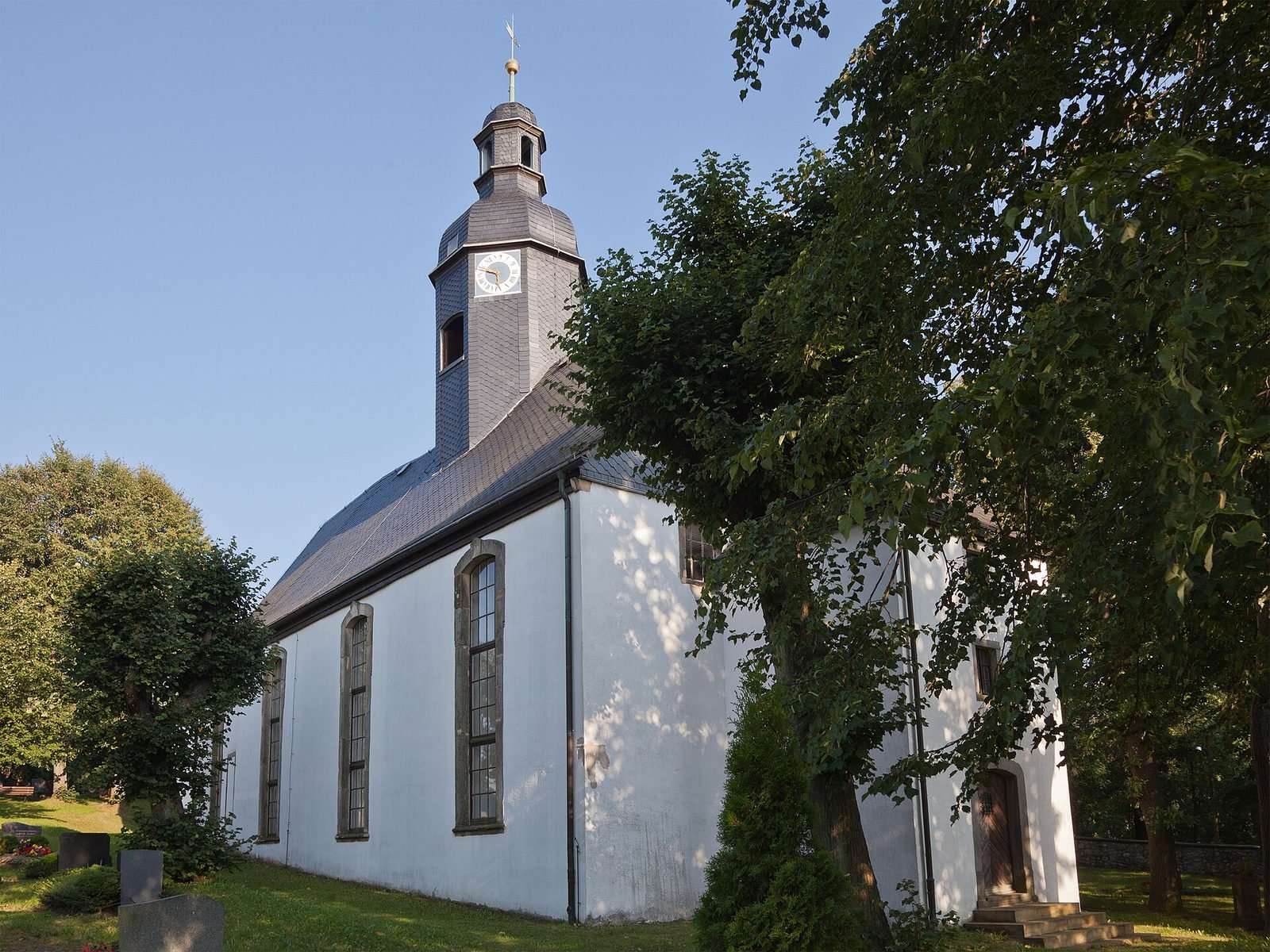
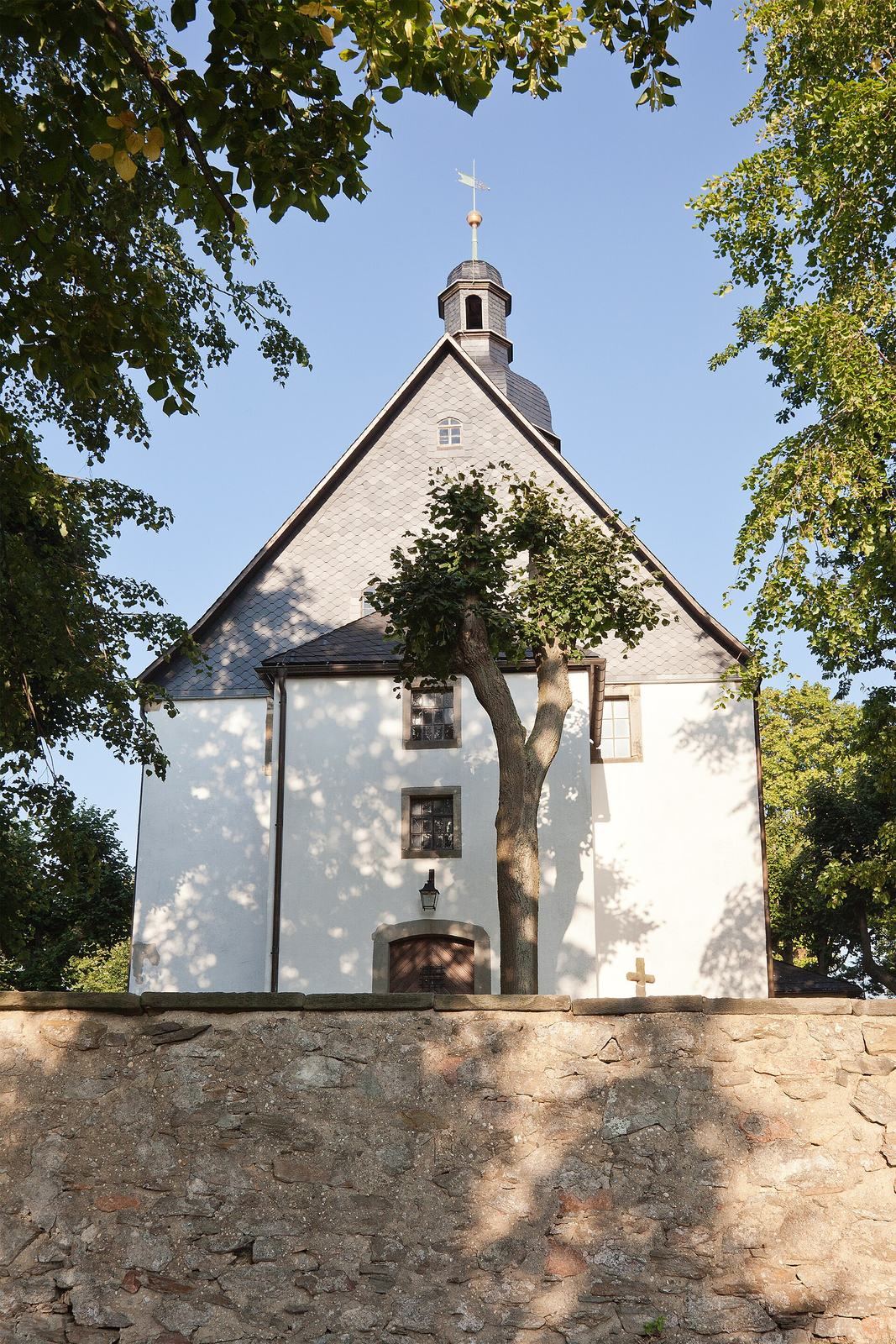
The church is built of rubble stone covered with plaster. Its recessed choir ends in three sides and has buttresses, while the windows have broad, shallow arches. A slate-covered hipped roof carries a roof turret topped by a curved, domed cap. The three-storey west porch has a simple broad-arched portal and an exterior staircase.
Interior and furnishings
A flat ceiling spans the interior, with two levels of galleries running around it; several enclosed box pews stand in the choir. The pulpit altar was assembled from pieces in 1857. Its pulpit platform includes a basket dating to 1683, decorated with small twisted columns, and two short cast-iron grilles stand before the altar. Other furnishings include a chalice-shaped sandstone font from 1816, a wooden baptismal angel from 1729, and a white-painted wooden lectern made in 1750.
Organ
The organ stands on the west gallery and remains largely in its original state. Its well-proportioned case contains 19 stops, which control sets of pipes, two manuals, or hand-played keyboards, and a pedal keyboard played with the feet. Its fittings include a coupler linking the second manual to the first, as well as a bell. Since 1998, the instrument has used a reconstruction of Silbermann’s well-tempered tuning system, which adjusts intervals between pitches. Its present pitch is a1 = 469 Hz, and its wind pressure is about 85 millimetres of water column.
Bells
The church’s three bells are made of bronze and hang in an oak frame.
Parsonage and outbuildings
The associated parsonage bears the date 1796. It has two storeys, with partial slate cladding and a half-timbered upper floor, and retains several vaults formed by the intersection of barrel-shaped ceilings. Its associated single-storey outbuildings also date to the late eighteenth century.