Kirche Machern: St. Nikolai Church in Germany


Site at a Glance
- Rating
- 4.6
- Popularity
- Very Low
- Country
- Germany
- Primary era
- Medieval
- Eras represented
- Medieval, Early Modern, Modern
- Civilizations
- Electorate of Saxony, German, Holy Roman Empire
- Site type
- Religious
- Remains
- Church
On this page16 sections
History
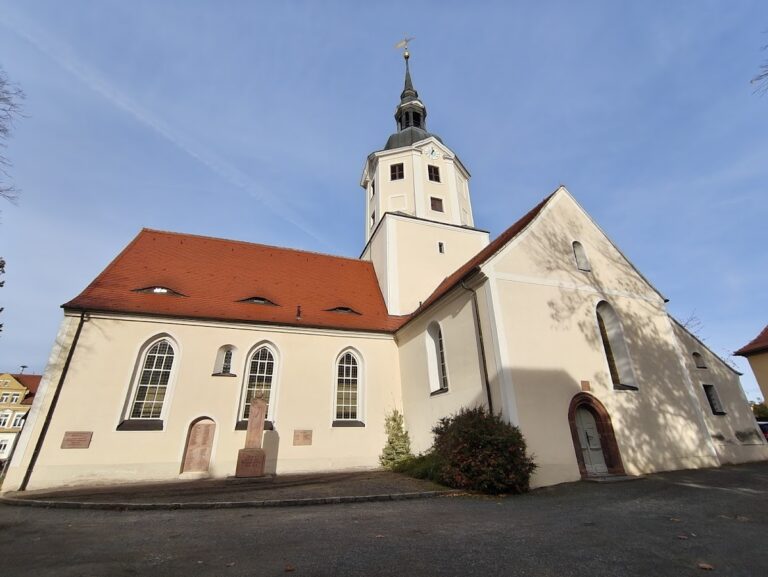
Kirche Machern, also known as St. Nikolai, is a historic church in Machern, Germany, whose late Gothic choir dates from around 1430 and whose Baroque tower was completed in 1753. Dedicated to Saint Nicholas of Myra, a fourth-century Christian bishop traditionally associated with charity and aid to the poor, it stands at the center of the settlement and remains the only sacred building in Machern.
Medieval parish and the Reformation
Machern was first mentioned in 1121, and its early ecclesiastical ties probably extended to the Diocese of Merseburg, a historic Roman Catholic diocese in central Germany. In 1268, Machern and Brandis were separated in church law, making Machern an independent parish.
The church became closely connected with the Reformation, the sixteenth-century movement that transformed Western Christianity and established Protestant church structures in the region. In 1492, Friedrich von Lindenau donated two bells. His son, Albrecht II von Lindenau, supported the Reformation, and Albrecht’s son Heinrich brought the monk Conrad Kluge from Wittenberg. Kluge became Machern’s first Protestant pastor in 1521, eighteen years before the Reformation was officially introduced in the Duchy of Saxony.
Heinrich von Lindenau married Gertrud von Schellenberg at Machern in 1524. Like Martin Luther’s wife, Katharina von Bora, Gertrud had been a nun at Nimbschen Convent before fleeing. The wedding sermon was preached by Georg Spalatin, a humanist, theologian, and electoral court preacher closely associated with Luther and the Reformation.
Baroque rebuilding and nineteenth-century changes
The church was renovated during the mid-eighteenth century, when its tower was newly built in the Baroque style. The 34-meter tower was completed on 3 July 1753. Karl Heinrich August von Lindenau donated a new organ in 1786.
A major renovation followed in 1824. The municipality paid for the exterior work, while the merchant family Gottfried Schnetger financed repairs to the altar, pulpit, and floor. The Schnetgers had succeeded the Counts of Lindenau as patrons of the church and owners of Machern Castle and estate.
In 1875, the workshop of Conrad Geißler installed the organ that remains playable today. The installation required the nave, the main longitudinal body of the church, to be raised and lengthened. During the interior renovation of 1896, the Schnetger family donated three large cathedral-glass windows, followed by a weather vane in 1906. The weather vane was replaced in 1998. The Baroque tower was repaired in 1967, and the organ was restored by Benjamin Welde in 1999.
Parish administration and later history
After the division of Saxony in 1815, the Machern parish moved from the Eilenburg ecclesiastical district to the Leipzig ecclesiastical office. It was transferred soon afterward to the Grimma ecclesiastical district and ultimately to the Wurzen superintendency.
Financial hardship led the congregation to sell its late Gothic Marian altar in 1959. The altar was later placed in Christ Church in Leipzig-Eutritzsch. A late Gothic carved altar from Leulitz was installed at Machern as a loan in 1995.
On 1 January 2020, Machern’s Evangelical-Lutheran St. Nikolai congregation entered a sister-church relationship with several neighboring congregations in the Leipzig Land church district. The Evangelical-Lutheran Parish of Parthenaue-Borsdorf became the joint employer and administrative parish for the shared pastoral positions, and Lydia Messerschmidt became pastor of the congregation on 1 April 2020.
The church is a station on the Ecumenical Pilgrimage Route, a German section of the Way of Saint James, the network of Christian pilgrimage routes leading to Santiago de Compostela. Its churchyard contains Machern cemetery, where Gottfried Schnetger and his wife, as well as three later Schnetger lords of Machern Castle and their wives, are buried.
Remains
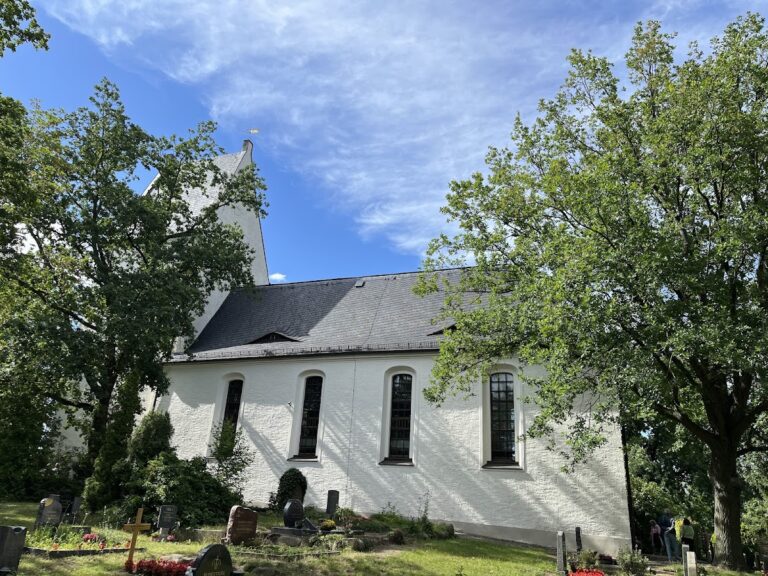
Kirche Machern combines a late Gothic choir and nave with a later Baroque tower. The building is surrounded by a small historic cemetery, and its interior preserves memorials, liturgical furnishings, bells, and a nineteenth-century organ that together reflect successive phases of the church’s history.
Gothic church fabric and Baroque tower
Choir and nave
The late Gothic choir was built around 1430 and has an irregular star vault, a Gothic ceiling whose ribs form a star-like pattern. The nave dates from around 1490 and was lengthened in 1615, when the sacristy, the room used to store liturgical objects and prepare for worship, was added.
Baroque tower
The tower is a 34-meter-high Baroque structure completed in 1753. It was repaired in 1967 and forms the church’s principal later addition to the medieval building.
Altars and choir furnishings
High altar and colored-glass window
The choir contains an altar stone, the stone slab associated with the altar, together with a high altar, the church’s principal altar. Behind it is a colored-glass window donated by Wilhelm Eduard Heinrich Schnetger and his wife. Made using mosaic glass, which assembles colored pieces into an image, it depicts Jesus Christ with a chalice and host. A scroll at his feet bears the inscription “Through me to the Father.”
Late Gothic carved altar
The late Gothic carved altar from the Laurentius Church in Leulitz was conserved at the Dresden art academy in 1978 and installed at Machern as a loan in 1995. Its predella, the lower section of an altar beneath its principal images, shows Jesus with his disciples in the Garden of Gethsemane on the evening before the Crucifixion. The other scene depicts Pope Gregory the Great receiving a vision of the risen Christ during a Eucharistic celebration.
Each side wing contains four saints. The left wing shows Maternus, Catherine, Barbara, and Sebastian, while the right wing shows John the Baptist, Saint Anne with Mary and Jesus, John the Evangelist, and James in pilgrim dress with a staff and scallop-shell hat. The central shrine depicts Saint Lawrence with a palm branch, the crowned Virgin Mary holding the Christ Child between two angels, and Saint Andrew. On the reverse of the left wing is the Archangel Gabriel’s Annunciation to Mary, while the reverse of the right wing shows the Adoration of the Magi.
Former Marian altar
The late Gothic Marian altar removed from Machern in 1959 is now located in Christ Church in Leipzig-Eutritzsch.
Memorials and organ
Family and pastoral memorials
Sixteenth-century epitaphs of the von Lindenau family stand on the right side of the interior. An epitaph is a funerary monument or memorial, often carrying an inscription and an image of the deceased. Memorials to two Machern pastors stand on the left. Behind the pulpit, on the left side of the choir, are three von Lindenau memorials: two stone epitaphs, including one with a praying knight and another with elaborate sculpture and an extensive inscription, and a painted epitaph from 1770 showing Count Heinrich Gottlieb von Lindenau. The portrait was painted by Anton Graff, an eighteenth-century portrait painter born in Switzerland who worked chiefly in Saxony. The church also contains an epitaph for Pastor Gottfried Klauser, who died in 1713, as well as a baptismal font.
Organ
The organ installed by Conrad Geißler’s workshop in 1875 has 15 stops, two manuals, and a pedal. Stops control sets of pipes, manuals are keyboards played by the hands, and the pedal is played with the feet. Its couplers connect Manual II to Manual I and Manual I to the pedal.
Bells
The present bell ensemble includes two bronze bells from 1492, whose founders are unknown. One has the tone f’ -2, a lower diameter of 1,106 millimeters, and an approximate weight of 850 kilograms. The other has the tone b’ -1, a lower diameter of 860 millimeters, and an approximate weight of 350 kilograms. A smaller bell cracked and was recast and slightly enlarged in 1865 at the expense of Wilhelm Schnetger. Machern’s inhabitants called it the Agnes Bell after the church patron’s wife.