King John’s Castle: Anglo-Norman Fortress in Limerick, Ireland


Site at a Glance
- Rating
- 4.4
- Popularity
- Medium
- Country
- Ireland
- Primary era
- Medieval
- Eras represented
- Medieval, Early Modern, Modern
- Civilizations
- British, English, Norman, Norse
- Site type
- Military
- Remains
- Castle
On this page12 sections
History
King John’s Castle is a thirteenth-century Anglo-Norman fortress in Limerick, Ireland, built around 1200 and completed around 1210 on King’s Island in the River Shannon. The Anglo-Normans were military and political settlers from England and Normandy who expanded English rule in Ireland from the late twelfth century. The castle stood in Limerick’s medieval English Town and protected the city from Gaelic kingdoms to the west and rebellious Norman lords to the east and south.
From Viking stronghold to Anglo-Norman city
The site had been occupied by a Viking stronghold established in 922. It served as a base for raids along the Shannon between Lough Derg and Lough Ree, including attacks on ecclesiastical settlements. Limerick’s Vikings were defeated by the Vikings of Dublin on Lough Ree in 937. In 943, forces associated with the Dalcassian clan and Ceallachán, king of Munster, defeated them again, after which their political power declined.
Domnall Mor Ua Briain burned the settlement in 1174 to prevent its capture by the Anglo-Normans. They took control of the area in 1195, when John was Lord of Ireland. Limerick received its first charter and its first mayor, Adam Sarvant, in 1197. John, who later ruled as King of England from 1199 to 1216, ordered the castle’s construction soon afterwards.
The castle’s position beside the Shannon and near a bridge helped defend the English-controlled city while also protecting cargo moving through Limerick. The town prospered as a port and trading centre under Norman rule. King John authorized a mint in the castle, and coins from this period are preserved in the Limerick city museum.
Seventeenth-century sieges
The castle endured five sieges during the seventeenth century. In 1642, Irish Confederate forces under Garret Barry attacked the English Protestant forces occupying the castle during the Irish Rebellion. The walls suffered severe damage during the assault.
Henry Ireton attacked Limerick in 1650 during the Cromwellian conquest, the campaign led by Oliver Cromwell and his forces to reassert English parliamentary control over Ireland. Heavy rain and freezing conditions forced Ireton to abandon the siege in October. He returned in June 1651 with better equipment and 8,000 men, blockading the city until famine and plague weakened its population. Hugh Dubh O’Neill, the city’s commander, eventually surrendered.
The fourth and fifth sieges came in 1690 and 1691 during the Williamite and Jacobite wars, conflicts between supporters of the Protestant King William III and supporters of the Catholic James II and his heirs. Jacobite French and Irish forces resisted in 1690. In 1691, the premature raising of the drawbridge exposed Irish soldiers on Thomond Bridge. After heavy fighting, the Jacobites surrendered and agreed to a truce that led to the Treaty of Limerick.
Military use and archaeological investigation
A military barracks was built inside the castle in 1791. More than 400 British Army personnel lived there until 1922, and the towers were adapted for modern weapons. In 1935, twenty-two houses were constructed in the courtyard for a medieval-tavern-style restaurant and craft shops. These buildings were demolished in 1989.
Archaeological excavations in 1990 examined the former curtain walls and revealed defensive remains, a pre-Norman settlement, and mines and countermines associated with the 1642 siege. A mine was a tunnel dug beneath a fortification to weaken it, while a countermine was a defensive tunnel intended to detect or obstruct such an attack. Major redevelopment between 2011 and 2013 added a modern visitor building, expanded the museum facilities, and introduced interactive exhibitions with computer-generated animations. King John’s Castle is a protected National Monument of Ireland and functions as a historic site and military museum.
Remains
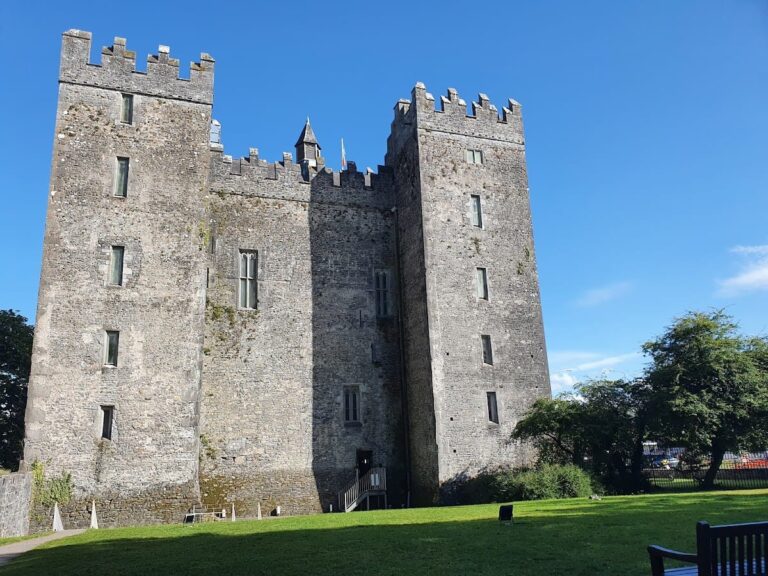
The surviving castle is a thirteenth-century example of fortified Anglo-Norman architecture. A five-sided defensive perimeter encloses a rectangular courtyard. Large round towers strengthen the entrance and the connecting curtain walls, while the high outer wall, formerly taller than it is today, was designed to hinder medieval siege engines.
Defensive perimeter
Curtain walls and round towers
The lower sections of the walls curve outward, a defensive feature that helped deflect projectiles launched from the battlements. The corner towers project beyond the walls, allowing archers to fire across intersecting lines of sight. The castle was originally believed to have been surrounded by a moat. The walls were partly destroyed during the 1642 siege and were subsequently almost entirely restored.
Entrance and barbican
The entrance was positioned between two towers and connected by a drawbridge to a barbican. A drawbridge was a movable bridge that could be raised to block access, while a barbican was an outer defensive structure protecting an entrance. These elements formed the approach to the fortified enclosure.
Courtyard buildings and archaeological remains
Hall and internal buildings
The courtyard formerly held a thirteenth-century hall, kitchens, military tents, and stables. The internal buildings were destroyed, but remains of the thirteenth-century hall remain visible within the castle complex.
Mint and excavated features
One of the corner towers housed a mint. Excavations also uncovered defensive architectural features, the remains of a pre-Norman settlement, and siege mines and countermines connected with the 1642 assault.
Modern archaeological presentation
The modern visitor building stands above the archaeological excavation areas. Its exhibitions present the history of the castle and the city of Limerick, incorporating the evidence recovered from the site into the interpretation of the fortress and its earlier occupation.