Kindrochit Castle: A Medieval Royal Fortification in Scotland


Site at a Glance
- Rating
- 4.4
- Popularity
- Very Low
- Country
- United Kingdom
- Primary era
- Medieval
- Eras represented
- Medieval
- Civilizations
- Kingdom of Scotland
- Site type
- Military
- Remains
- Castle
On this page7 sections
History
Kindrochit Castle is a ruined medieval Scottish fortification in Braemar, United Kingdom. Its earliest phase dates to the eleventh century, while the surviving tower belongs to a later fourteenth-century rebuilding. The site controlled the only easy crossing of the Clunie Water for several days’ travel in either direction, giving it a strategic role in the local landscape.
Early royal site
Tradition attributes the original castle to Malcolm III, also known as Malcolm Canmore, a medieval king of Scotland who reigned from 1058 to 1093, and places its construction between 1057 and 1093. The earliest phase is dated archaeologically to the eleventh century. A stone bridge was built across the Clunie Water at the same time, strengthening the importance of the crossing.
Kindrochit later served as a hunting seat, a residence used by a ruler during organized hunting expeditions. Robert II, the first Scottish king of the Stewart dynasty, visited the castle and issued royal charters there in most years between 1371 and 1388.
The Drummond tower
On 10 November 1390, Robert III, Robert II’s son and successor, granted Kindrochit to his brother-in-law Malcolm Drummond. The grant included permission to build a new tower on the site. Drummond intended the building to become the fifth-largest tower in Scotland, but unknown assailants murdered him before construction was complete.
Ruin and investigation
By 1618, Kindrochit was already ruined. During his journey through Scotland, the poet John Taylor was shown the castle by John Erskine, Earl of Mar. Taylor was told that Malcolm Canmore had built it as a hunting lodge in 1059, a tradition distinct from the later archaeological dating of the earliest phase. Taylor regarded the ruin as remarkable because he saw no other house during the following twelve days of travel.
The earlier royal lodge was excavated in the 1920s, with archaeological work specifically recorded in 1925. Restoration followed in 2013 and 2014. Kindrochit Castle became a scheduled monument on 31 January 1967. This legal designation protects archaeological and historic sites considered nationally important.
C. Michael Hogan suggested that Kindrochit, together with Kildrummy and Durris Castles, occupied strategic positions in relation to the ancient Elsick Mounth trackway across the Grampian Mountains. This remains a suggestion rather than an established interpretation.
Remains
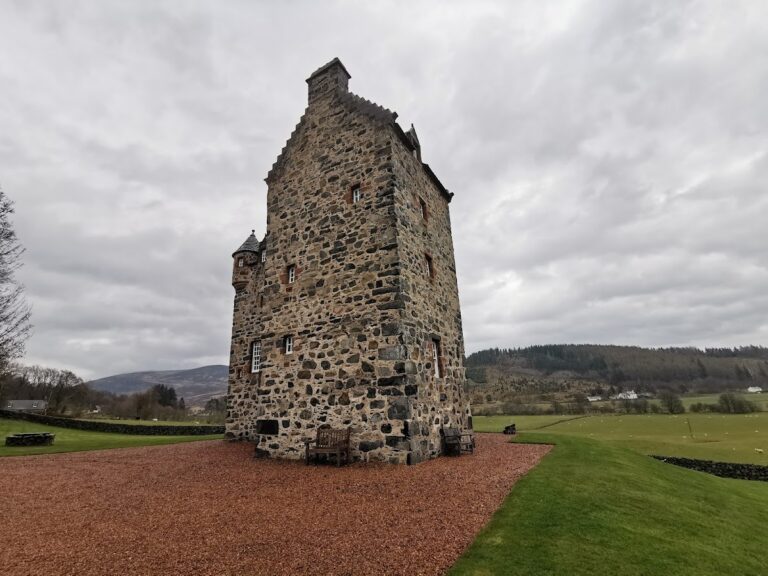
The ruins stand on the right bank of the Clunie Water, a tributary of the River Dee, within the village of Braemar. The castle occupied the crossing beside the watercourse. Its remains represent two principal building phases, an earlier residential complex and a later tower, while the associated stone bridge formed part of the early arrangement.
Eleventh-century residential complex
The earliest known complex included a residential hall approximately 30 metres long and 9 to 10 metres wide. It was partly basemented and had small square towers at its corners. A stone bridge crossed the Clunie Water in association with this early construction.
Fourteenth-century tower
The tower begun in 1390 was approximately 21 by 14 metres, with walls about 3 metres thick. The present ruin preserves its ground floor, which measures approximately 19.3 by 13 metres. The surviving masonry therefore represents only part of the planned residential tower, whose construction was left incomplete after Malcolm Drummond’s murder.