Volotovo Church: A Medieval Novgorodian Assumption Church in Russia


Site at a Glance
- Rating
- 4.9
- Popularity
- Very Low
- Country
- Russia
- Primary era
- Medieval
- External website
- Open
- Eras represented
- Medieval
- Civilizations
- Novgorod Republic
- Site type
- Religious
- Remains
- Church
On this page11 sections
History
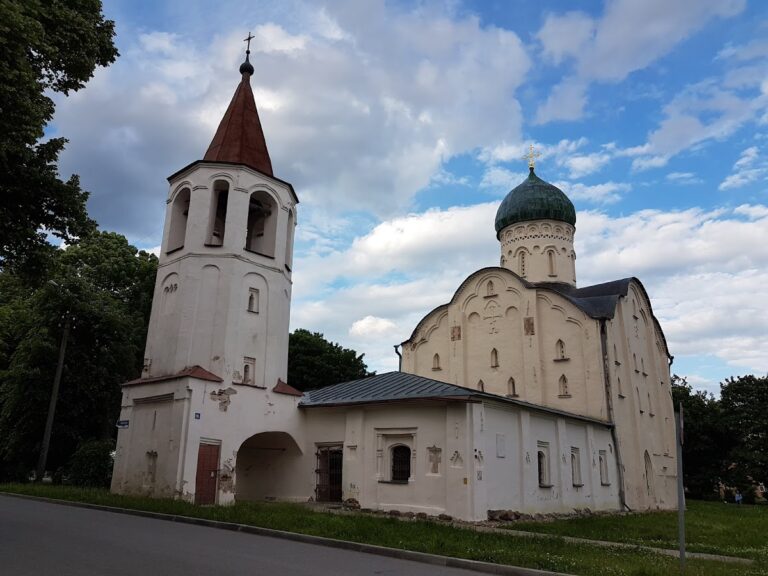
Volotovo Church is a medieval Novgorodian church dedicated to the Assumption of Mary in Russia, near Veliky Novgorod. Built in 1352 on the initiative of Moisey, Archbishop of Novgorod, it stands on the elevated bank of the Maly Volkhovets and is an early example of Novgorod stone architecture.
Foundation and fresco painting
The church was painted during the tenure of Alexey, another archbishop of Novgorod. A chronicle records that part of the building was frescoed in 1363, while the rest of the interior may have been completed later, around 1380. The paintings became an important subject in twentieth-century art-historical study, including the work of Mikhail Alpatov and other scholars.
The frescoes were once attributed to Theophanes the Greek, a prominent late-fourteenth-century Byzantine painter active in Rus. That attribution is no longer generally accepted. Stylistic analysis points instead to at least three artists, or to one principal master assisted by pupils, while the leading painter remains unidentified. The paintings are distinctly Novgorodian in artistic language, though their principal artist knew the work of Theophanes.
Fire, alteration, and wartime destruction
A fire damaged the church and its associated monastic establishment in 1386, but the frescoes were little affected. The building was repaired in 1630 and 1700. Swedish soldiers looted it during the early seventeenth century without causing major damage to its walls or paintings. During that century, a new bell tower was added on the north side, and the original roof was replaced with a hipped roof. The roof was renewed in 1740 and 1839; a helmet-shaped dome installed in 1740 was later replaced by a Baroque dome. Lightning damaged part of the building during a thunderstorm in 1825.
During the Second World War, the church stood on the front line for 29 months before German artillery completely destroyed it. About 350 square metres of fresco painting were lost or reduced to fragments. After the war, the ruins were stabilized in 1955, and roughly 1.7 million fragments were collected and conserved. Extensive pre-war black-and-white photographs and colored copies supplied essential evidence for reconstructing the paintings.
Reconstruction and present status
Restorers began rebuilding the fresco ensemble from surviving fragments in 1993. A joint German-Russian project reconstructed the church between 2001 and 2003, and the rebuilt building was inaugurated on 28 August 2003. The restoration and reinstallation of the paintings continued afterward. In 2004, restoration architect Ninel Kuzmina and conservator Leonid Krasnorechyev received the State Prize of the Russian Federation for their work.
The Assumption Church was added to the UNESCO World Heritage List on 14 December 1992 and is a federally significant cultural-heritage monument of Russia. It is no longer an active church and functions as a museum exhibit administered by the Museum of the Artistic Culture of the Novgorod Land.
Remains
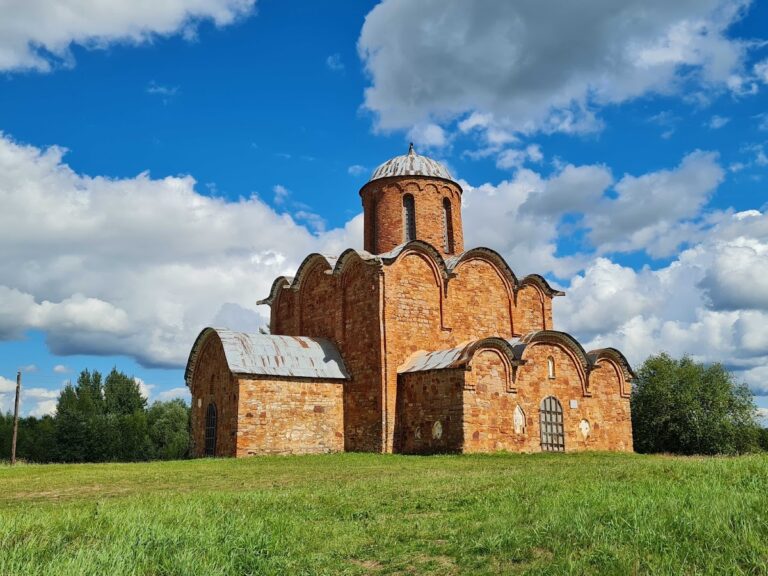
Volotovo Church follows a cross-domed plan, organized around a central dome supported by structural arms forming a cross-shaped interior scheme. Its harmonious proportions, elegant dome, and three-lobed upper façade contours reflect the Novgorodian architectural tradition. The façades have relatively few windows and lack the pilasters customary in contemporary Novgorodian churches. The asymmetrical relationship between the entrance vestibule and the side chapel is a distinctive feature of the composition.
Church structure
The church was built on a raised riverbank beside the Maly Volkhovets. It was originally left unplastered, as was common among many Novgorodian churches. During the reconstruction of 2001 to 2003, the exterior was plastered and whitewashed, while the modern roofs were covered with sheet metal. The reconstructed structure preserves the building’s cross-domed arrangement and the relationship between its main body, vestibule, and side chapel.
Fresco ensemble
Fresco program
The interior was covered with an extensive fourteenth-century fresco ensemble. The dome and its drum contained Christ Pantocrator, a representation of Christ as universal ruler, together with archangels and prophets. The apse, the usually semicircular eastern end of the church, contained the Virgin Mary and the Apostles. The elongated figures have forceful movement, dynamic poses, natural attitudes, and faces treated as though observed from life. Details drawn from everyday experience appear among the religious scenes. Inscriptions use Old Russian and Ancient Greek.
Reconstructed compositions
Surviving and partially reconstructed scenes include the martyr Procopius with ornamental decoration, two unidentified female martyrs, and a liturgical ornamental towel. Other restored compositions include Jacob’s Dream, medallions of the martyrs Nikita and Joasaph, the Archangel Michael, and the Prophet Zechariah. Portions of former compositions were reassembled from the approximately 1.7 million fragments recovered from the wartime debris and placed in the reconstructed church. More than one hundred fragments were still undergoing restoration in 2007.
Reinstallation of paintings
The first restored frescoes returned to their original locations in 2008, including the image of Procopius, the composition with the two female martyrs, and fragments of the ornamental towel. In 2009, Jacob’s Dream and the medallions of Nikita and Joasaph were returned. In 2010, the frescoes of the Archangel Michael and the Prophet Zechariah, covering about four square metres, were restored and reinstalled.
Drawings and graffiti
A drawing discovered in 2002 on an unburned brick from 1352 depicts a sailing boat with an animal-headed prow carrying three mail-clad warriors. Other graffiti show a beast biting the tip of its own tail, mounted riders, a bow and its string, and a hunting scene in which a wolf attacks a deer or elk. One rider bears an inscription interpreted as “Macedonian,” which led Tatyana Rozhdestvenskaya to propose a connection with the medieval Alexander narrative. Additional inscriptions include a short text whose translation remains uncertain and what Alexey Gippius identified as the first Novgorod example of litoreya, a cryptic form of medieval East Slavic writing, rendering “Lord, have mercy.”