Keston Roman Villa: A Roman Rural Estate in England
Site at a Glance
- Popularity
- Low
- Country
- United Kingdom
- Primary era
- Classical
- Eras represented
- Iron Age, Classical, Medieval
- Civilizations
- Anglo-Saxon, Roman
- Site type
- Domestic
- Remains
- Villa
On this page15 sections
History
Keston Roman villa is the remains of a Roman rural estate in Leaves Green, Keston, United Kingdom. Its first villa-like buildings were erected around AD 160. Excavations have traced the development from an Iron Age settlement to a Roman villa and examined the wider complex, including work buildings and a cemetery.
Before the villa
The earliest settlement remains date to around 2000 BC and may belong to either the Neolithic or Bronze Age. Some flint tools could be older, dating to the Mesolithic. A later settlement belongs to the Middle Iron Age, around 600 to 200 BC. The Iron Age was the period before Roman rule in Britain.
Settlement continued in the Late Iron Age, around 50 BC to AD 50. Occupation carried on under Roman rule from about AD 50 to 160, without a major break. Pottery was being made at the site by the middle of the first century AD.
Roman villa and later use
The first buildings considered villa-like appeared around AD 160. The western building was probably the main residence and was destroyed by fire around this time. Around AD 200 it was replaced in stone and later enlarged. In the fourth century, the southern building was also rebuilt in stone, while the northern timber building was abandoned and a simple hut took its place.
The villa was probably abandoned late in the fourth century, although the main building remained in use until about AD 400. An early Saxon village in the area, dated to around AD 450 to 550, points to later occupation nearby but does not establish that settlement continued at the villa itself. The early Saxon period was an early medieval phase of post-Roman Britain associated with Anglo-Saxon communities.
Excavation and protection
Farmers discovered a sarcophagus, a stone coffin for a burial, around 1783. The remains were described in 1815, and the mausoleum drew further interest. Formal excavations in 1828 uncovered the round mausoleum and another sarcophagus. A further investigation examined the same structures that year, with a detailed account published in 1829. The main villa was excavated in 1854, followed by smaller investigations. Work in 1961 was not published. The West Kent Border Archaeology Group excavated and recorded the complex in 1967 and from 1968 to 1990, publishing its findings in two volumes in 1991 and 1999.
The excavations shed light on the change from an Iron Age settlement to a Roman villa and on features beyond the principal residence, including work buildings and a cemetery. The site is a scheduled monument, a legal designation for an archaeologically or historically important site in England, under the name “Iron Age settlement and Roman villa at Warbank, Keston.”
Remains
The remains include settlement traces and a villa complex arranged around a large courtyard. Buildings stood on its west, north and south sides, and the complex combined timber and stone structures. A small cemetery lay north of the villa.
Early settlement
Three pits containing pottery belong to the Middle Iron Age. Later Iron Age remains include many pits and holes left by posts. Around ten groups of these postholes have been interpreted as small rectangular buildings, possibly raised grain stores or storage huts. A ditch enclosed part of the settlement. During the Roman-period occupation, around AD 50 to 160, two enclosures and deep pits containing several animal skeletons were present. The pits may have had a religious purpose.
Villa courtyard complex
First timber buildings
Three timber buildings stood around the courtyard in the first villa phase. The western building measured about 17 metres by 6.5 metres and was probably the principal residence. Fragments of wall paintings, some damaged by fire, show that at least some rooms were decorated. Buildings to the north and south probably served agricultural or other economic purposes. A small flint building in the courtyard’s centre had an uncertain function.
Stone residence
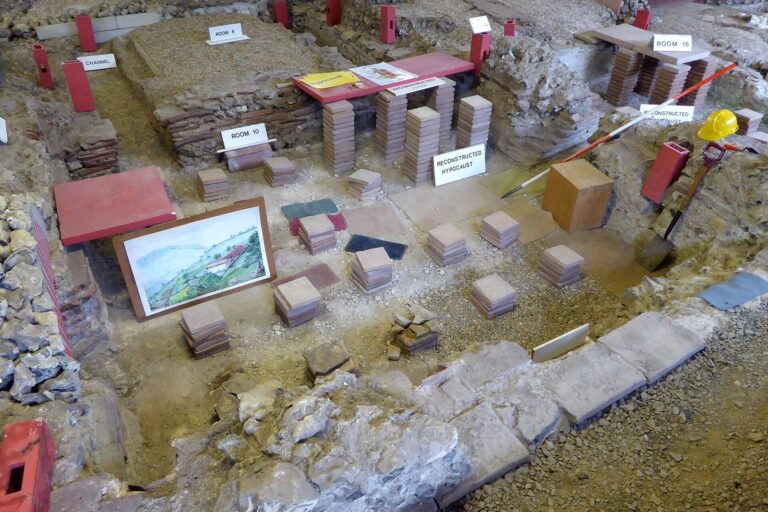
The western residence was rebuilt in stone around AD 200 and subsequently enlarged. It had a covered, columned frontage and projecting sections at its corners. Three large rooms occupied the centre, with a small bath to the south. Wall paintings and floors made from small pieces set into a surface were found in the building. At least one room had a hypocaust, an underfloor heating system. Two large, roughly square pits inside the house probably served as cellars. The building is poorly preserved.
Courtyard and work buildings
Timber buildings on the north and south sides of the courtyard probably had commercial uses. The northern building contained two grain-drying ovens. Iron fittings from a wooden water pipe were found in the courtyard; the water probably came from a nearby spring. Two water basins stood in the courtyard’s centre.
Fourth-century buildings
The fourth-century stone building on the south side had wall paintings and was probably a residence. Traces of metalworking were found there. On the north side, the timber building was replaced by a simple hut.
Cemetery and tombs
Round mausoleum
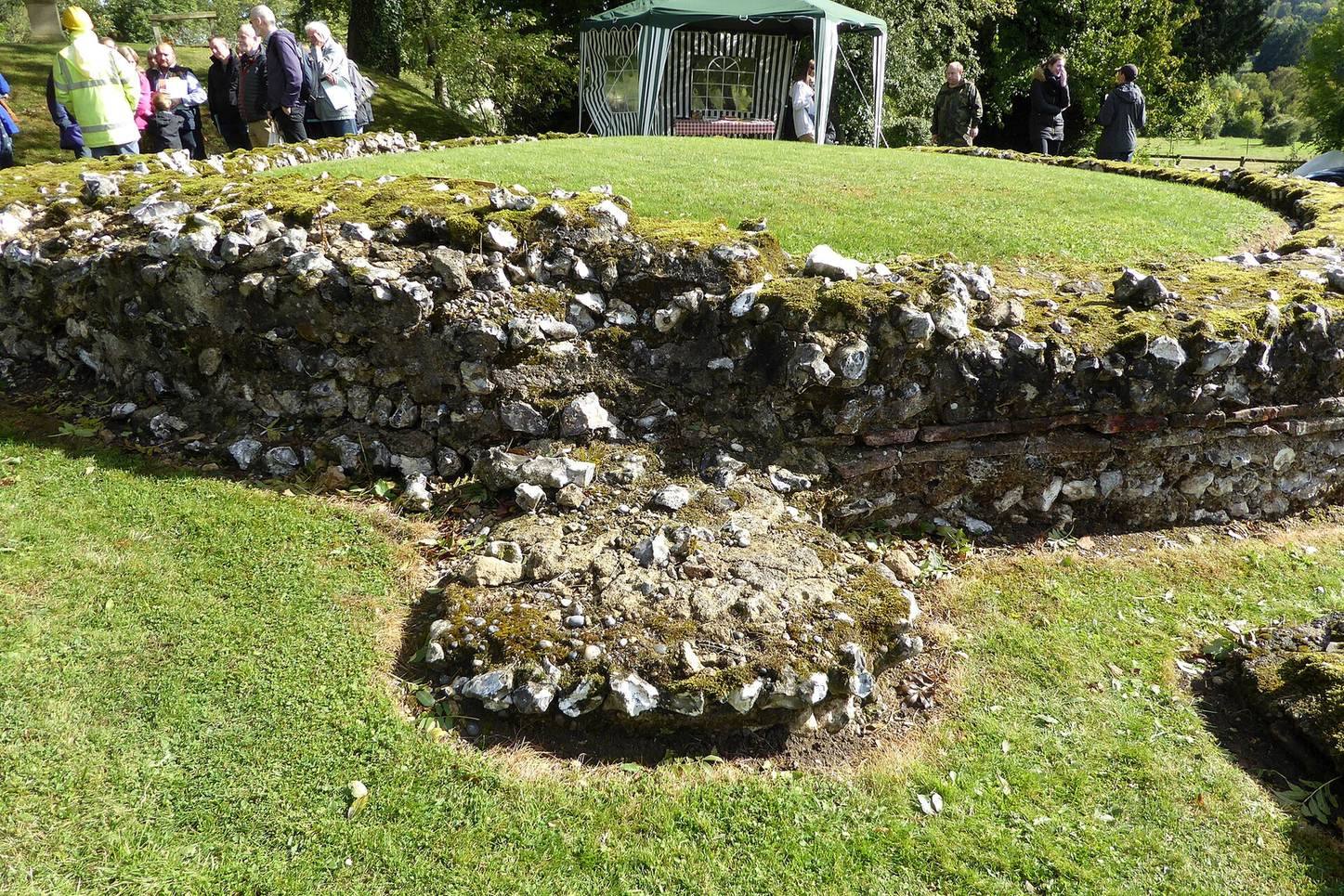
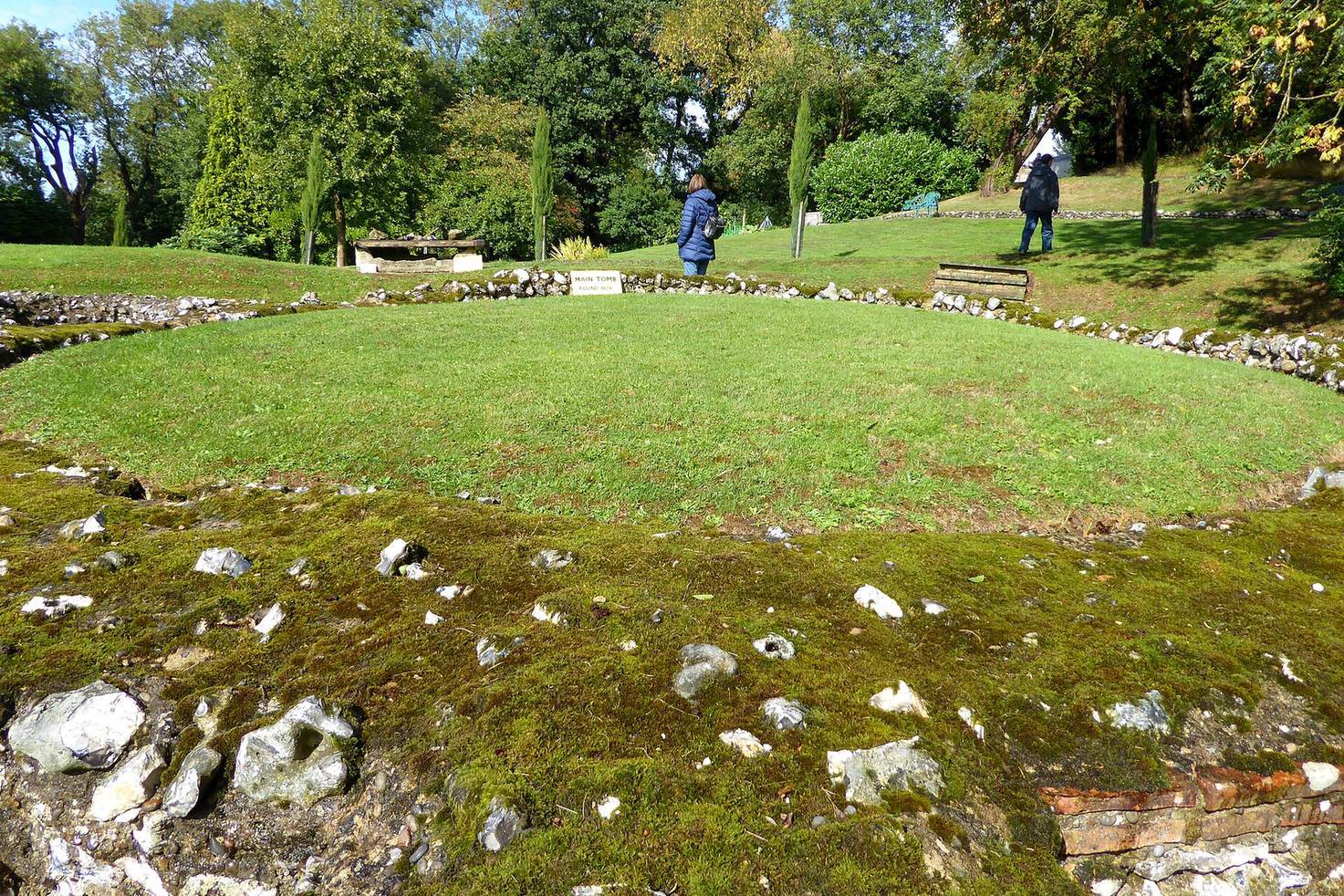
The cemetery’s central structure was a round mausoleum, or monumental tomb, just under 8 metres in diameter. It had projecting supports on the exterior, which was once coated in red plaster. The interior may have been filled with sand to support urns. The building was initially interpreted as a temple.
Other tombs and burials
A smaller rectangular mausoleum beside the round one contained a robbed burial. A third, semicircular tomb was attached directly to the round mausoleum. Its underground burial chamber held a lead urn containing the remains of an adult, a pig and possibly a bird. Three sarcophagi were found in the cemetery over the centuries, including one decorated on its exterior. Other burials lay around the mausoleums, which survive at foundation level in a private park.
Finds and later hut
About 400 fragments of fine Roman tableware came from the site. They fall into two groups, one dating to the second half of the first century and the other mainly to the middle of the second century AD. About 50 potter’s wheels provide evidence for pottery production in the mid-first century AD. Other finds include iron tools and keys, brooches and a bone die. A simple early Saxon hut was also excavated at the site.