Kasbah of Béja: A Historic Citadel in Tunisia


Site at a Glance
- Rating
- 4.3
- Popularity
- Very Low
- Country
- Tunisia
- Primary era
- Classical
- Eras represented
- Classical, Medieval, Early Modern
- Civilizations
- Aghlabid, Byzantine, Carthaginian, Hafsid, Ottoman, Roman
- Site type
- Military
- Remains
- Citadel
On this page10 sections
History
The Kasbah of Béja is a historical citadel in Béja, Tunisia, whose first fortification was built by the Carthaginians in the second century BC. At that time, Béja was known as Vaga and was an important agricultural town. The fortress protected the settlement and the surrounding territory from its position above the old city.
From Carthaginian fortress to Roman stronghold
After Carthage lost control of the region following the Third Punic War, the Numidians expanded their influence. Jugurtha, the Numidian king who later fought Rome, made the fortress his center of rule. Roman forces took control in 109 BC, destroyed the existing fortress, and rebuilt it in 14 BC. The Roman installation included a garrison, enclosing walls, and 22 towers.
The fortress was later completely razed during the Vandal invasion of North Africa. After the Byzantine reconquest, Emperor Justinian I ordered Count Paulos to rebuild it in 533. This reconstruction returned the site to defensive use under Byzantine rule.
Muslim, Hafsid, and Ottoman transformations
Following the Muslim conquest of the Maghreb, the fortress became known as a kasbah, a fortified administrative or residential complex. It served as the official center for local representatives of the northern region, and its expansion continued under Muslim rulers, including the Aghlabids, a ninth-century dynasty based in Ifriqiya, the historical region corresponding broadly to present-day Tunisia and nearby areas.
Béja suffered severe damage when the Kharijite rebel Abu Yazid, a leader associated with an early Islamic movement that led several North African rebellions, sacked the city in 943. The Fatimid caliph al-Mansur bi-Nasr Allah restored the kasbah in 946. During the sixteenth century, the Hafsid ruler Ahmed Aḥmida strengthened the fortress with a fortification equipped with 14 cannons.
The Ottomans expanded the citadel further by adding a southern flanking tower, a structure positioned to defend the side of a fortification and support fire along its walls. They also established facilities for a Janissary garrison. Janissaries were elite infantry of the Ottoman army. In 1677, the Tunisian ruler Ali I Bey reinforced the garrison with a 500-man battalion of Spahis, mounted troops recruited from tribal or provincial forces.
French-period use and later conservation
After the French protectorate over Tunisia was established in 1881, the kasbah became a gendarmerie barracks. It retained this function from 21 September 1888 until Tunisian independence in 1957.
After independence, the fortress was converted into a cultural center. The Tunisian National Heritage Institute, the state institution responsible for archaeological research, heritage protection, and conservation, began restoration work in 2005. The project stopped because of insufficient funding, and the allocated restoration budget of up to 250,000 Tunisian dinars did not result in properly completed work. Part of the kasbah has also been used for commercial purposes without authorization.
Remains
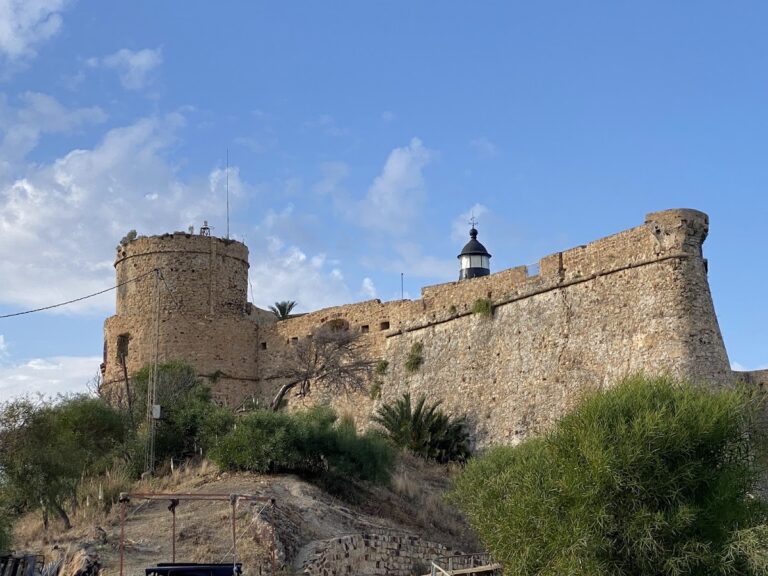
The Kasbah of Béja occupies a steep hill rising to 305 metres above sea level in northern Béja. Its elevated position overlooks the city as well as the adjoining plains and countryside. The surviving citadel is a layered fortified complex shaped by Carthaginian, Roman, Byzantine, Muslim, Hafsid, Ottoman, and later uses.
Fortified complex
Carthaginian and Roman defenses
The original Carthaginian installation was a small fort. Roman rebuilding created a more substantial complex with a garrison, enclosing walls, and 22 towers. These Roman defenses formed the main large-scale expansion of the hilltop stronghold after the earlier fortification was destroyed in 109 BC.
Hafsid artillery defenses
The fortress was strengthened during the sixteenth century under Ahmed Aḥmida through the installation of a fortification equipped with 14 cannons. This artillery provision reflects a later defensive phase within the citadel’s long architectural development.
Ottoman southern tower and garrison facilities
Ottoman additions included a semicircular flanking tower at the southern extremity of the kasbah. It was designed to protect the southern side of the fortress and provide supporting fire along its walls. Facilities associated with the Janissary garrison also formed part of this Ottoman expansion.
Condition and surviving use
The kasbah still survives, but its condition is deteriorated and neglected. Restoration efforts begun in 2005 remain incomplete, leaving the physical complex affected by unfinished conservation work and later unauthorized commercial use.