Old Mosque: An Early Ottoman Mosque and Museum of Religions in Bulgaria


Site at a Glance
- Rating
- 4.5
- Popularity
- Low
- Country
- Bulgaria
- Primary era
- Medieval
- External website
- Open
- Eras represented
- Medieval, Modern
- Civilizations
- Ottoman
- Site type
- Religious
- Remains
- Mosque
On this page7 sections
History
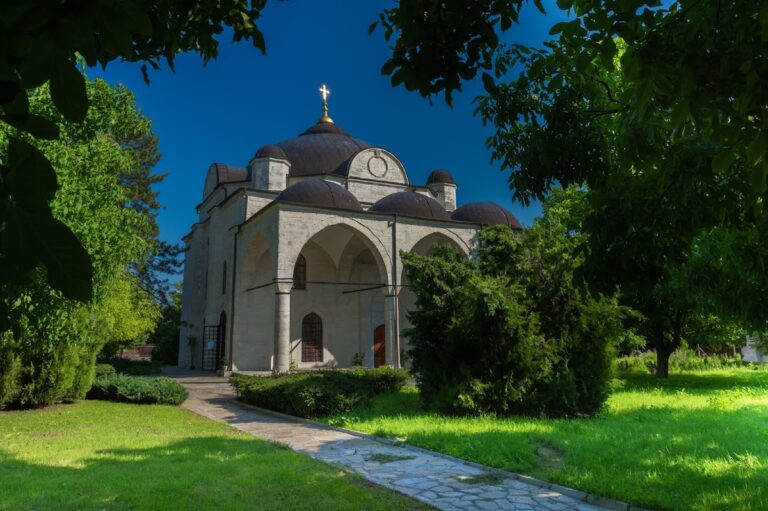
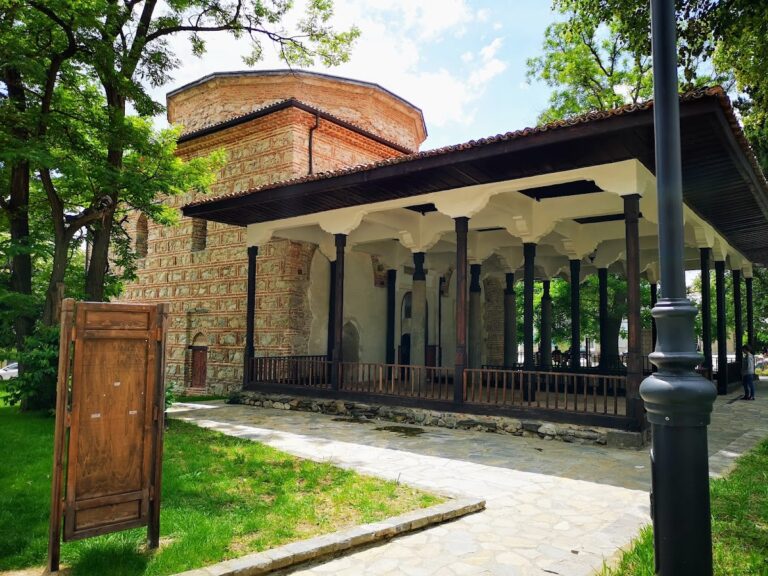
Old Mosque, also known as Hamza Bey Mosque, is a former Sunni Muslim mosque in Stara Zagora, Bulgaria, built in 1409 in the Ottoman architectural tradition on the orders of Emir Hamza Bey. Hamza Bey, an Ottoman title-holder associated with the government of Stara Zagora, commissioned the building during the Ottoman interregnum, the dynastic conflict that followed Sultan Bayezid I’s defeat and capture in 1402 and ended with the consolidation of Ottoman rule in 1413. The mosque is regarded as an important early example of the single-domed Ottoman type.
Earlier sacred use
Archaeological investigations in 2001 and from 2009 to 2011 revealed that the mosque stands above several earlier religious and funerary phases. The location had previously held a Thracian sanctuary and a Roman-period sanctuary dedicated to the Thracian Horseman, a major Thracian deity represented as a divine rider on horseback. During the tenth century, the area formed part of the medieval city’s necropolis and contained a single-nave cemetery church. That church, built between the second half of the tenth century and the beginning of the eleventh, had a single apse and was already in ruins when construction of the mosque began in the early fifteenth century.
Ottoman and modern transformations
The mosque was repaired in 1789 and 1790, then severely damaged by fire in 1856. Its interior wall paintings and the wooden gallery above the entrance were probably added in 1859 and 1860. During the Russo-Turkish War of 1877 to 1878, the Central Ottoman Army burned Stara Zagora. Old Mosque was among the few buildings to survive and is described as the only surviving building from that group still preserved.
After Bulgaria’s liberation in 1878, the building was temporarily used as a church before returning to use as a Muslim house of prayer. Bulgaria’s National Institute for Cultural Monuments later carried out major restoration, completed in 1976. In the mid-1980s, following the forced renaming of Bulgaria’s Turks, the minaret was demolished because it was considered structurally unsafe, and the crescent was removed from the dome.
Further restoration took place from 2008 to 2013 with support from a European Union grant. The building was then converted into the Museum of Religions and no longer functions as a mosque.
Remains
Prayer hall and vestibule
The surviving building is organized around a square prayer hall with a vestibule on its north side. A mihrab, the prayer niche indicating the direction of Mecca, is set within the thickness of the south wall directly opposite the entrance. The prayer hall is covered by a dome 17.47 metres in diameter. It rests solely on the surrounding walls, without intermediate supports, an arrangement described as architecturally unusual for its period. The mosque is considered the second-largest example of a single-domed mosque after the mosque at Mudurnu in northwestern Anatolia, built by Bayezid I in 1388.
The northern vestibule was added later and is covered by three small domes. A small central room lies opposite the entrance to the prayer hall, with a side room on either side. The minaret formerly rose from the northwestern corner of the prayer hall before its demolition in the mid-1980s because of the danger of self-collapse.
Interior decoration and associated bath
The interior walls carry ornamental mural painting in the Baroque style, probably dating from 1859 and 1860, after the fire that damaged the building. A wooden gallery from the same period stands above the entrance door inside the prayer hall. Immediately east of the mosque was a Turkish bath, or hammam, a traditional Ottoman bath complex. Its position corresponded to the arrangement at the mosque in Mudurnu.
Earlier church foundations
Below the prayer hall, the foundations of the medieval Christian church remain beneath the mosque. They belong to a single-nave, single-apse building that formed part of the medieval city necropolis. The preserved foundations provide the physical evidence for the site’s earlier Christian phase and its reuse for Ottoman religious architecture.
Nearby sites