Křikava: A Medieval Spur Castle in Czechia


Site at a Glance
- Rating
- 4.3
- Popularity
- Very Low
- Country
- Czechia
- Primary era
- Medieval
- Eras represented
- Medieval
- Civilizations
- Holy Roman Empire, Kingdom of Bohemia
- Site type
- Military
- Remains
- Castle
On this page7 sections
History
Křikava is a ruined medieval castle in Czechia, founded in the mid-fourteenth century by Hugo von Donnerstein, a court steward of Queen Blanca of Bohemia and a member of a Bavarian knightly family. The castle was established during the later medieval period as the center of a lordship that included several villages and estates.
Foundation and lordship
In 1348, Hugo acquired the village of Myštice from Charles I. Křikava was first mentioned in 1357, when its estate also included Černívsko. Hugo’s sons, Koloman, Huk, Buzek, and Přibyslav, divided the Křikava lordship among themselves in 1367. The family used both the names von Donnerstein and von Krikawa.
Černívsko served as the parish and principal center of the lordship. The lords of Křikava jointly held the patronage of its church with the related minor nobles of Huzenice. In 1399, the castle belonged to Přibek and Jindřich of Křikava.
Destruction during the Hussite Wars
In 1402, the robber Dobešík of Bor captured, devastated, and plundered Křikava. Jindřich Kolman of Křikava, who served as kitchen master to Wenceslas IV, the late-medieval king of Bohemia, did not rebuild the castle after its destruction.
In 1418, Jindřich sold Křikava, Myštice, two peasant farmsteads in Černívsko, the Velká meadow near Zaroždice, and a mill to Peter Zmrzlík of Schweißing at Worlik, together with his other estates in the Prachin District. He withdrew to Obořiště to escape the Hussites. In 1425, insurgents led by Peter and John Zmrzlík of Schweißing captured the fortress there and killed Jindřich. Křikava was completely ruined during the Hussite Wars, fifteenth-century religious and political conflicts in Bohemia associated with the reform movement founded by Jan Hus.
Abandonment and conservation
Toward the end of the fifteenth century, Tašek of Drahenice acquired the abandoned castle and Černívsko and incorporated them into the Uzeničky estate. During the eighteenth and nineteenth centuries, the ruin was generally called the Old Castle, or Starý hrad, on Křikava Hill. In the first half of the nineteenth century, Johann Prokop, Count Hartmann of Klarstein and owner of the Drahenice estate, arranged conservation measures to slow its decay.
Remains
Křikava occupies a wooded rocky spur opposite Černívsko, on the left bank of the Kostratecký stream and above Černívský pond. The site lies at approximately 480 metres above sea level in the Central Bohemian uplands, while Křikava Hill rises to 520 metres to the northeast. The enclosed castle had a rectangular plan. A deep ditch defended the northeastern side, steep slopes protected the other sides, and the pond added protection to the west.
Defenses and entrance
The entrance was located on the eastern side of the complex. Its position connected the approach to the enclosed castle, while the ditch, slopes, and pond formed the principal natural defenses. The site is also known by the alternative names Krikawa and Starý hrad.
Residential buildings
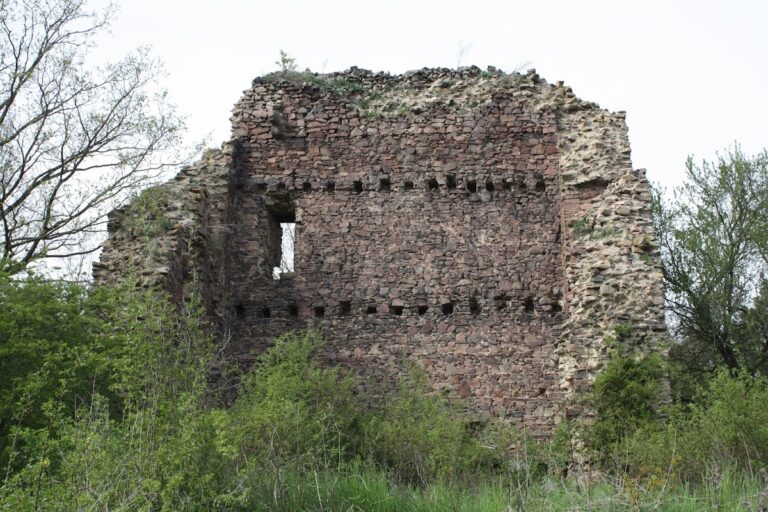
The upper courtyard was centered on a prismatic residential tower. Approximately four metres of its masonry survive. The palas, the principal residential or representative building of a medieval castle, stood on the southern side. Remains of the palas survive on the southwest, including a spiral staircase that descends to a filled-in cellar.
Nearby sites