Blatná Chateau: A Medieval Water Castle in Czechia


Site at a Glance
- Rating
- 4.7
- Popularity
- Medium
- Country
- Czechia
- Primary era
- Modern
- External website
- Open
- Eras represented
- Medieval, Early Modern, Modern
- Civilizations
- Habsburg, Holy Roman Empire, Kingdom of Bohemia
- Site type
- Domestic
- Remains
- Castle
On this page15 sections
History
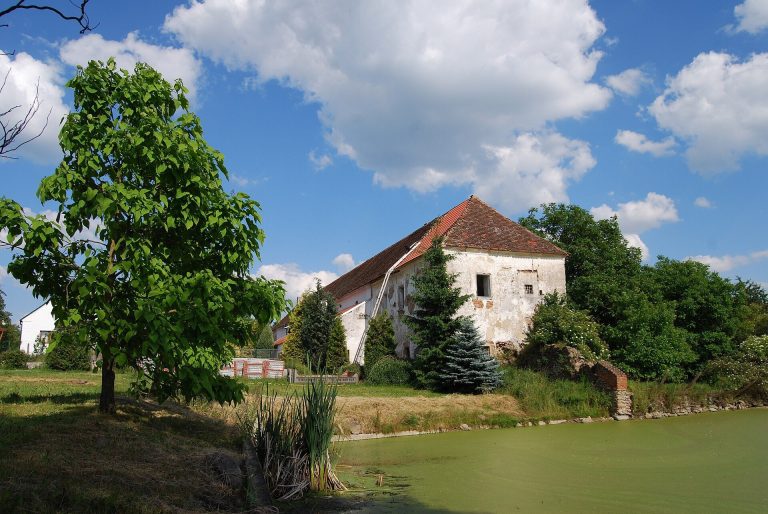
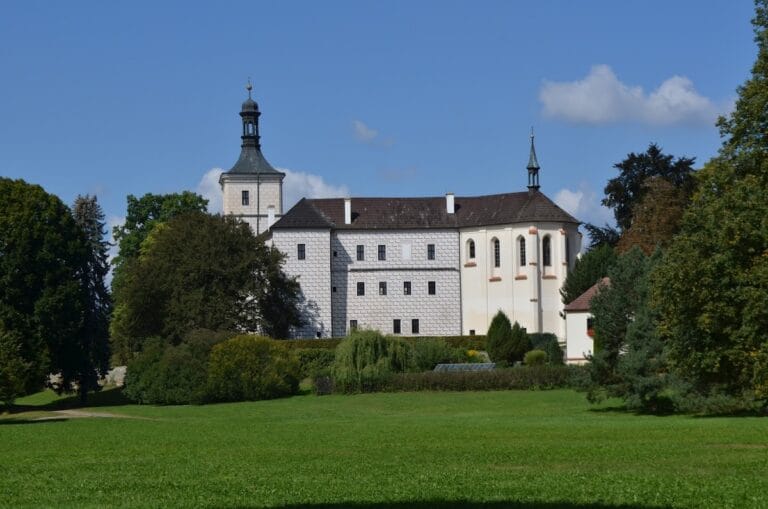
Blatná Chateau is a medieval water castle in Czechia, traditionally dated to the late twelfth century and now predominantly Neo-Gothic. Built on a low rocky elevation amid marshes beside the Lomnice River, it is one of the oldest lowland castles in the country and one of its three best-preserved water castles. Its name derives from the surrounding wetlands.
Medieval origins and the Bavor family
The area around Blatná had been inhabited since prehistoric times. The earliest written reference to the castle dates from 1235, when Vyšemír of Blatná appeared as a witness to a charter issued by King Wenceslaus I for the foundation of Chotěšov Monastery. A charter of 1241 named Předota and his brother among the owners of the settlement, by which time the fortress was already surrounded by water.
During the second half of the thirteenth century, the Bavors of Strakonice acquired Blatná. They replaced its wooden buildings with stone structures and organized the surrounding marshes into a system of water defenses. By the close of the century, the site had probably developed into a typical feudal castle. Around 1313, after the division of Bavor II of Strakonice’s possessions, Blatná and its estate passed to his younger son Mikuláš, who adopted the territorial name “of Blatná.” His son Bavor IV later inherited the remaining Bavor possessions after the death of his uncle Wilhelm of Strakonice in 1359.
The Strakonice and Rožmitál lords
In 1394, Břeněk, also known as Břetislav of Strakonice, took control of the Bavor estates. Because he was a minor, his uncle Zdeněk the Elder of Rožmitál acted as guardian and administrator. Břeněk made Blatná his residence and undertook a substantial rebuilding at the end of the fourteenth century. He and Zdeněk joined a noble uprising against King Wenceslaus IV. Royal forces besieged Horažďovice in 1399, although the dispute ended through negotiation. Financial difficulties forced Břeněk to sell most of the family estates in 1402, and Blatná passed to the Rožmitál family in 1403.
Under Jan of Rožmitál, who died in 1430, the Romanesque fortress was rapidly transformed into a Gothic citadel with a fortified entrance tower. During the Hussite Wars, the fifteenth-century religious and political conflicts in Bohemia, Blatná served as a stronghold of the Catholic party in southern Bohemia.
Jan’s sons Protiva and Jaroslav Lev of Rožmitál inherited the estate. Jaroslav Lev, identified as the owner from 1446, rebuilt Blatná extensively around 1475–1480. The work changed the castle from a primarily defensive fortress into a representative residence. Jaroslav Lev spent his final years there and was buried nearby. His son Zdeněk Lev of Rožmitál, the highest burgrave of the Kingdom of Bohemia, continued the rebuilding around the turn of the sixteenth century.
Renaissance, war, and Baroque change
Zdeněk Lev’s son Adam Lev inherited a heavily indebted estate and sold Blatná in 1555 to the sisters Kateřina and Anna Řepická of Sudoměř. In 1560, Kateřina’s husband, Zdeněk of Šternberk, acquired the estate. Count Jan Rozdražovský, a member of an old Polish noble family, purchased Blatná in 1577 or 1579. After his death, his son Václav inherited it and commissioned the Renaissance Rozdražovský Palace.
The Bohemian Estates’ Revolt of 1618–1620, followed by the Thirty Years’ War, a European conflict from 1618 to 1648 that brought occupation and destruction to many Bohemian estates, interrupted Blatná’s development. Rebel forces led by Mansfeld captured and completely plundered the castle, while plague also reached the town. Václav Rozdražovský fled to Silesia in 1622 and died there in 1625. His widow Anna-Maria and their underage son František Ignác remained at Blatná and gradually repaired the damaged residence. The castle chapel was reconsecrated after repairs in 1635.
František Ignác took control of the estate in 1645 and died without an heir in 1691, ending the Rozdražovský line. His nephew, Count Jan František Kolowrat-Krakowsky, inherited Blatná and sold it in 1695 to the Hungarian Countess Ernestina Serényi. The Serényi family introduced Baroque elements, and a major fire in the eighteenth century led to extensive rebuilding between 1763 and 1767.
The Hildprandt residence
In 1798, the Serényis sold Blatná to Baron Wenzel Karl Hildprandt von Ottenhausen, a member of a Czech-Tyrolean noble family. Under his elder son Franz Hildprandt, the castle became a comfortable representative residence. Its grounds were developed with a stone bridge, sheepfolds, a riding arena, an irregular park, and an artificial lake.
Robert Hildprandt inherited the estate in 1845 and directed a Neo-Gothic reconstruction between 1850 and 1856. The work followed designs by the Munich architect Bernard Grüber, whose nineteenth-century architecture drew on medieval Gothic forms. This rebuilding gave Blatná essentially the appearance it retains today. The Czech scientist Jan Evangelista Purkyně also lived at the castle and tutored Franz Hildprandt’s children from 1810 to 1813. A granite plaque in the courtyard commemorates his residence.
Dispossession and return
In 1947, Blatná came under the administration of the Czechoslovak National Heritage Commission. After the Communist takeover of 1948, it was nationalized. In 1952, the last owner, Bedřich Hildprandt, his wife Cornelia, and their two daughters were forcibly expelled.
Through Cornelia’s father’s personal connections with Emperor Haile Selassie I, the family received permission to emigrate in 1959 and moved to Addis Ababa. The castle now includes an exhibition about the family’s years in Ethiopia. Cornelia Hildprandt and her daughters Josefina and Jana returned to Blatná in 1990. Restitution returned the castle to them in 1992, after which the Hildprandt family resumed ownership. The estate is managed by Jana’s son, Stephanos Germenis-Hildprandt.
The castle and park are protected as a Czech cultural monument. Blatná is also recognized as one of the country’s three best-preserved water castles, together with Švihov and Červená Lhota. A later tradition claims that the Knights Templar built the castle and concealed treasure within its walls, with secret signs and a hidden cavity behind a wall painting. This story is unconfirmed and probably arose from the presence of the Knights Hospitaller at nearby Strakonice, an order that held no rights to Blatná. The castle and its surroundings have also served as filming locations, including for The White Lady (1965), The Incredibly Sad Princess (1968), Dívka s flétnou (2007), and Křišťálek meč (2007).
Remains
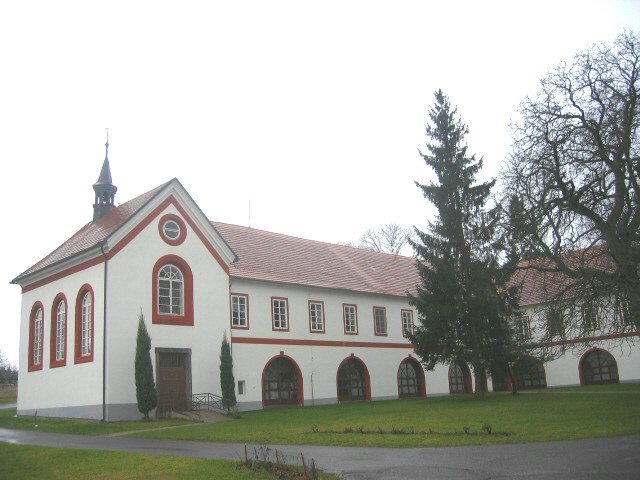
Blatná is organized around a low rocky elevation and retains the form of a water castle, with the buildings surrounded by parks, lakes, and elements of the former water-defense system. Its present character is predominantly Neo-Gothic, while Gothic, Renaissance, and Baroque features survive within the complex. The removal of the western wing left a horseshoe-shaped plan opening toward the east, where the entrance tower and bridge are located.
Entrance tower and chapel
Entrance tower
The eastern side is dominated by a four-sided, four-storey entrance tower. A stone bridge crosses the surrounding water and reaches its pointed-arch entrance. The tower was created during the Gothic transformation of the castle, when its pointed-arch portal replaced the earlier gateway. Frescoes survive on the first floor, and the Green Chamber, a named room within the tower, contains well-preserved fifteenth-century frescoes.
Chapel of the Virgin Mary
A Gothic chapel dedicated to the Virgin Mary was added to the southeast side of the entrance tower during the late fifteenth-century rebuilding. It connected the tower with the Rožmitál Palace. The chapel is now dedicated to the Virgin Mary and Saint Andrew and was rebuilt in Neo-Gothic form by Bernard Grüber in 1878. Part of a Romanesque chapel in the courtyard, dated between the late twelfth century and 1225, also survives. That chapel formed part of the western wing, which was probably dismantled in the 1820s.
Palaces and interior features
Rožmitál and Rejt Palaces
The southern wing consists of the Rožmitál Palace and the adjoining Rejt Palace. The Rožmitál Palace was rebuilt in the late Gothic period and retains fresco decoration. The Rejt Palace occupies the southwestern part of the complex and was transformed around the turn of the sixteenth century into a three-storey Gothic-Renaissance residence designed by Benedikt Rejt, a prominent royal architect active in Bohemia during that period.
Rozdražovský Palace
The northern wing is formed by the Renaissance Rozdražovský Palace, which adjoins the entrance tower on its northeast side. The Serényi family later remodeled the palace in the Baroque style, adding another layer to the complex’s architectural development.
Surviving interiors
The castle contains a medieval latrine, while its interiors include hunting trophies and furniture made from fallow-deer antlers. Within the park stands the restored Empire-style house occupied by the Hildprandt family.
Park and water landscape
The courtyard connects with a large park and an extensive game reserve established in the seventeenth century. The reserve included captive birds of prey and preserves several centuries-old oak trees. Franz Hildprandt reshaped its front section in the manner of an English landscape park while leaving the rear section in a more original condition. During the Napoleonic Wars, in 1815, he employed local people to construct an artificial cave.
The park landscape includes the former greenhouse, hunting lodge, and Swiss cottage as part of its recorded estate history, as well as the reserve’s present herd of fallow deer, peacocks, and alpacas. The reserve extends to the Naděje pond and the adjacent right bank of the Lomnice River. This area is protected as the Blatná natural monument.