Juma-Jami Mosque: Yevpatoria’s Principal Friday Mosque


Site at a Glance
- Rating
- 4.7
- Popularity
- Medium
- Country
- Ukraine
- Primary era
- Early Modern
- Eras represented
- Early Modern
- Civilizations
- Crimean Khanate, Ottoman
- Site type
- Religious
- Remains
- Mosque
On this page10 sections
History
Juma-Jami Mosque is a historic Sunni Friday mosque in Yevpatoria, Ukraine, built under the Crimean Khanate between 1552 and 1564 in the Ottoman architectural tradition. Construction began at Kezlev under Devlet I Giray, the khan of the Crimean Khanate, a dynastic Muslim state that ruled Crimea, and was completed under his successor, Mehmed II Giray. The project was designed by Mimar Sinan, the chief architect of the Ottoman Empire.
Construction and Ottoman design
The mosque was established as the principal Friday mosque of Yevpatoria. Its composition may have been influenced by Hagia Sophia in Constantinople, a major historic monument whose domed form later influenced Ottoman mosque architecture. Juma-Jami’s design follows the Ottoman architectural approach associated with Mimar Sinan and his major imperial projects.
Alterations and damage
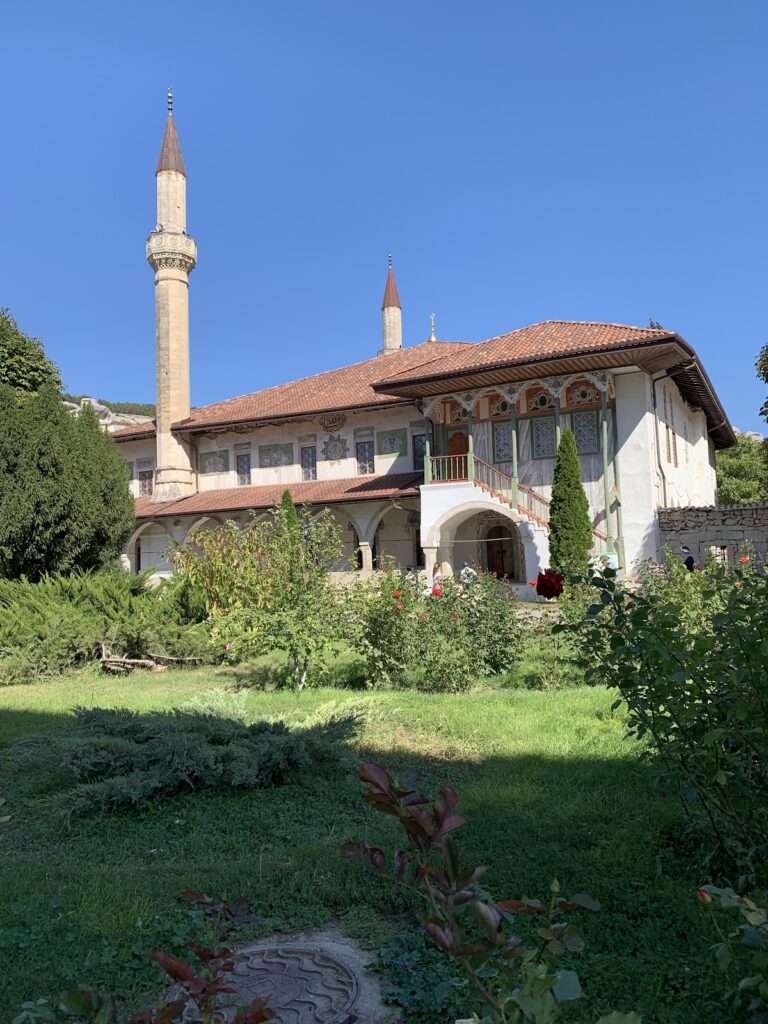
The building underwent repeated changes after its completion. The main structure was rebuilt and restored between 1740 and 1743, while paintings were added to the western facade between 1758 and 1769. One minaret had been destroyed before 1665, and the second was destroyed in 1836. Both were completely reconstructed in 1985.
Soviet and later history
During the Soviet period, Juma-Jami was closed as a religious institution. It first served as a warehouse for agricultural products and was later used for construction materials. From the mid-1980s, it functioned as an architectural monument and museum before being returned to Muslim worshippers in the 1990s, with 1990 given as a specific date for its return.
The mosque is currently active. It is recognized as a cultural-heritage monument of national significance in Ukraine and as a cultural-heritage site of federal significance in the Russian legal system, reflecting the disputed political status of Crimea. In August 2014, the mosque’s imam left the Spiritual Administration of Muslims of Crimea and joined the Taurida Muftiate, two Islamic religious administrative bodies. Their competing claims led to a dispute over control of the property. In July 2015, the Supreme Court of Crimea upheld the ownership claim of the Spiritual Administration of Muslims of Crimea and ordered representatives of the Taurida Muftiate to leave the mosque.
Two important relics were associated with Juma-Jami. One was a Quran dating from the fourteenth or fifteenth century and valued as more precious than the mosque itself. The other was a document bearing the signatures of 18 Crimean khans who ruled before the peninsula’s incorporation into the Russian Empire. After receiving the right to rule the khanate in Istanbul and while traveling to Bakhchisaray, the khans disembarked at Yevpatoria, presented their authority to their subjects at the mosque, and signed the document. The relics may have remained at the mosque until 1927. Their later whereabouts are uncertain, since they may be held in a museum in Saint Petersburg or may have disappeared during the Second World War.
In 2016, the Bank of Russia issued a three-ruble silver coin dedicated to Juma-Jami in its “Architectural Monuments of Russia” series.
Remains
Plan and exterior
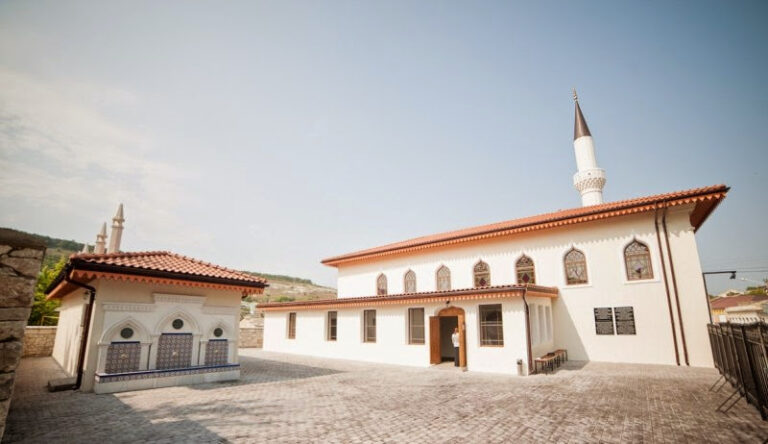
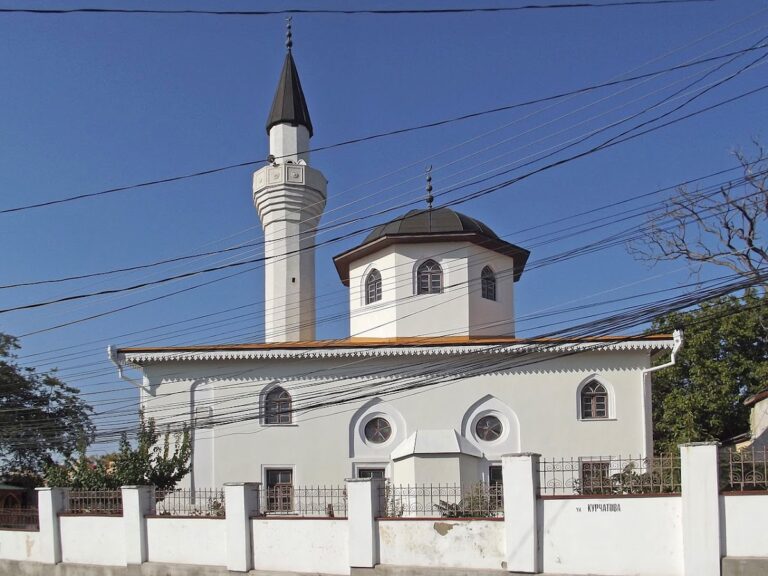
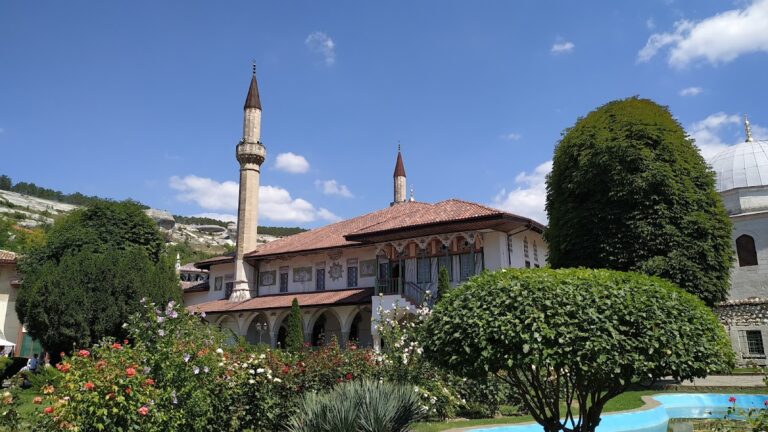
Juma-Jami is a central-domed building with a plan approaching a square. Its north-facing facade is flanked by two minarets attached to the eastern and western sides. The building stands near Karaev Park and rises above the surrounding buildings, making it visible from both the sea and the shore. It is the largest mosque in Crimea.
Limestone forms the load-bearing elements, while shell rock is the principal construction material. The structure is organized through increasing volumes, with the central mass rising above the surrounding parts. This arrangement gives the mosque its characteristic Ottoman form.
Galleries and domes
Lateral galleries
Two tiers of relatively widely spaced windows illuminate the two-story lateral galleries. Flat domes cover these galleries in rows of three, creating a series of smaller roofed spaces around the central hall.
Central hall
The central hall rises approximately 22 meters and is covered by a substantial dome with 16 windows. The outer dome reaches approximately 20 meters, and the mosque contains 13 domes in total.
Minarets
Each of the mosque’s two minarets is approximately 35 meters high. The present towers were reconstructed in 1985 after the destruction of one minaret before 1665 and the other in 1836.
Nearby sites