Juliusz Heinzl Palace: An Industrialist’s Residence in Łódź

Site at a Glance
- Rating
- 4.6
- Popularity
- Very Low
- Country
- Poland
- Primary era
- Modern
- Eras represented
- Modern
- Civilizations
- Kingdom of Poland, Russian
- Site type
- Civic
- Remains
- Palace
On this page6 sections
History
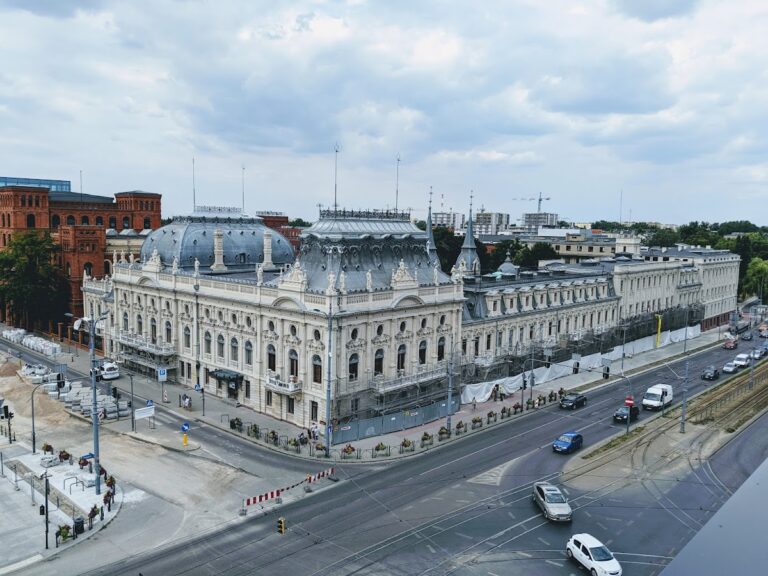
Juliusz Heinzl Palace is a nineteenth-century palace in Łódź, Poland, completed in 1882 for industrialist Juliusz Heinzl in an eclectic style with references to the Berlin Renaissance, a nineteenth-century revival of Renaissance forms associated with Berlin. It was the first of Heinzl’s three residences and stood beside his wool-products factory, whose buildings extended deep behind the street-facing residence.
Industrial origins and construction
The Heinzl family probably came to Łódź from Bohemia or Lower Silesia during the 1830s. In 1864, Juliusz Heinzl established a mechanical weaving mill producing woolen goods. By around 1874, he had developed the largest production complex in the Kingdom of Poland for woolen and semi-woolen products. The Kingdom of Poland was then a Polish political territory under the Russian Empire, within which Łódź underwent major textile expansion.
Heinzl commissioned the palace beside this industrial enterprise. Hilary Majewski designed the building, and Otto Gehlig carried out its construction. Gehlig later became Heinzl’s son-in-law. The residence faced Piotrkowska Street, while the factory buildings occupied the deeper part of the property.
Reconstruction and civic use
The palace was altered and reconstructed over time, especially in its side wings. During the 1950s, it was integrated with the factory buildings, which were adapted for offices and for a meeting hall used by the then Municipal National Council. The reconstruction was designed by Ignacy Gutman. Former ancillary buildings, including a weaving mill, were demolished, and the surviving façades were unified in a severe, largely undecorated form.
In the twenty-first century, the integrated complex has served as the seat of the Łódź Provincial Office and Łódź City Hall. Juliusz Heinzl Palace has been entered in Poland’s register of monuments as number A/41 since 20 January 1971.
The palace has also formed part of Łódź’s civic traditions. From 29 July 1998, the city’s official bugle call, Prząśniczka, was played daily at noon from the palace balcony. Since 8 September 2011, the ceremonial bugle call has instead been performed by trumpet from a City Council window at 106 Piotrkowska Street. In 1999, a monument to the Polish poet and writer Julian Tuwim, created by sculptor Wojciech Gryniewicz, was unveiled in front of the palace.
Remains
The complex occupies the regulatory building line at 104 Piotrkowska Street, with the palace standing directly in front of the former factory buildings. Its western side adjoins Komuny Paryskiej Square. The surviving arrangement expresses the original division between the formal street residence and the industrial premises behind it, although the buildings are now integrated as office premises.
Palace façade and pavilions
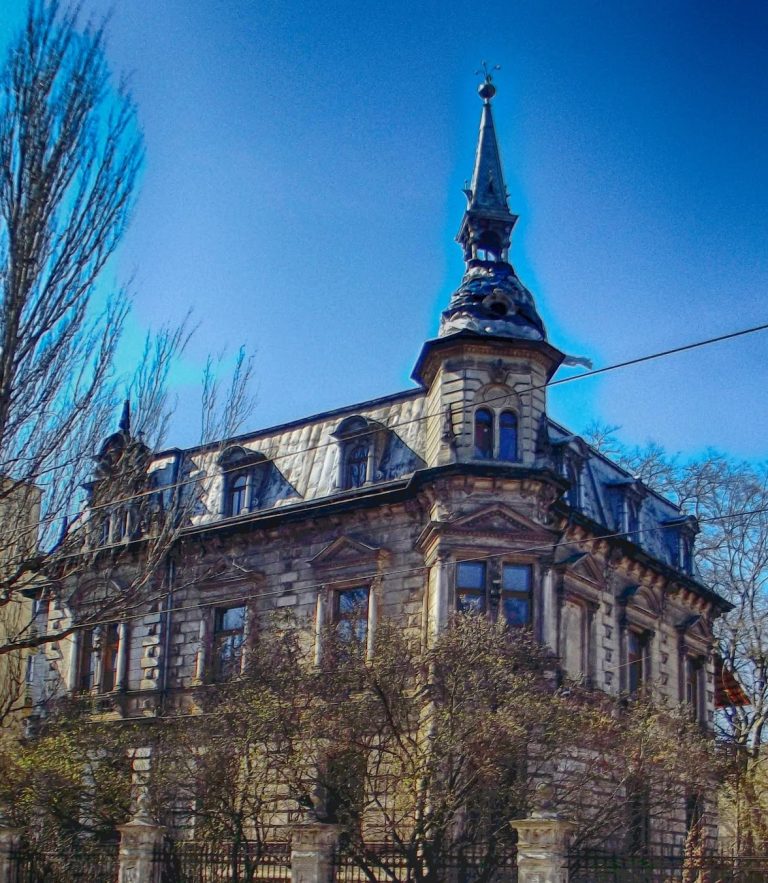
The palace is an eclectic composition combining motifs from several historical styles, with the Berlin Renaissance providing its dominant architectural reference. Its main body rises three storeys and is accompanied by lower side wings. Two pavilions ending in towers were separated from the palace by decorative metal grating.
On the first floor of the front façade, symmetrically placed side bay windows have baluster railings. A frieze of cartouche-shaped panels runs beneath the cordon cornice, bearing emblems associated with industry and trade. Above the façade is a sculptural composition allegorising Freedom, Industry, and Trade. The work is signed “EMS” and dated 1880.
Integrated factory buildings
The former factory buildings behind the palace were adapted as offices and included a meeting hall during the twentieth-century reconstruction. The former ancillary buildings, among them the weaving mill, were demolished, while the remaining side buildings received unified façades with few decorative details. This reconstruction gave the industrial portion of the complex a markedly austere appearance compared with the ornamented palace front.
Nearby sites