Château de Neuvicq: A Country Château and Town Hall in France


Site at a Glance
- Rating
- 4.6
- Popularity
- Very Low
- Country
- France
- Primary era
- Early Modern
- External website
- Open
- Eras represented
- Medieval, Early Modern
- Civilizations
- French
- Site type
- Domestic
- Remains
- Castle
On this page7 sections
History
Château de Neuvicq is a country château in France, at Neuvicq-le-Château in Charente-Maritime, on the edge of Saintonge and within the Fins Bois wine-growing area. Its surviving buildings combine late Flamboyant Gothic, a late medieval style known for elaborate ornamental stonework, with early French Renaissance features. The present residence was commissioned around 1500, after an earlier fortified site had been damaged and abandoned.
Medieval Fortress
A motte, a raised earthwork mound used as the base of a medieval fortified residence, stood at Neuvicq by the early twelfth century. A charter from around 1266 refers to the fortified site as fortalicum de Novo Vico. Guillaume de Neuvicq and his son Foulques were the first known members of the local noble family associated with it. They held the site as vassals of the bishop of Angoulême, and their family line ended in the fourteenth century.
English troops captured the medieval castle during the Hundred Years’ War, the prolonged conflict between the English and French crowns that affected much of France from the fourteenth into the fifteenth century. The attackers wholly or partly destroyed the castle before withdrawing in 1375. By 1398, when a member of the La Rochefoucauld family received the castle and lordship of Neuvicq as a fief, the site was in ruins.
Rebuilding and Noble Ownership
The estate passed to the La Rocheandry family around 1420. The family name also appears as Larocheandry or Rochendry, and Jean de La Rocheandry was lord of Neuvicq in 1452. His descendant Antoine de La Rocheandry commissioned a new building around 1500. The surviving coat of arms associated with the château is linked to this rebuilding.
In 1593 the estate was acquired by the d’Espièmont family. Arnaud de Colombières d’Espièmont was lord of Neuvicq in 1600, and in 1625 or 1630 he passed the property to his daughter Louise. Her husband, Marquis Jean-Jacques de Goth de Basternay, added a Renaissance staircase tower and a square pavilion to the existing manor house.
After Jean-Jacques de Goth de Basternay died in 1666, the estate passed by inheritance to Louis-Henri de Pardaillan de Gondrin, Marquis of Montespan. He was the son of Jean-Jacques’s half-sister and the husband of Madame de Montespan, a prominent French aristocrat and the official mistress of Louis XIV. Their son, Louis-Antoine de Pardaillan de Gondrin, dismantled the drawbridges and filled the surrounding moats late in the seventeenth century, removing the château’s defensive features.
From Private Estate to Commune Property
Louis-Antoine sold the estate in 1705 to Noël Bertrand de La Laurencie, Marquis of Charras. La Laurencie used the château again as a residence, and his family retained it until the French Revolution. On 12 February 1792, Noël Bertrand’s grandson, François de La Laurencie, sold the château without its accompanying land to Jean Martel of Cognac to avoid impending confiscation. The surrounding land was sold to inhabitants of the village.
Martel’s descendants sold the dilapidated and emptied château in 1856 to Michel Calluaud of Neuvicq, who gave it to his daughter Marie. Around 1860, the Calluauds demolished part of a large defensive tower and the entire west wing, selling the stone for building material. Marie bequeathed the property to her nephew Etienne Clais in 1893. When Clais planned to sell it for demolition in 1904, Neuvicq’s mayor, Alphonse Porchaire, arranged for the commune to purchase and preserve it.
The commune has owned Château de Neuvicq since 1904, and the building continues to house the town hall of Neuvicq-le-Château. It has been partially restored and protected as a classified monument historique, a French legal heritage status for historically significant buildings and sites, since 14 September 1912.
Remains
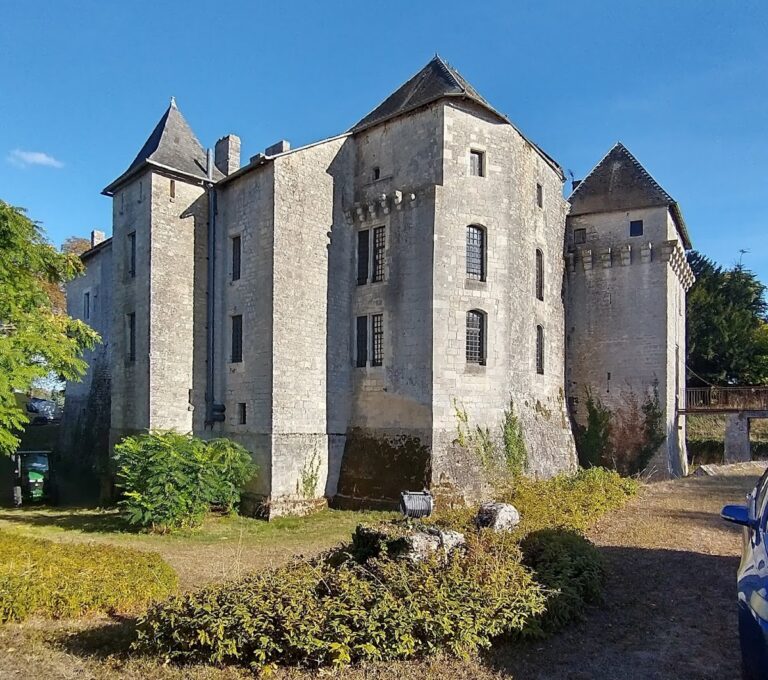
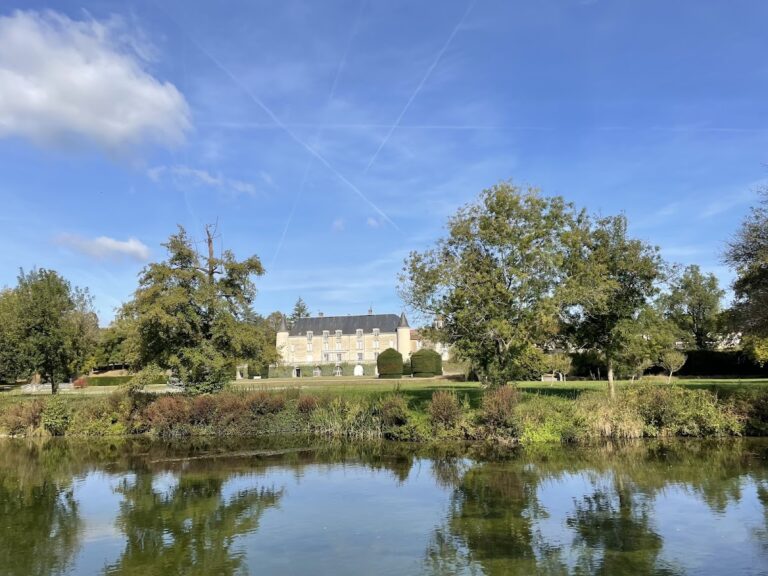
Château de Neuvicq stands on a limestone outcrop whose edges are supported by a retaining wall. The principal building combines fifteenth- and seventeenth-century fabric in a compact residence with corner towers, a projecting staircase tower, and a later pavilion. Slate-covered roofs, sculpted openings, and surviving interior fittings preserve elements from the château’s medieval and early modern phases.
Principal Residence
The late Gothic residential block has three storeys beneath a high, two-sloped slate roof. Cylindrical towers of unequal diameter occupy its northeast and southeast corners. Their conical or pepper-pot roofs and machicolations, projecting openings or defensive galleries used to drop objects or discharge missiles, preserve reminders of the building’s fortified origins.
A five-storey hexagonal staircase tower projects from the centre of the west facade. It is covered by a polygonal roof, and its stone spiral staircase is entered through a portal on the tower’s northwest side. The portal is surmounted by a keel arch. The tower’s uppermost window has an elaborately worked and richly sculpted gable.
The three-storey pavilion at the southwest corner of the main block was added in the seventeenth century, together with the staircase tower. It has a tall, kinked hipped roof. Elsewhere, the buildings retain slate-covered roofs and cross or transom windows. An attic dormer is crowned by a triangular gable with crocketed pinnacles and a cross finial.
Inside, panelling and fireplaces from the fifteenth and seventeenth centuries remain in place. The former kitchen occupies a barrel-vaulted basement and contains a large fireplace, linking the surviving interior to the château’s former domestic functions.
Southern Outbuilding
A large circular dovecote stands south of the main residence. Its substantial form belongs to the estate’s former domestic and seigneurial organization, when a seigneur, or feudal lord, held authority over a territory or estate.
A local legend associates Château de Neuvicq with an underground passage leading to the motte at Bois de Fouet. The story forms part of local tradition surrounding the medieval fortified site.
Nearby sites