Jukhtak Vank: A Medieval Armenian Monastic Complex near Dilijan


Site at a Glance
- Rating
- 4.8
- Popularity
- Low
- Country
- Armenia
- Primary era
- Medieval
- Eras represented
- Medieval
- Civilizations
- Armenian, Georgian
- Site type
- Religious
- Remains
- Monastery
On this page8 sections
History
Jukhtak Vank is a medieval Armenian Apostolic monastic complex in Armenia, near Dilijan, whose surviving churches represent different phases of medieval construction. Located about 3 to 3.2 kilometres northwest of the town in a forested setting, the complex is also known as Petros Vank and Gisheravank. It includes the churches of Surb Astvatsatsin, meaning Holy Mother of God, and Surb Grigor, referring to Gregory the Illuminator, a foundational figure in Armenian Christianity.
Medieval foundation
The name Jukhtak is popularly associated with the presence of two churches. Surb Grigor is the earlier of the pair, according to the inscriptions on the lintel of its western entrance. Its exact date is uncertain, but it belongs to the medieval period.
Surb Astvatsatsin was built in 1201 through the initiative of Hayrapet, abbot of Surb Petros Monastery, and according to the conception of the architect Sargis. An inscription states that Hayrapet commissioned the church so that masses would be offered for himself, his brother Shmavon, and their parents. The church therefore preserves both a medieval religious purpose and a record of personal commemoration.
Abandonment and preservation
The monastery is now abandoned and semi-ruined. Between 1973 and 1977, the Armenian Society for the Preservation of Historical Monuments carried out stabilization work, including metal reinforcement around Surb Grigor and strengthening of its eastern foundation. Additional strengthening took place during the 1980s. The complex is recognized as a cultural monument in Armenia.
Jukhtak Vank has also suffered repeated vandalism. Candles burned on khachkars, altars, and walls caused some khachkars to burn completely and damaged parts of the altars and walls. In 2009, young visitors covered the interior walls of Surb Grigor with white oil paint. Later visitors added graffiti consisting of names and declarations of love, further affecting the church’s interior.
Remains
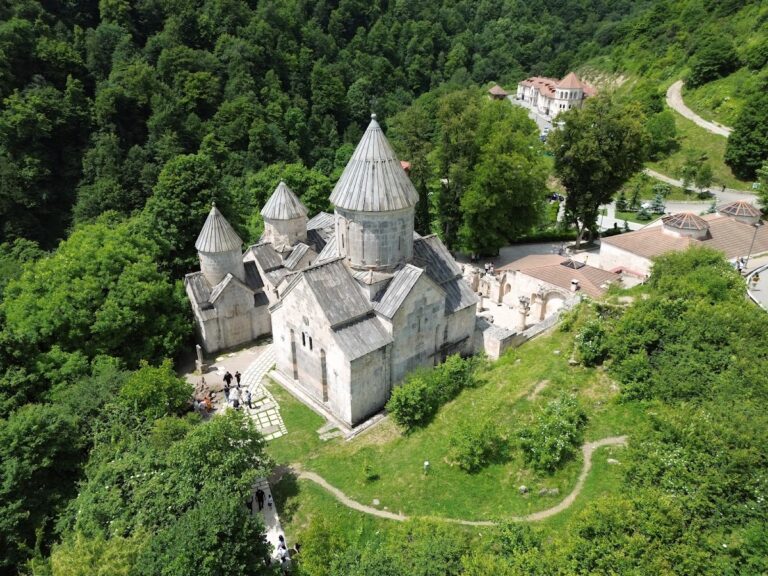
The complex occupies a forested hillside or clearing in the Bldan River valley, near the Dilijan–Vanadzor road. The cemetery surrounds the two churches, while traces of auxiliary buildings remain within the monastic grounds. About 15 metres east of Surb Astvatsatsin stands the larger Surb Grigor, creating a compact arrangement of two separate churches and their surrounding medieval burial ground.
Churches
Surb Grigor
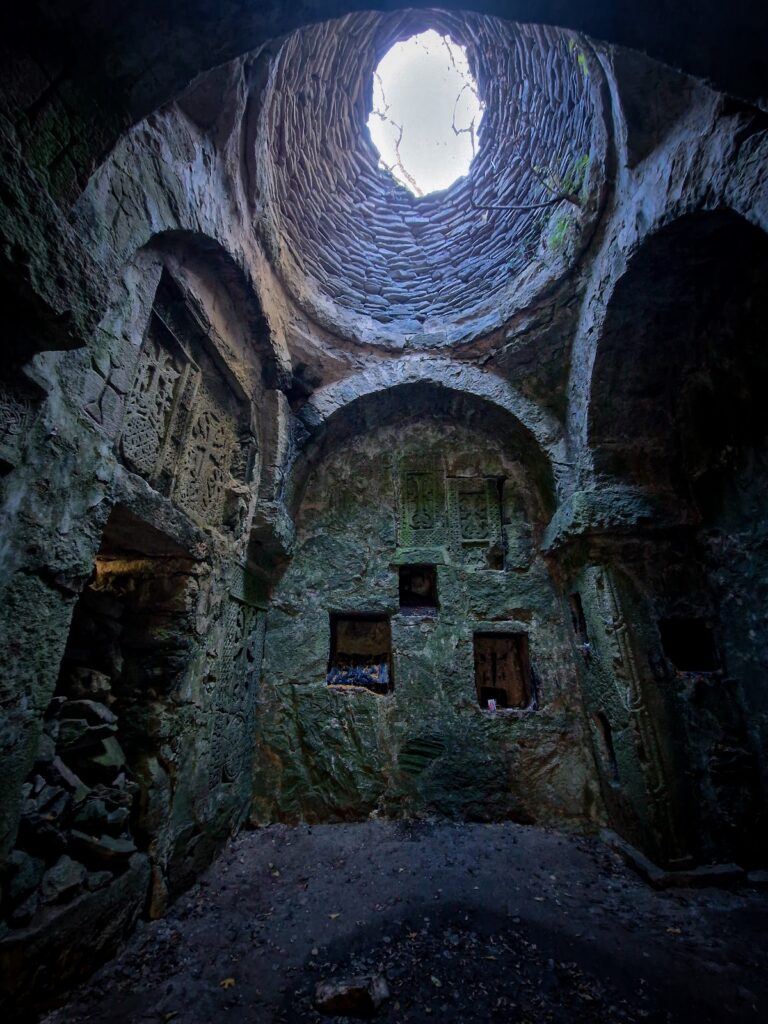
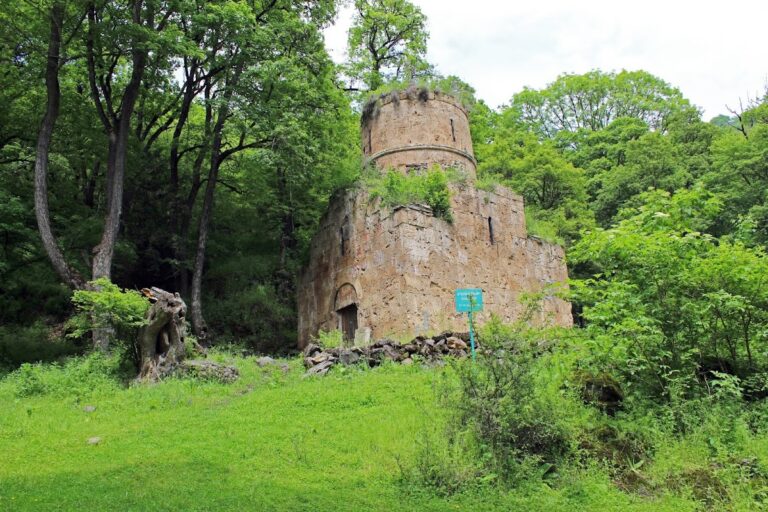
Surb Grigor is a small cruciform, central-plan church, meaning that its spaces are organized around a central architectural core, commonly beneath a dome. Built from finely dressed stone, it measures approximately 9.7 by 7.5 metres. Four arches rested on wall piers, and a single portal provided the entrance. The dome and drum collapsed long ago, while the exterior walls remain standing.
Metal reinforcement now encloses the church walls to help prevent further collapse. Landslides have weakened the eastern foundation, and cracks remain in the walls. The side chambers contain finely carved and elaborate ornament. Carved inscriptions appear on the church, including lettering on the lintel of the western entrance.
Surb Astvatsatsin
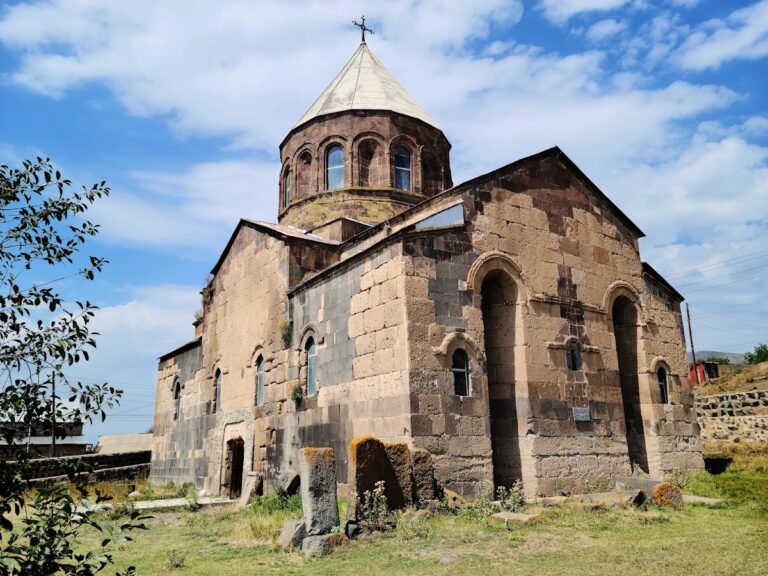
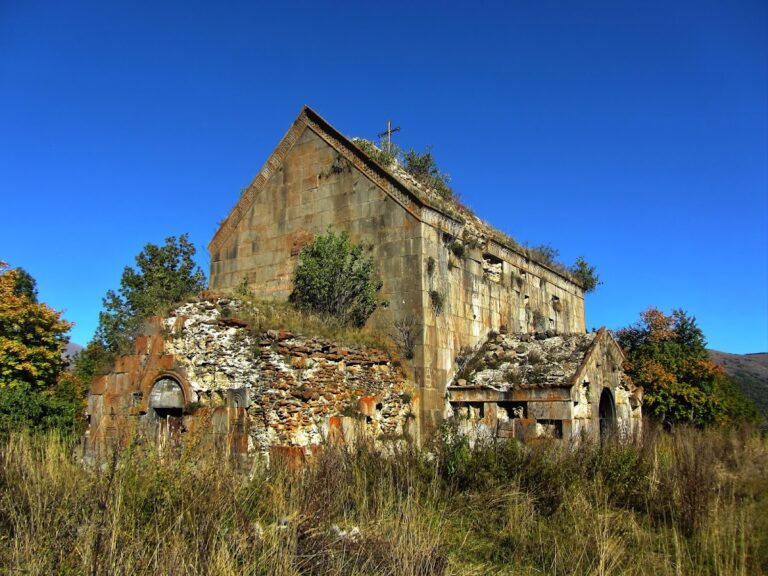
Surb Astvatsatsin is a smaller rectangular, single-nave basilica, a church with one principal longitudinal interior space. It has a vaulted interior, meaning that the roof is formed by a curved masonry structure, and a gabled roof. The building is made of finely dressed, yellowish multicoloured felsite and measures approximately 8.6 by 6.4 metres.
Finely carved khachkars, Armenian stone cross monuments with ornamental designs and sometimes commemorative inscriptions, are embedded on both sides of the entrance. The entrance lintel carries several construction and donation inscriptions, while another inscription is carved on the church’s semicircular tympanum stone.
Cemetery and surrounding remains
The medieval cemetery extends around both churches and contains distinctive gravestones. These stones are currently in very poor condition. South of the monastery, on higher ground to the right, lie the remains of the settlement of Matos. Its ruins include the 1247 Matosavank church, a 1251 cross monument, and a cemetery.
Nearby sites