Jinshan Temple: A Chan Buddhist Monastery in Zhenjiang, China
Site at a Glance
- Rating
- 4.3
- Popularity
- Very Low
- Country
- China
- Primary era
- Medieval
- Eras represented
- Medieval
- Civilizations
- Chinese
- Site type
- Religious
- Remains
- Monastery
On this page24 sections
History
Jinshan Temple is a Chan Buddhist monastery on Jinshan in Zhenjiang, Jiangsu, China. Associated with the Chinese tradition of Buddhism centered on meditation and disciplined monastic practice, it probably originated during the Eastern Jin dynasty, although its precise foundation remains uncertain. Traditions place its establishment around 323 to 325 under Emperor Ming of Jin, while others associate its beginnings with the Liang or Tang dynasty. Its earliest recorded name was Zexin Temple.
Early foundations and imperial patronage
During the Liang dynasty, Emperor Wu visited the temple in the fourth year of the Tianjian period, around 502 to 505. The visit was described by a monk of the Liang period and by Yuanji, a monk associated with the temple. These traditions place Jinshan within the religious landscape of southern China at a time when imperial support helped Buddhist institutions develop their standing.
The temple’s Tang-period history is connected with its re-establishment as a Chan monastery. Tradition attributes this renewal to the monk Lingtan, while another account credits the ascetic master Pei Toutuo, also known as Chan Master Fahai, with beginning construction. The name Jinshan Temple is traditionally linked to 805, when Li Qi petitioned the court and secured the name for the monastery.
During the Song dynasty, Emperor Zhenzong renamed the temple Longyou Temple after a dream in which he visited it. The abbot Foyin expanded the monastery greatly during the Yuanfeng period, around 1078 to 1085. Foyin was a prominent monk and a friend of the poet Su Shi, whose literary association later became part of the temple’s cultural memory.
Changes under the Song, Yuan, and Qing dynasties
Emperor Huizong’s strong support for Taoism brought another change. The monastery was converted into a Taoist institution and renamed Shenxiao Yuqing Wanshou Palace. After the fall of the Northern Song, it returned to the name Longyou Temple, and during the Yuan dynasty it was again renamed Jinshan Temple.
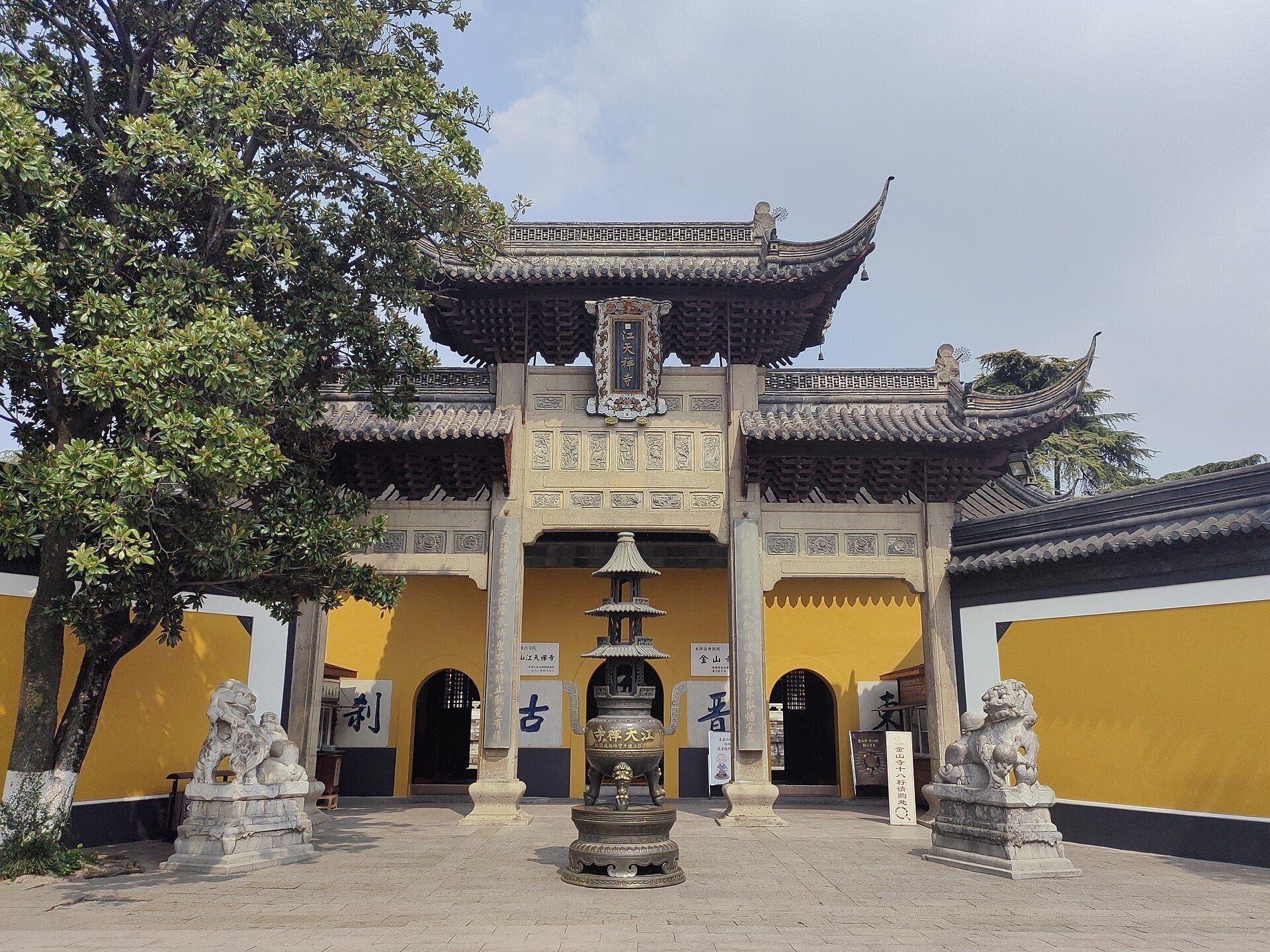
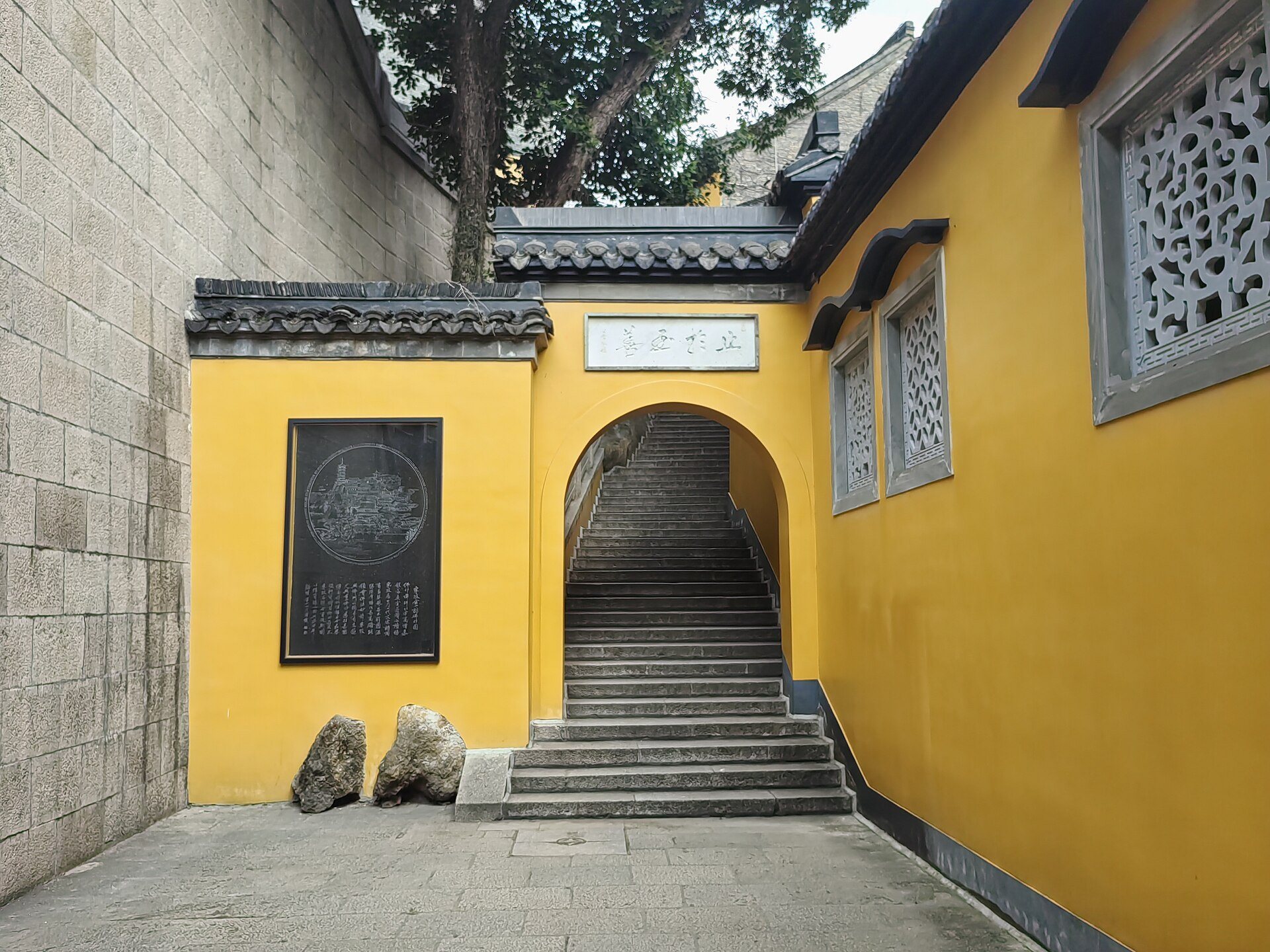
The monastery was also called Jiangtian Chan Temple. In the 1680s, during the Kangxi emperor’s inspection tour of southern China, the emperor visited Jinshan and inscribed this name on a plaque. The phrase referred to the mountain’s position between the river and the sky. During the Qing dynasty, Jinshan was regarded, together with Putuo Temple, Wenshu Temple, and Daming Temple, as one of China’s four famous monasteries. It was also regarded as an imperial temple, a status traditionally associated with its yellow walls.
Two affiliated temples supported the main monastery. One stood about three miles away and housed two monks, while the other was about twenty-five miles distant and housed eight. Jinshan itself became known for unusually intensive Chan practice. Its annual meditation retreat lasted seven weeks, or forty-nine days, and the monastery held seven meditation cycles each day.
Jiangtian also enforced strict rules for itinerant monks. Travelling monks who wore leather shoes or silk robes could not receive food or lodging until they exchanged them for clothing and footwear not associated with the killing of animals. The discipline of the monastery helped establish a reputation from which abbots of major monasteries were often chosen. At its height, the community housed approximately 3,000 monks.
Dharma lineage and succession
Jinshan’s influence extended through a collective Jiangsu system of Dharma transmission. A Dharma lineage is a chain of religious teaching passed from master to disciple. In the system used at Jinshan, several masters transmitted the Dharma collectively to several disciples, who then served successively as abbots. The transmitted Dharma was understood as belonging to Jinshan itself, and receiving it qualified, and often obliged, a monk to become abbot.
In the eighteenth century, the abbots Daxiao Shiche and his disciple Tiantao Jiyun had both previously served at Tianning Temple. Their appointments brought Tianning’s Dharma lineage into Jinshan and gave the two monasteries a shared line of transmission. Jinshan later transmitted its lineage to monasteries including Qixia, Tianning, and Haichao, and from those institutions to Xingfu in Changshu and Liuyun in Shanghai. Daxiao transmitted Jinshan’s Dharma to Tianning during the Qianlong period, while Yuexia transmitted Tianning’s Dharma to Xingfu in 1917.
The forty-fourth Dharma generation received transmission around 1890 and began serving successively as abbots. In 1910, it transmitted to five monks of the forty-fifth generation, who first held administrative positions at the monastery. When Qingquan was abbot in 1912, Yinbing Weiyi worked in the business office and Shuangting Weiguang served in guest administration.
Qingquan’s planned retirement around 1915 led to a complicated succession. Zongyang Yinleng was rejected because he had entered politics and worn lay clothing. He later spent three years in silence at Jinshan before rebuilding Qixia Temple in 1919. The abbacy therefore passed first to Rongtong Yinche and later to Meicun Yinxiu. The first abbots of the forty-fifth generation were Jingguan Weidao, Yinbing Weiyi, and Shuangting Weiguang. After other candidates departed or were judged unsuitable, Shuangting made a final transmission and retired. Taicang Xinrang became abbot in 1945.
Destruction, revival, and modern history
The Taiping Rebellion almost completely destroyed Jinshan Temple. Reconstruction was completed around 1869 to 1870. Zongyang Yinleng received monastic ordination at Jinshan in 1880 and later became one of the best-known Chinese Buddhist revivalists of the twentieth century.
During the Japanese invasion of China after 1937, the abbot Shuangting Weiguang became chairman of the Japanese-Chinese Buddhist Association in Zhenjiang. He accepted the position after Japanese threats, partly to protect the monastery and Chinese officers whom he was hiding in a cave. The monastery itself was not damaged during the occupation, although a monk was shot after what was described as a language difficulty.
In 1948, a major fire destroyed more than 200 buildings, including the Mahavira Hall, the Buddhist Texts Library, the abbot’s quarters, the Great Temple, and the Dharma building. During the Cultural Revolution, which began in 1966, Red Guards attacked and vandalized the monastery. Many stupas were destroyed, resident monks were forced to disrobe, and some monks who refused were sent to work on farms for nearly twenty years. The monastery later revived.
Jinshan Temple became a National Key Buddhist Temple in the Han Chinese Area in 1983. It is also protected as a provincial cultural monument of Jiangsu, classified as historic architecture in a designation recognized in 2011. Since 1995, the monastery has operated the Jinshan Buddhist Academy. Its Buddhist water-and-land ritual music entered China’s national representative list of intangible cultural heritage in 2014.
Traditions and associated places
Jinshan is associated with the legend of the White Snake, in which Chan Master Fahai separates a man from a snake woman. Local traditions also connect the site with Liang Hongyu’s resistance to the Jin army and with stories concerning Yue Fei. These accounts belong to legend and local tradition rather than established historical events.
Wenzong Pavilion beside the monastery was built in 1779 as a Qing imperial library for the Siku Quanshu, an imperial compilation of Chinese writings arranged in major literary and scholarly categories. The original pavilion stood on a nearby river island and was destroyed in 1853 during fighting involving Taiping and Xiang armies. A Qing-style reconstruction beside Jinshan Temple contains facsimile copies of the collection held in Wenyuan Pavilion of the Palace Museum.
Remains
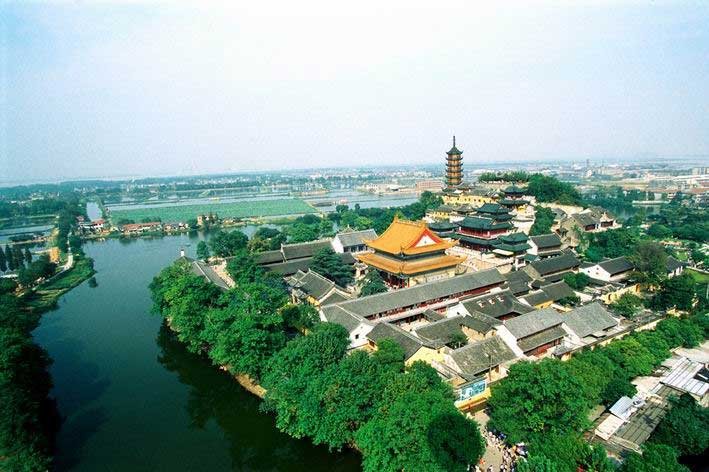
Built from wood, brick, and stone, Jinshan Temple rises across Jinshan beside the Yangtze River. The monastery is described as occupying about 45 hectares, while the separately defined Jinshan Scenic Area covers about 10 hectares. The mountain rises approximately 43.7 metres. It was formerly an island in the Yangtze, but changes in the river channel gradually connected it with the southern bank by the Guangxu period of the Qing dynasty. The former island setting explains the traditional image of the monastery enclosing the mountain.
Mountain layout and entrance courts
The complex climbs the mountain in a continuous sequence of halls, pavilions, terraces, and towers. It faces west overall. The principal order runs from the mountain gate through the Hall of the Four Heavenly Kings, the Mahavira Hall, the Hall of the Patriarch, Furong Tower, Qifeng Pavilion, and Cishou Pagoda. The arrangement combines a central route with structures placed on terraces and slopes.
Entrance temples and Danchi courtyard
From the main gate, the Hall of the Guardian Kings occupies the central axis. The Dragon King Temple stands immediately to the left of the entrance, and the Guandi Temple stands to the right. Guandi is the deified form of Guan Yu, a historical military figure who became a widely worshipped protective deity.
Behind the Guardian Kings Hall is the Danchi courtyard, a courtyard within a Buddhist monastery complex. Its left side is enclosed by the Chanting Pavilion, Weituo Pavilion, and Teachers’ Pavilion. The guest office stands on the right, followed farther right by accommodation for itinerant monks. The small Buddha-Name Recitation Pavilion lies farther to the right. It housed only twelve monks and served as a relaxation hall for those exhausted by the monastery’s demanding meditation regime.
Chan buildings and central halls
Chan meditation hall
The Chan meditation hall, or chantang, was the monastery’s most important building. It stood near the Hall of the Patriarch and the abbot’s quarters, but faced south rather than east, as many meditation halls in other monasteries did. Access led from the courtyard along the central axis, up steps, then left past the Teachers’ Pavilion and left again. The small Hall of the Patriarch stood below it, approximately level with the Dragon King Temple, while the meditation hall occupied a higher position to its right. It was the monastery’s third-largest building and had two wells or springs in front of its facade.
Service and administrative buildings
A service pavilion stood to the right of the meditation hall, with the abbot’s quarters above and slightly to its right. Farther right on the main axis was the Great Temple, the largest building in the complex. The refectory, monastery business office, and main kitchen followed it, forming a group of buildings connected with communal administration and daily monastic life.
Dharma building and library
Behind the Great Temple, beyond a courtyard and on the central axis, stood the Dharma building, used for Buddhist teaching and ritual. It was the monastery’s second-largest building, and its upper floor contained the library. The Liuyu Pavilion bounded the courtyard on the left, while Miaogao Terrace bounded it on the right. The Dharma building was destroyed in the fire of 1948.
Terraces, caves, and summit structures
Miaogao Terrace
Miaogao Terrace was also called the Terrace for Drying Scriptures. According to a record by Liu Bian, the monk Foyin created it during the Yuanyou period, around 1086 to 1094, by cutting into the cliff. The terrace and its small pavilion were repeatedly destroyed and rebuilt, including reconstructions by the monk Shizong during the Ming dynasty and Xue Shuchang during the Qing dynasty. The 1948 fire destroyed the terrace along with the Great Temple and Dharma building. Su Dongpo is traditionally said to have viewed the moon from this terrace.
Fahai Cave
Fahai Cave, also called Peigong Cave, lies in the cliff to the left of the Dharma building. It contains a statue of Chan Master Fahai, who may have been the monastery’s founder and is also central to local legend. The cave is associated with Pei Toutuo’s ascetic practice and meditation.
Cishou Pagoda
Cishou Pagoda stands above the Dharma building on the left and rises at the summit of Jinshan. A pagoda is a tower associated with Buddhist worship and relic traditions. Cishou is an octagonal, seven-storey structure about 36 metres high. A pagoda on the site was first built during the Southern Dynasties and refurbished around 1098 to 1100 during the Song dynasty. The present pagoda was rebuilt in 1900.
Surviving halls and collections
Hall of the Four Heavenly Kings
The Hall of the Four Heavenly Kings was first built during the Zhengtong period of the Ming dynasty, around 1436 to 1449, and rebuilt in 1869 during the Qing dynasty. It contains images of Maitreya, Skanda, and the Four Heavenly Kings. The Four Heavenly Kings are Buddhist guardian deities traditionally placed at the entrances of East Asian Buddhist temples.
Mahavira Hall
The Mahavira Hall, the principal Buddha hall of a Chinese Buddhist monastery, was rebuilt in 1989 with a double-eaved gable-and-hip roof. It contains images of the Three Buddhas of the Three Ages: Shakyamuni, Amitabha, and Bhaisajyaguru. Guanyin is enshrined at the rear, with Shancai on the left and Longnu on the right, while the Eighteen Arhats stand along both sides. A plaque bearing the words “Mahavira Hall” was written by Zhao Puchu, a former head of the Buddhist Association of China.
Furong Tower
Furong Tower is approximately 19 metres high and has upper and lower storeys with double-eaved gable-and-hip roofs. Its plaque was written by Jiang Zemin, who served as president of China and general secretary of the Chinese Communist Party.
Buddhist Texts Library
The present Buddhist Texts Library, or Zangjing Ge, was completed in 1984 after the earlier building burned in 1948. It is a four-storey structure with a gable-and-hip roof, about 21 metres high and covering approximately 1,200 square metres.
Celebrated objects
Four objects are associated with Jinshan’s history and cultural memory: a jade belt linked with Su Shi, also known as Su Dongpo; a war drum associated with the Song-period heroine Liang Hongyu; a map of Jinshan made by Wen Zhengming; and a famous bronze tripod dating from the Zhou period.
Wenzong Pavilion
Beside Jinshan Temple, Wenzong Pavilion is a traditional brick-and-timber building covering about 934 square metres, with a total floor area of approximately 1,286 square metres. Its reconstruction follows an historical depiction of the original pavilion and adopts the style of the Qing building. It contains facsimile copies of the Siku Quanshu held in Wenyuan Pavilion of the Palace Museum, continuing the pavilion’s association with the imperial scholarly collection.